
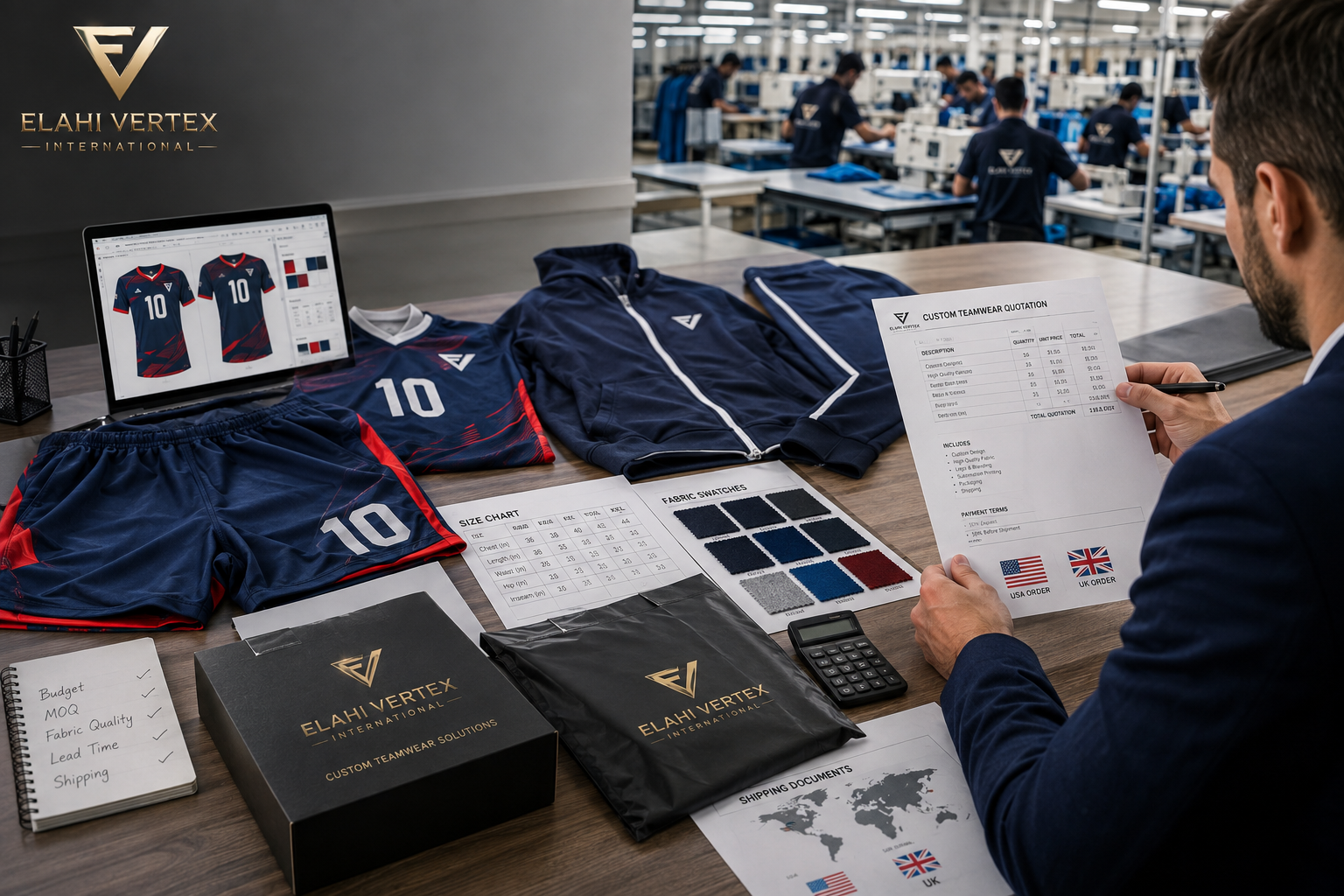
If you are sourcing custom teamwear for a sports brand, club, academy, wholesaler, distributor, retailer, or private-label business, the quoted custom teamwear pricing is only one part of the real cost.
The same jersey can have very different pricing depending on fabric, quantity, design complexity, customization, sizing, packaging, production requirements, shipping, and destination-country import costs.
That is why experienced B2B buyers should not simply ask:
“What is your price per piece?”
A better question is:
“What is included in the quotation, and what will my total landed cost be?”
This guide explains the 9 key factors that influence custom teamwear pricing for USA and UK B2B orders and shows how to request a more accurate quotation from a manufacturer.
Table of Contents
- What Determines Custom Teamwear Pricing?
- Fabric Type and Quality
- Design Complexity
- Customization and Branding
- Order Quantity and MOQ
- Size Range and Grading
- Labels, Packaging and Finishing
- Production Timeline
- Shipping and Logistics
- Import Duties, Taxes and Landed Cost
- How USA and UK Buyers Should Compare Quotes
- How to Reduce Teamwear Costs Without Sacrificing Quality
- Common Buyer Mistakes
- How to Request an Accurate Teamwear Quote
- Why Choose Elahi Vertex International?
- Frequently Asked Questions
- Conclusion
What Determines Custom Teamwear Pricing?
There is no single universal price for custom teamwear because each B2B order can have different specifications.
A practical cost model is:
Manufacturing cost + customization + packaging + logistics + applicable import costs = potential landed cost
The main factors include:FactorWhy it can affect costFabricDifferent materials have different costs and performance characteristicsDesignComplex construction and artwork can require more production workCustomizationPrinting, embroidery, patches, names and numbers add requirementsQuantityProduction economics can change at different order volumesSizingMultiple size ranges and custom grading add complexityPackagingBranded packaging and special packing instructions add scopeProduction timelineRush requirements can affect production planningShippingFreight depends on destination, weight, volume and methodImport costsDuties, taxes and customs treatment can affect landed cost
A manufacturer should therefore receive the complete product specification before you treat a quotation as final.
1. Fabric Type and Quality
Fabric is one of the first things to consider when evaluating custom teamwear pricing.
Teamwear can require different characteristics depending on the sport and intended use:
- Breathability
- Moisture management
- Stretch
- Durability
- Weight
- Comfort
- Recovery
- Surface finish
- Performance requirements
A basic polyester garment and a technically specified performance garment should not automatically be expected to cost the same.
Why does fabric affect custom teamwear pricing?
Fabric influences more than the material itself. It can also affect:
- Cutting
- Sewing
- Printing compatibility
- Garment weight
- Finishing
- Quality-control requirements
- Packaging and shipment volume
For example, a buyer requesting a lightweight performance jersey with specific stretch and moisture-management characteristics is providing a very different specification from a buyer requesting a basic promotional shirt.
How B2B buyers can control fabric costs
Instead of simply asking for the cheapest material, ask the manufacturer for suitable options.
For example:
“Please recommend two or three fabric options suitable for competitive teamwear and quote them separately.”
This lets you compare performance versus cost instead of blindly choosing the cheapest material.
2. Design Complexity
Design complexity is another important component of custom teamwear pricing.
A simple color-blocked jersey is generally easier to manufacture than a highly detailed garment containing multiple panels, complex artwork, sponsor placements and specialized construction.
Design complexity can involve:
- Number of colors
- Artwork coverage
- Multiple panels
- Logos
- Sponsors
- Player names
- Player numbers
- Collar construction
- Contrast elements
- Special trims
- Custom garment construction
Simple vs. complex specifications
DesignRelative complexityBasic color-blocked jerseyLowerStandard custom artworkModerateMulti-color detailed designModerate to higherMultiple sponsors and personalizationHigherUnusual construction + extensive brandingHigher
The important point is that visual complexity and manufacturing complexity are not always identical.
A design may look simple but require difficult construction. Conversely, an intricate printed graphic may be relatively efficient if the production method is appropriate.
How to avoid unnecessary costs
You can control complexity by:
- Finalizing artwork before production.
- Providing clean artwork files.
- Confirming sponsor positions.
- Confirming colors.
- Confirming measurements.
- Avoiding unnecessary changes after approval.
The objective is not to make your teamwear boring.
The objective is to make the specification efficient to manufacture.
3. Customization and Branding
Customization is one of the main reasons B2B buyers choose custom teamwear.
But “customization” can mean many different things.
Depending on the project, it may include:
- Sublimation
- Screen printing
- Heat transfer
- Embroidery
- Patches
- Woven labels
- Printed labels
- Player names
- Player numbers
- Sponsor logos
- Custom trims
- Hangtags
- Branded packaging
Different decoration methods can have different material, labor, setup and production requirements.
Example
Consider two orders.
Order A
- Custom jersey
- One team logo
- Standard packaging
Order B
- Custom jersey
- Multiple sponsor logos
- Player names
- Player numbers
- Embroidery
- Custom labels
- Branded packaging
Even if both orders contain the same number of garments, their manufacturing requirements are not equivalent.
Best practice
Ask the manufacturer to separate the quotation where practical:
- Base garment
- Customization
- Labels
- Packaging
- Shipping
This makes supplier comparisons much more meaningful.
4. Order Quantity and MOQ
Order quantity can have a significant effect on the economics of a B2B manufacturing project.
Manufacturers may have production-related costs associated with:
- Material preparation
- Cutting
- Artwork
- Setup
- Labor
- Quality control
- Packaging
- Administration
When these activities are spread over more units, the economics can change.
Industry pricing guides similarly identify quantity as a major variable in custom uniform pricing. (XROAD SPORTS)
But bigger orders are not automatically better
This is an important point.
Ordering more units simply to obtain a lower unit price can be a bad business decision if you cannot sell the inventory.
Excess inventory creates:
- Cash-flow pressure
- Storage requirements
- Unsold sizes
- Discounting
- Obsolescence risk
- Working-capital requirements
Better strategy
Ask for tiered pricing.
For example:QuantityAsk the manufacturer forTrial quantityUnit price and setup requirementsMedium orderUnit priceLarger orderBest scalable unit priceRepeat programPotential future-order pricing
This gives you visibility into the supplier’s pricing structure without forcing you to over-order.
5. Size Range and Grading
Size requirements can also affect the production specification.
A teamwear order may include:
- Youth sizes
- Adult sizes
- Extended sizes
- Custom measurements
- Multiple size charts
- Special grading
A buyer who says:
“I need 100 jerseys.”
has not necessarily provided enough information for an accurate quotation.
The real requirement could be:
“100 jerseys across youth, adult and extended sizes, with player names and numbers.”
That is a much more detailed production brief.
Give your manufacturer a complete size breakdown
Include:
- Total quantity
- Sizes
- Quantity per size
- Youth/adult requirements
- Standard or custom sizing
- Size chart
- Special measurements
If you already have a technical size chart, provide it before the quotation is finalized.
6. Labels, Packaging and Finishing
Packaging is frequently overlooked during the initial pricing discussion.
For a B2B order, packaging may include:
- Individual polybags
- Custom labels
- Woven labels
- Hangtags
- Barcode labels
- Size stickers
- Branded packaging
- Carton markings
- Special folding
- Retail-ready presentation
Why does packaging matter?
Because packaging is part of the production specification.
There is a significant difference between:
Bulk-packed teamwear
and
Individually packed, branded, retail-ready teamwear.
The second option requires additional materials and labor.
This is particularly important for:
- Private-label brands
- Retailers
- E-commerce sellers
- Distributors
- Wholesalers
Smart RFQ approach
Ask:
“Please quote standard export packaging separately from our requested branded packaging.”
That allows you to see exactly how much your packaging requirements add to the order.
7. Production Timeline
Production time can influence the overall cost and commercial risk of a teamwear order.
A manufacturer needs to coordinate:
- Material sourcing
- Artwork
- Sampling
- Cutting
- Sewing
- Printing
- Embroidery
- Finishing
- Quality control
- Packing
If a buyer requests an unusually short production schedule, the manufacturer may need to reorganize production planning.
Don’t confuse production time with shipping time
These are two different stages.
Production time:
How long it takes to manufacture the goods.
Shipping time:
How long it takes to transport the completed goods to the destination.
Your actual project timeline needs to account for both.
If you have a deadline
Tell the manufacturer:
- Target delivery date
- Destination
- Quantity
- Sampling requirements
- Whether the date is flexible
Do not wait until production begins to mention an important event, tournament or launch date.
8. Shipping and Logistics
International shipping can materially affect the total cost of a B2B teamwear order.
Potential variables include:
- Destination
- Shipment weight
- Shipment volume
- Number of cartons
- Shipping method
- Delivery urgency
- Freight terms
- Customs responsibility
- Insurance
- Local delivery
Factory price is not landed cost
For example:
Quote A:
$X per piece, excluding shipping.
Quote B:
$Y per piece including certain delivery costs.
You cannot fairly compare the two without understanding what each quotation contains.
Ask these questions
Before approving an international order, clarify:
- Is shipping included?
- Which shipping method is being quoted?
- Which Incoterm applies?
- Who handles customs clearance?
- Are duties included?
- Are taxes included?
- Is insurance included?
- Are destination charges included?
The answer can materially change your actual cost.
9. Import Duties, Taxes and Landed Cost
This is particularly important for USA and UK B2B buyers.
The manufacturer’s price is not necessarily your final cost.
Your potential landed cost can be thought of as:
Manufacturing + customization + packaging + freight + applicable customs charges + applicable taxes = landed cost
The exact treatment depends on the product, classification, origin, destination and commercial terms.
USA Buyers
U.S. buyers should determine the appropriate tariff classification for the imported apparel rather than assuming that every jersey or sportswear product has the same duty treatment.
For textile and apparel imports, classification and applicable customs requirements should be checked against current U.S. customs guidance before importing.
Do not rely on a generic percentage from an online article to estimate your actual duty.
The product’s characteristics and classification matter.
UK Buyers
UK buyers should pay particular attention to the correct commodity code.
GOV.UK explains that the commodity code is used to determine applicable Customs Duty and import VAT and can also affect other import requirements. (GOV.UK)
The UK government’s import guidance also states that importers need the commodity code on their import declaration and that the code helps determine the duty payable. (GOV.UK)
For UK imports, the calculation of import VAT can include the customs value together with applicable duty and certain incidental expenses. (GOV.UK)
Important
The correct classification should be verified for the actual product being imported.
Do not assume that a generic “sportswear” classification applies to every garment.
How USA and UK Buyers Should Compare Teamwear Quotes
The biggest sourcing mistake is comparing suppliers based only on the headline unit price.
Instead, build a like-for-like comparison.Cost componentSupplier ASupplier BSupplier CBase garment———Fabric———Customization———Labels———Packaging———Sampling———Shipping———Customs/destination costs———Estimated landed cost———
This approach exposes hidden differences between quotations.
The cheapest factory price may not be the cheapest order.
That is a critical distinction.
How to Reduce Custom Teamwear Costs Without Sacrificing Quality
Cost optimization does not mean choosing the lowest-quality fabric.
A smarter approach is to remove unnecessary cost.
1. Finalize the design early
Late artwork changes create avoidable production complexity.
2. Compare fabric options
Ask your manufacturer to recommend suitable alternatives based on your target performance and budget.
3. Optimize order quantity
Order enough to achieve sensible production economics without creating unnecessary inventory.
4. Simplify unnecessary customization
Keep the branding that matters to your customer.
Remove decorative complexity that does not add meaningful commercial value.
5. Plan production in advance
Avoid unnecessary rush production.
6. Optimize shipping
Choose the shipping method based on your actual deadline and order economics.
7. Compare landed cost
Do not select a manufacturer based solely on factory price.
9 Common Buyer Mistakes
1. Choosing only by price
The cheapest quotation is not automatically the best commercial option.
2. Comparing different specifications
Supplier A may quote a different fabric, decoration method or packaging specification.
3. Not providing complete artwork
Incomplete artwork can make the initial quotation less reliable.
4. Ignoring size distribution
“500 pieces” is not enough if the order contains multiple size categories.
5. Forgetting packaging
Branded packaging can materially change the production scope.
6. Ignoring shipping
Factory price and delivered cost are different measurements.
7. Assuming import costs are included
Always confirm exactly what your supplier’s quotation covers.
8. Changing specifications after approval
Late changes can create delays, additional work or revised pricing.
9. Choosing a supplier based only on unit cost
A B2B manufacturing relationship also depends on communication, specification accuracy, quality control, production reliability and commercial transparency.
How to Request an Accurate Custom Teamwear Quote
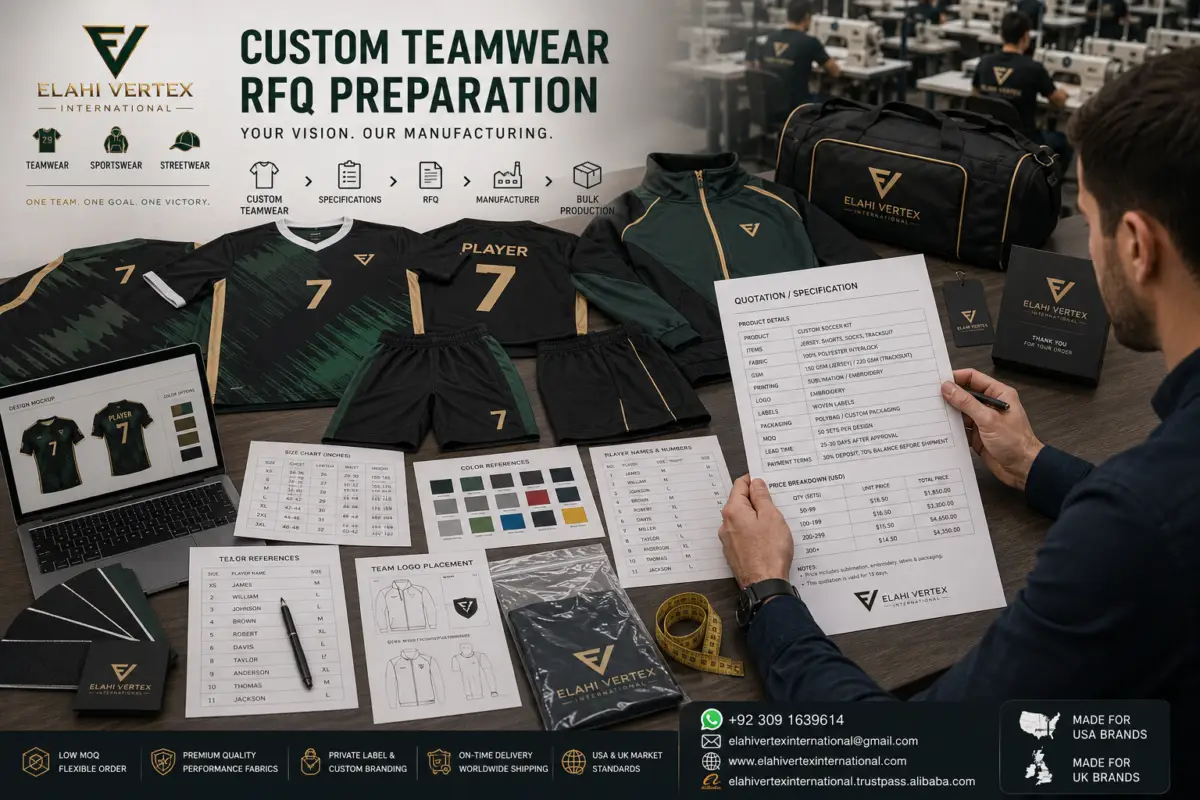
If you want a manufacturer to provide a useful quotation, send a complete RFQ.
Include:
- Product type
- Sport
- Quantity
- Target market
- Fabric preference
- Artwork
- Logo files
- Sponsor logos
- Player names
- Player numbers
- Decoration requirements
- Size range
- Size quantities
- Labels
- Packaging
- Target delivery date
- Destination
- Preferred shipping method
- Reference images
- Technical pack, if available
Example RFQ
Product: Custom team jerseys
Quantity: 500 pieces
Market: USA
Fabric: Performance polyester
Design: Attached artwork
Branding: Team logo + sponsor + player names/numbers
Sizes: Youth + Adult
Packaging: Individual polybags
Destination: USA
Required delivery: [date]
Please quote: Product, customization, packaging and shipping separately where possible.
This gives the manufacturer a much clearer basis for pricing.
Why Choose Elahi Vertex International?
Elahi Vertex International works as a B2B manufacturer, exporter, OEM/ODM supplier and private-label manufacturing partner for international buyers.
For buyers sourcing custom teamwear, the objective should not simply be obtaining the lowest number.
The better objective is to establish a clear manufacturing specification so both buyer and manufacturer understand:
- What is being produced
- Which materials are required
- How the product will be customized
- How many pieces are required
- What sizes are needed
- What packaging is expected
- Where the order is being delivered
- What the quotation includes
- Which costs still require confirmation
That creates a much stronger foundation for international B2B sourcing.
Ready to discuss your custom teamwear order?
Send your design + quantity + size breakdown + destination + customization requirements to Elahi Vertex International for a project-specific manufacturing discussion.
WhatsApp: +92 309 1639614
Email: elahivertexinternational@gmail.com
Frequently Asked Questions
What affects custom teamwear pricing?
The major factors are fabric, design complexity, customization, order quantity, sizing, packaging, production requirements, shipping and applicable import costs.
Is a larger MOQ always cheaper?
Not necessarily. Larger orders can improve unit economics, but ordering excessive inventory can create cash-flow and stock risks.
Does fabric quality affect teamwear pricing?
Yes. Different fabrics have different material costs and may require different production specifications.
Does customization increase the price?
It can. Printing, embroidery, patches, names, numbers, sponsor logos and other branding requirements can change the production scope.
Does packaging affect teamwear cost?
Yes. Standard bulk packaging and branded retail-ready packaging are different requirements.
Does shipping affect the final price?
Yes. Shipping method, destination, weight, volume and commercial terms can all affect landed cost.
Are customs duties included in a manufacturer’s quotation?
Not necessarily. Always confirm what the quotation includes and who is responsible for destination customs and taxes.
How can USA buyers estimate import costs?
USA buyers should determine the appropriate customs classification and check the applicable current tariff and import requirements for the actual product.
How can UK buyers estimate import costs?
UK buyers should identify the correct commodity code and check the current UK Trade Tariff for applicable duty and VAT information. (GOV.UK)
Should I request a sample before a bulk order?
For many custom B2B projects, a sample can be a useful risk-control step for checking fit, fabric, construction and decoration before committing to bulk production.
What should I send when requesting a quotation?
Send your product specification, quantity, artwork, fabric requirements, customization, sizes, packaging, destination and target delivery date.
Conclusion
Custom teamwear pricing is not simply a price-per-jersey calculation.
The nine factors you should evaluate are:
- Fabric type and quality
- Design complexity
- Customization and branding
- Order quantity and MOQ
- Size range and grading
- Labels, packaging and finishing
- Production timeline
- Shipping and logistics
- Import duties, taxes and landed cost
For USA and UK B2B buyers, the smartest sourcing decision is to compare like-for-like specifications and estimated landed cost, rather than choosing the manufacturer with the lowest headline unit price.
A detailed RFQ also helps manufacturers provide a more meaningful quotation because the actual production scope is clear from the beginning.
If you are sourcing custom teamwear for a sports brand, club, academy, distributor, wholesaler, retailer or private-label business, prepare your specifications carefully and compare manufacturers on cost, quality requirements, communication, production capability, logistics and commercial transparency.
Ready to discuss your custom teamwear project?
Contact Elahi Vertex International:
WhatsApp: +92 309 1639614
Email: elahivertexinternational@gmail.com
Website: Elahi Vertex International