
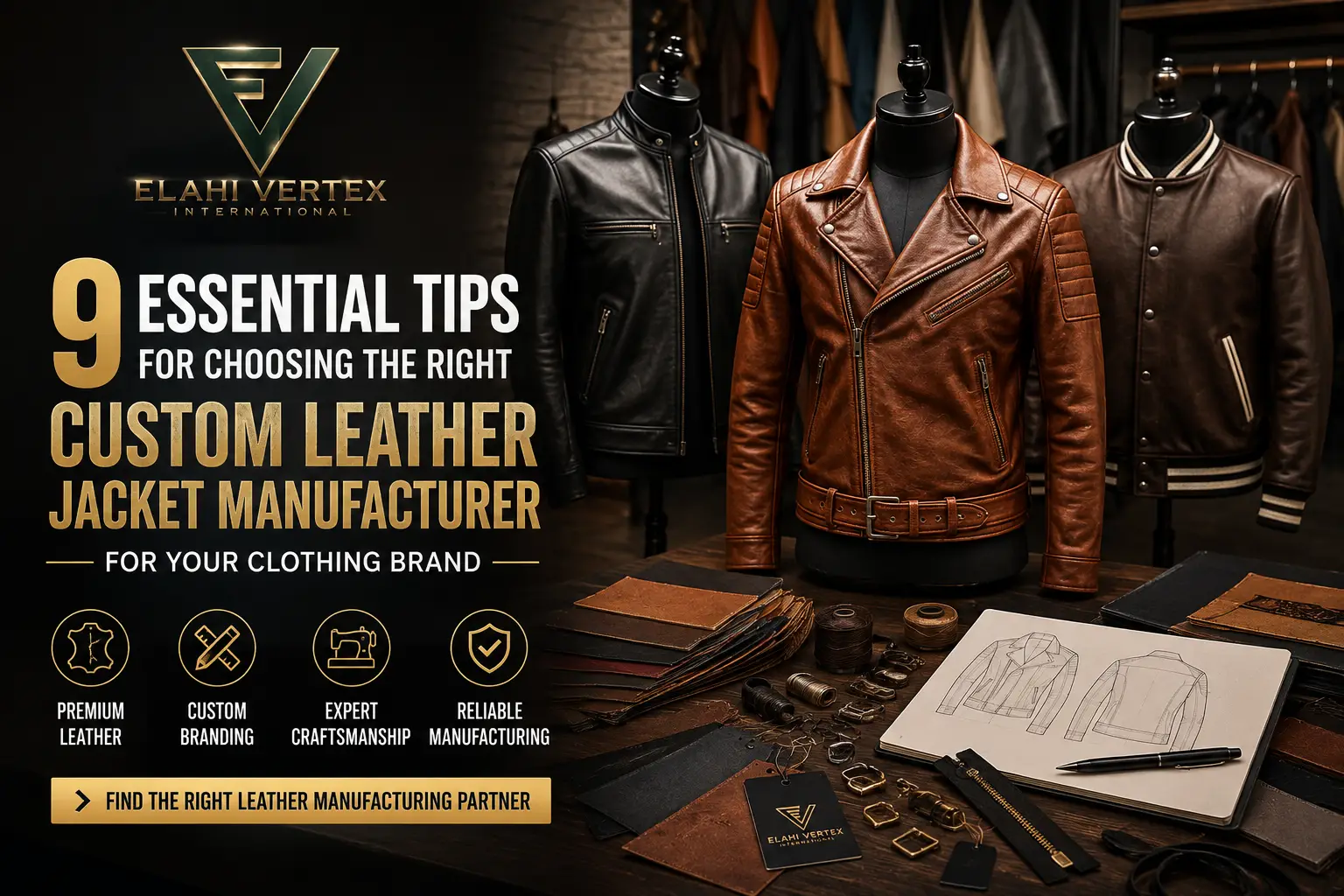
Choosing the right custom leather jacket manufacturer can determine whether your clothing brand builds a strong premium reputation or struggles with inconsistent quality, poor fit, production delays, and expensive product returns.
Leather jackets are more complicated to manufacture than many everyday apparel products. The leather itself matters, but so do hide selection, thickness, grain, tanning, finishing, pattern development, stitching, lining, hardware, sizing, fit, branding, and final inspection.
For a clothing brand selling in the USA, UK, Europe, Canada, or other international markets, the manufacturer is therefore more than a supplier. The manufacturer becomes part of your product-development and quality-control process.
This guide explains 9 essential tips for choosing a custom leather jacket manufacturer, with a practical framework for startups, streetwear labels, private-label brands, fashion companies, retailers, and established clothing businesses.
[FEATURED IMAGE — PLACE AFTER TITLE]
Image concept: Premium custom leather jackets arranged in a professional B2B manufacturing studio, with leather swatches, hardware, patterns, measuring tools, labels and packaging visible.
SEO filename: custom-leather-jacket-manufacturer-clothing-brand.jpg
ALT: Custom leather jacket manufacturer for clothing brands
Table of Contents
- Understand What Your Brand Actually Needs
- Evaluate Leather Quality and Material Transparency
- Check Customization and Product-Development Capability
- Ask About Sampling Before Bulk Production
- Examine Stitching, Fit, Hardware and Finishing
- Compare MOQ, Pricing and Total Production Cost
- Verify Quality-Control and Communication Processes
- Evaluate Private Label, OEM and ODM Support
- Think Beyond the First Order
- Custom Leather Jacket Manufacturer Comparison Checklist
- Common Mistakes Clothing Brands Should Avoid
- How to Prepare a Strong Leather Jacket RFQ
- Why Work With Elahi Vertex International?
- Frequently Asked Questions
- Useful External Resources
- Final Thoughts
Why Choosing the Right Custom Leather Jacket Manufacturer Matters
A leather jacket represents a significant product investment for a clothing brand. Customers notice the material, weight, fit, zipper quality, stitching, lining, finishing and overall construction.
A low-cost supplier may appear attractive during the initial quotation stage, but the cheapest quotation is not necessarily the lowest total cost.
A poorly developed jacket can create:
- Product returns
- Customer complaints
- Inconsistent sizing
- Damaged brand reputation
- Rework expenses
- Missed seasonal launches
- Unsold inventory
- Difficult supplier relationships
- Unexpected production costs
A strong custom leather jacket manufacturer, by contrast, should help you translate your design into a repeatable production specification.
The important question is therefore not simply:
“Who offers the cheapest leather jacket?”
A better question is:
“Which manufacturer can consistently reproduce my required design, material, fit, branding and quality specifications at commercially workable terms?”
That change in thinking can make supplier selection much more effective.
[IMAGE 2 — PLACE AFTER THIS SECTION]
Image concept: Buyer evaluating two leather jackets side by side with a quality checklist.
SEO filename: choose-custom-leather-jacket-manufacturer.jpg
ALT: Choosing a custom leather jacket manufacturer using a quality checklist
1. Understand What Your Brand Actually Needs
Before contacting a custom leather jacket manufacturer, define the product you want to manufacture.
A vague request such as “I need premium leather jackets” does not give a factory enough information to produce the same product you have in mind.
Your initial specification should describe as many of these elements as possible:SpecificationWhat to DefineJacket styleBiker, bomber, racer, aviator, trucker, fashion, varsity-inspired, etc.GenderMen’s, women’s, unisexLeatherCowhide, sheepskin, goatskin, or another approved materialFinishSmooth, matte, distressed, washed, vintage, etc.ColorBlack, brown, custom color or approved swatchThicknessRequired thickness or target hand feelLiningFabric type, weight and colorHardwareZippers, snaps, buttons, buckles and finishBrandingLabels, patches, embroidery, embossing or other approved brandingFitOversized, regular, slim, relaxed, cropped, etc.SizesRequired size rangePackagingIndividual and bulk packaging requirementsQuantitySample quantity and planned bulk quantity
The more precise your specifications are, the easier it becomes for a custom leather jacket manufacturer to quote and develop the correct product.
Build a Tech Pack
If your brand has professional design resources, create a tech pack containing:
- Technical drawings
- Measurements
- Size specifications
- Construction details
- Stitching requirements
- Material information
- Hardware references
- Label placement
- Logo dimensions
- Color references
- Packaging instructions
If you do not have a complete tech pack, provide sketches, reference photographs, measurements and physical samples wherever possible.
A manufacturer can then identify what still needs clarification before sampling.
Expert Tip
Do not ask several manufacturers to quote an undefined product and then compare prices as if every quotation represents the same jacket.
Different leather grades, thicknesses, linings, hardware, construction methods and finishing requirements can produce dramatically different costs.
2. Evaluate Leather Quality and Material Transparency
The phrase “genuine leather” alone is not enough to evaluate a leather jacket.
Your custom leather jacket manufacturer should be able to clearly explain the proposed leather material and finishing process.
Depending on your product, you may evaluate:
- Leather type
- Animal source category
- Grain characteristics
- Thickness
- Hand feel
- Finish
- Color consistency
- Surface appearance
- Tanning approach
- Softness
- Durability requirements
- Expected natural variations
Leather is a natural material, so variation is not automatically a defect. However, your manufacturer should understand the level of variation acceptable for your brand.
Ask for Leather Samples
Before approving production, request material samples or swatches where practical.
Compare:
- Texture
- Thickness
- Flexibility
- Color
- Surface finish
- Smell
- Grain
- Consistency
- Overall hand feel
Your approved leather sample should become part of the production reference.
Ask About Traceability
Traceability is increasingly important for brands that want stronger visibility into their leather supply chain.
The Leather Working Group explains that its leather manufacturer audit includes areas such as incoming and outgoing material traceability, environmental management, restricted substances, chemical management, waste and other operational factors. (Leather Working Group)
That does not mean every manufacturer must hold an LWG certification. It means buyers should understand what evidence and documentation are available for their specific sourcing requirements.
If certification is important to your brand, verify the exact certificate, scope, facility and validity rather than accepting a general statement such as “certified factory.”
3. Check Customization and Product-Development Capability
A true custom leather jacket manufacturer should be able to work from your specifications rather than simply offering a fixed catalog.
Ask whether the manufacturer can accommodate requirements involving:
- Jacket silhouette
- Pattern modifications
- Leather selection
- Color
- Lining
- Zipper configuration
- Pocket design
- Collar construction
- Cuffs
- Waistband
- Stitching
- Patches
- Labels
- Embossing
- Printing
- Custom hardware
- Packaging
For a fashion brand, customization is often where the manufacturer becomes strategically valuable.
OEM vs ODM
OEM generally means the buyer supplies the design or specifications and the manufacturer produces according to those requirements.
ODM generally involves the manufacturer providing existing design or development capabilities that can be adapted to the buyer’s brand requirements.
Neither model is automatically better.
If your brand has a distinctive design language, OEM production may provide greater control.
If your brand needs development support, an ODM relationship may be more practical.
The important issue is whether the custom leather jacket manufacturer clearly understands which model you require.
Protect Your Product Identity
If you provide original designs, ask how the manufacturer handles:
- Tech packs
- Patterns
- Logos
- Brand labels
- Product photographs
- Confidential design information
- Samples
- Production files
A professional sourcing relationship should make ownership and confidentiality expectations clear before development begins.
4. Ask About Sampling Before Bulk Production
One of the most important rules when selecting a custom leather jacket manufacturer is simple:
Do not treat a quotation as proof of production quality.
A quotation tells you what the manufacturer proposes to charge.
A sample gives you an opportunity to evaluate what the manufacturer can actually produce.
[IMAGE 3 — PLACE AFTER THIS SECTION]
Image concept: Leather jacket prototype on a worktable surrounded by leather swatches, measurement tape, technical drawings and hardware samples.
SEO filename: custom-leather-jacket-sampling-process.jpg
ALT: Custom leather jacket sampling and product development process
What Should You Check During Sampling?
Evaluate:
Fit
- Shoulder width
- Sleeve length
- Chest measurement
- Body length
- Armhole
- Cuff position
- Overall silhouette
Construction
- Seam consistency
- Stitch density
- Seam strength
- Panel alignment
- Pocket positioning
- Collar construction
Material
- Leather appearance
- Thickness
- Flexibility
- Surface finish
- Color
Hardware
- Zipper operation
- Snap strength
- Button finishing
- Hardware color
- Hardware placement
Interior
- Lining quality
- Lining attachment
- Inside seams
- Label placement
- Internal finishing
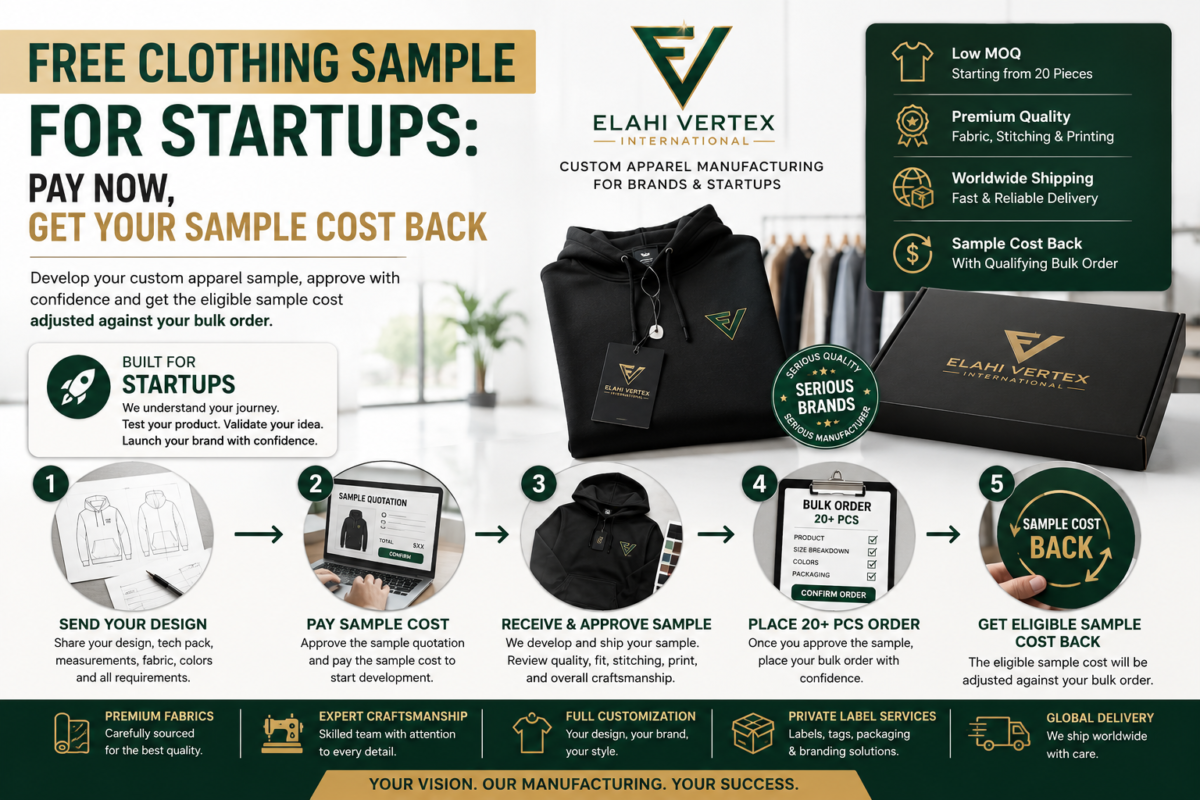
Use a Sample Approval Process
A practical workflow can be:
- Send design requirements.
- Confirm materials.
- Review quotation.
- Develop prototype.
- Inspect sample.
- Request revisions.
- Approve final sample.
- Freeze specifications.
- Begin bulk production.
- Conduct final inspection.
The exact process depends on the manufacturer and project.
The key principle is to avoid moving into bulk production before your critical product specifications are sufficiently approved.
5. Examine Stitching, Fit, Hardware and Finishing
A premium leather jacket is a combination of multiple construction details.
Do not evaluate the jacket only by looking at the leather.
A strong custom leather jacket manufacturer should understand that product quality includes the relationship between the leather, pattern, stitching, lining and hardware.
Inspect Stitching
Look for:
- Consistent stitch lines
- Clean seams
- No obvious loose threads
- Proper seam alignment
- Appropriate reinforcement
- Consistent construction across panels
Inspect the Fit
The same leather can produce a completely different customer experience depending on the pattern.
Check:
- Shoulder shape
- Sleeve rotation
- Chest ease
- Waist shape
- Back length
- Sleeve length
- Collar position
For a clothing brand, fit consistency is particularly important when customers reorder the same style or purchase different colorways.
Inspect Hardware
Zippers and snaps are highly visible components.
Test:
- Opening and closing
- Smooth movement
- Attachment
- Alignment
- Puller strength
- Finish consistency
Inspect Finishing
Look at:
- Edge finishing
- Seam finishing
- Lining attachment
- Label attachment
- Pocket finishing
- Internal construction
- Final appearance
A professional quality-control checklist should define what counts as acceptable before bulk production starts.
6. Compare MOQ, Pricing and Total Production Cost
MOQ is important, especially for startups and growing clothing brands.
However, MOQ should not be the only supplier-selection criterion.
A custom leather jacket manufacturer may offer a lower MOQ but have higher sample costs, limited customization, inconsistent quality or expensive revisions.
Another manufacturer may offer different commercial terms but provide a stronger development process.
Compare the Complete Cost
When comparing suppliers, consider:Cost AreaQuestions to AskSampleWhat does development cost?MaterialWhat leather specification is included?HardwareAre premium hardware options included?BrandingAre labels and branding included?PackagingWhat packaging is included?RevisionsAre sample revisions charged?ProductionWhat is the bulk unit cost?ShippingWhat shipping options are available?InspectionWho performs final inspection?ReworkHow are quality issues handled?
Do not compare one manufacturer’s premium leather quotation against another manufacturer’s lower-grade leather quotation.
That is not a meaningful price comparison.
Ask for a Structured Quotation
Your RFQ should request pricing based on clearly defined specifications.
For example:
“Please quote this jacket using the attached approved material specification, hardware requirements, size range, branding details and packaging instructions.”
That makes supplier comparison much more reliable.
7. Verify Quality-Control and Communication Processes
Communication is often underestimated when brands choose a custom leather jacket manufacturer.
International production involves multiple decisions.
You may need to discuss:
- Material approvals
- Pattern revisions
- Sample comments
- Color approvals
- Hardware
- Branding
- Packaging
- Production status
- Quality concerns
- Shipping documentation
A supplier that communicates clearly can reduce misunderstandings.
Ask These Questions
Before choosing a manufacturer, ask:
- Who will manage my project?
- How will sample revisions be documented?
- How are approved specifications recorded?
- How are production issues communicated?
- What happens if the material is unavailable?
- How is quality checked?
- When is final inspection performed?
- What happens if finished goods do not meet the approved specification?
Quality management is not just a final inspection.
It is a process that should begin with clear specifications and continue through production.
ISO describes ISO 9001 as a quality-management framework covering areas including planning, operations, performance evaluation and continual improvement. (ISO)
If a supplier claims ISO certification, verify the actual certification details rather than relying on a logo displayed on a website.
8. Evaluate Private Label, OEM and ODM Support
If your objective is to build a clothing brand rather than simply purchase generic jackets, private-label capability matters.
A suitable custom leather jacket manufacturer may need to support your brand with:
- Woven labels
- Neck labels
- Size labels
- Hangtags
- Custom packaging
- Logo applications
- Embossing
- Patches
- Product-specific branding
- Packaging instructions
Your branding should be treated as part of the product specification.
Ask About Your Complete Brand Package
Before placing an order, clarify:
- Which labels are required?
- Where should each label be placed?
- What are the dimensions?
- Which logo version should be used?
- What packaging should be used?
- How should each jacket be folded or protected?
- Are hangtags required?
- Are barcodes required?
- Are individual polybags required?
- Are carton markings required?
This is particularly important for international e-commerce and retail brands.
A jacket may be technically well manufactured but still fail your launch requirements if the branding and packaging are incorrect.
9. Think Beyond the First Order
The best custom leather jacket manufacturer is not necessarily the supplier with the most attractive first quotation.
Think about what happens after the first order.
Your brand may eventually need:
- Additional colorways
- New jacket styles
- Revised fits
- Repeat production
- Seasonal collections
- Larger quantities
- New branding
- Additional packaging
- Related leather products
A long-term manufacturing relationship can make future product development easier because the supplier becomes familiar with your specifications and quality expectations.
Evaluate Scalability Carefully
Ask:
- Can the manufacturer support future repeat orders?
- Can specifications be reproduced consistently?
- Can the same approved materials be sourced again?
- Can new styles be developed?
- Can production quantities change?
- How are repeat-order specifications maintained?
- Can the manufacturer communicate effectively as your business grows?
Do not assume scalability.
Ask for the specific capabilities relevant to your project and confirm them before making commercial commitments.
A Practical Custom Leather Jacket Manufacturer Comparison Framework
Use this framework when comparing several suppliers.Evaluation AreaSupplier ASupplier BSupplier CLeather specification clearly defined✓ / ✗✓ / ✗✓ / ✗Sample available✓ / ✗✓ / ✗✓ / ✗Custom patterns✓ / ✗✓ / ✗✓ / ✗Private label✓ / ✗✓ / ✗✓ / ✗OEM support✓ / ✗✓ / ✗✓ / ✗ODM support✓ / ✗✓ / ✗✓ / ✗Hardware customization✓ / ✗✓ / ✗✓ / ✗Branding customization✓ / ✗✓ / ✗✓ / ✗Quality process explained✓ / ✗✓ / ✗✓ / ✗MOQ confirmed✓ / ✗✓ / ✗✓ / ✗Packaging requirements✓ / ✗✓ / ✗✓ / ✗Communication process✓ / ✗✓ / ✗✓ / ✗Export requirements discussed✓ / ✗✓ / ✗✓ / ✗
This approach keeps the decision focused on business requirements instead of marketing claims.
Common Mistakes Clothing Brands Make
Choosing a custom leather jacket manufacturer based on price alone is one of the biggest mistakes.
Other common mistakes include:
1. Skipping the sample
A photograph is not a substitute for a physical or properly reviewed prototype.
2. Not specifying the leather
“Premium leather” is too vague for a production specification.
3. Ignoring the pattern
A beautiful leather can still produce a poor jacket if the pattern and fit are wrong.
4. Treating every leather as identical
Different leather types and finishes can behave differently during production and wear.
5. Not approving hardware
Zippers, snaps and buttons can materially affect the appearance and function of the finished jacket.
6. Comparing prices without comparing specifications
A cheaper quotation may represent a different material or construction standard.
7. Failing to clarify branding
Labels, patches, embossing and packaging should be specified before production.
8. Not documenting revisions
Sample comments should be recorded clearly so the final approved specification is unambiguous.
9. Ordering bulk production too early
Bulk production should follow an appropriate approval process for the project.
How to Prepare an RFQ for a Custom Leather Jacket Manufacturer
A good request for quotation makes it easier for a custom leather jacket manufacturer to understand your project.
Include:
Product Information
- Jacket style
- Intended market
- Men’s/women’s/unisex
- Quantity
- Size range
- Target launch date
Material Information
- Leather type
- Desired finish
- Color
- Thickness
- Lining
- Hardware
Design Information
- Tech pack
- Reference photographs
- Technical drawings
- Measurements
- Logo files
- Label artwork
Branding
- Neck label
- Size label
- Hangtag
- Patch
- Embossing
- Packaging
Commercial Information
- Sample requirement
- Target quantity
- Bulk quantity
- Shipping destination
- Packaging requirements
Questions for the Manufacturer
Ask:
- Can you produce according to the attached specifications?
- What leather options can you provide?
- Can you develop a prototype?
- What information is needed to begin sampling?
- What customization options are available?
- What private-label services are available?
- What MOQ applies to this exact design?
- What quality checks are performed?
- What packaging options are available?
- Which production and shipping details must be confirmed before order approval?
What Should a Clothing Brand Look for in a Custom Leather Jacket Manufacturer?
The ideal supplier should be evaluated across five major areas:
Product capability — Can the supplier actually produce your design?
Material capability — Can the supplier provide the leather specification you require?
Development capability — Can the supplier create, revise and approve samples effectively?
Commercial capability — Can the supplier offer workable MOQ, pricing and production terms?
Communication capability — Can your team communicate clearly throughout development and production?
No single factor should automatically decide the supplier.
A strong sourcing decision comes from evaluating the complete picture.
Why Choose Elahi Vertex International for Custom Manufacturing?
Elahi Vertex International is positioned as a B2B manufacturer, exporter and custom manufacturing partner serving international buyers.
For brands considering custom leather products, the most useful approach is to provide your actual requirements rather than relying on generic product descriptions.
Share your:
- Jacket design
- Leather requirements
- Measurements
- Branding requirements
- Quantity
- Target market
- Packaging requirements
- Sample requirements
Elahi Vertex International can then discuss the project and confirm which requirements are feasible for the specific order.
Important: MOQ, production time, material availability, pricing, certifications, shipping arrangements and other project-specific details should be confirmed directly for your individual requirements.
Discuss Your Leather Jacket Project
For a B2B manufacturing inquiry, contact Elahi Vertex International through:
WhatsApp / Phone: +92 309 1639614
Email: elahivertexinternational@gmail.com
When contacting the manufacturer, include your design, quantity and specifications so the project can be evaluated accurately.
[IMAGE 4 — PLACE AFTER THIS SECTION]
Image concept: Premium leather jacket private-label development board showing custom labels, logo placement, zipper hardware, leather swatches and packaging.
SEO filename: private-label-custom-leather-jacket-manufacturer.jpg
ALT: Private label custom leather jacket manufacturer for fashion brands
Frequently Asked Questions
What is a custom leather jacket manufacturer?
A custom leather jacket manufacturer produces jackets according to a buyer’s specified design, materials, measurements, branding, construction requirements and other product specifications rather than simply supplying generic ready-made products.
How do I choose the best custom leather jacket manufacturer?
Start by comparing material quality, customization capability, sampling, construction quality, MOQ, pricing, quality control, communication, private-label support and long-term production suitability.
Should I order a sample before bulk production?
For custom products, a sample or appropriate prototype approval process is strongly recommended before committing to bulk production. It allows the buyer to evaluate fit, materials, construction, hardware, branding and finishing.
What leather should I use for my clothing brand?
The appropriate leather depends on the design, target price, intended use, desired hand feel, appearance and durability requirements. Ask the manufacturer to provide suitable options and samples rather than choosing solely from a generic leather name.
Can a custom leather jacket manufacturer add my brand label?
Private-label manufacturers may offer branding such as labels, hangtags, patches, embossing and custom packaging. The exact options should be confirmed for the specific project.
What should I include in a leather jacket RFQ?
Include the design, leather specification, measurements, sizes, color, lining, hardware, branding, quantity, packaging, sample requirements and destination market.
Is the cheapest manufacturer the best choice?
Not necessarily. A lower unit price can become more expensive if it results in inconsistent quality, additional revisions, poor fit, defects, delays or excessive returns.
How important is leather traceability?
It can be very important depending on your brand’s sourcing, sustainability, customer and market requirements. Buyers should ask what documentation and traceability information is available for the specific leather being proposed. Leather Working Group resources explain several approaches to traceability within the leather supply chain. (Leather Working Group)
Should a leather jacket manufacturer have ISO certification?
ISO 9001 certification can provide additional information about a company’s quality-management system, but certification should not be treated as the only supplier-selection criterion. If a supplier claims certification, verify the certificate and its scope. (ISO)
What is the difference between OEM and ODM leather jacket manufacturing?
OEM generally means manufacturing according to the buyer’s design or specifications. ODM generally involves using or adapting manufacturer-developed designs or development resources. The exact commercial arrangement should be agreed before production.
How can I compare two leather jacket manufacturers fairly?
Give both manufacturers the same product specification and compare material, construction, sample, branding, MOQ, price, packaging, quality process and commercial terms.
Can startups work with a custom leather jacket manufacturer?
Potentially, depending on the manufacturer’s commercial requirements. Startups should clearly communicate their expected quantities, sampling needs, product specifications and long-term plans before selecting a supplier.
How do I request a quotation from Elahi Vertex International?
Send your design or reference images together with your desired quantity, material requirements, sizes, branding details and destination market through the official website, WhatsApp, email or Alibaba storefront.
Useful External Resources
- Leather Working Group — Leather Manufacturer Standard
Leather Working Group Leather Manufacturer Standard
Useful for understanding areas such as traceability, environmental management, chemical management and operational controls when evaluating leather supply chains. (Leather Working Group)
Supports: Leather quality, sourcing and supplier evaluation. - Leather Working Group — Certified Supplier Directory
Leather Working Group Certified Suppliers
Useful for researching certified leather suppliers and understanding what information can be available when evaluating leather supply-chain partners. (Leather Working Group)
Supports: Supplier research and leather sourcing. - OEKO-TEX® LEATHER STANDARD
OEKO-TEX LEATHER STANDARD
Useful for understanding testing for harmful substances in leather articles and materials. (OEKO-TEX)
Supports: Material and chemical-safety considerations. - ISO 9001 Quality Management
ISO 9001
Useful for understanding quality-management principles and what ISO 9001 certification represents. (ISO)
Supports: Quality-control and supplier evaluation. - Leather Working Group — Traceability
Leather Working Group Traceability
Useful for learning how leather traceability can be assessed through physical, documented, group or regional approaches. (Leather Working Group)
Supports: Traceability and responsible sourcing. - AurenMade — Custom Leather Jacket Manufacturer Guide
AurenMade Custom Leather Jacket Manufacturer Guide
Useful as an additional industry example of how a leather-jacket supplier presents OEM, private-label, customization and sourcing considerations. (Auren Made)
Supports: Manufacturer comparison and buyer research. - Mughal Apparel — Custom Leather Jackets
Mughal Apparel Custom Leather Jackets
Useful as another B2B industry reference when comparing how manufacturers communicate product styles, OEM/private-label services and customization options. (Mughal Apparel)
Supports: Competitive supplier research and manufacturer comparison.
Final Thoughts
Selecting the right custom leather jacket manufacturer is not simply a search for the lowest price.
It is a supplier-evaluation process.
Your clothing brand should look at the complete production relationship:
Design → Material → Sampling → Fit → Construction → Branding → Quality Control → Packaging → Production → Repeat Orders
The strongest manufacturer for your business is the one that can meet your actual specifications and commercial requirements with a process you can understand and verify.
Before placing a bulk order, define your product carefully, compare suppliers using the same specifications, inspect samples, confirm leather and hardware requirements, document revisions and clarify commercial terms.
For international clothing brands, this disciplined approach can reduce avoidable manufacturing risks and create a much stronger foundation for long-term product development.
If you are planning a custom leather jacket collection, send Elahi Vertex International your design, specifications, expected quantity and branding requirements for project-specific discussion.
Contact Elahi Vertex International
Discuss Your Project on WhatsApp
WhatsApp / Phone: +92 309 1639614
Email: elahivertexinternational@gmail.com
Elahi Vertex International Alibaba Storefront