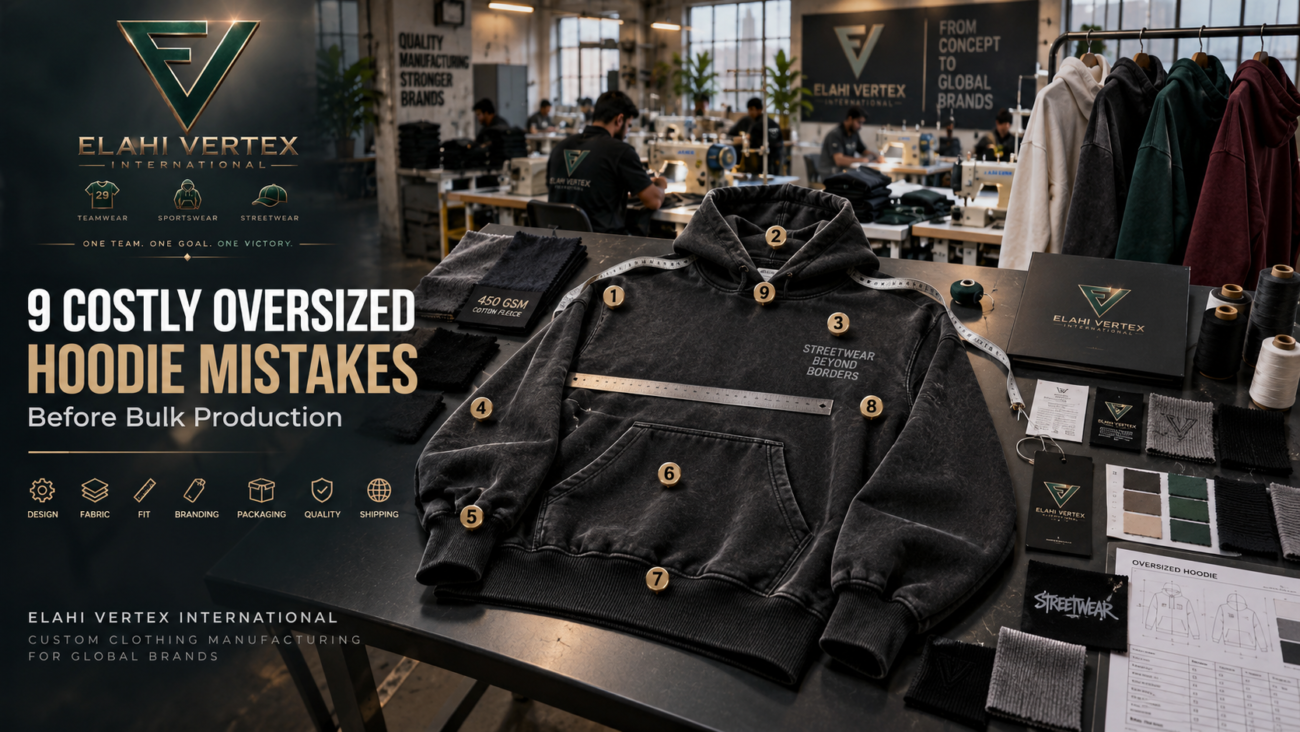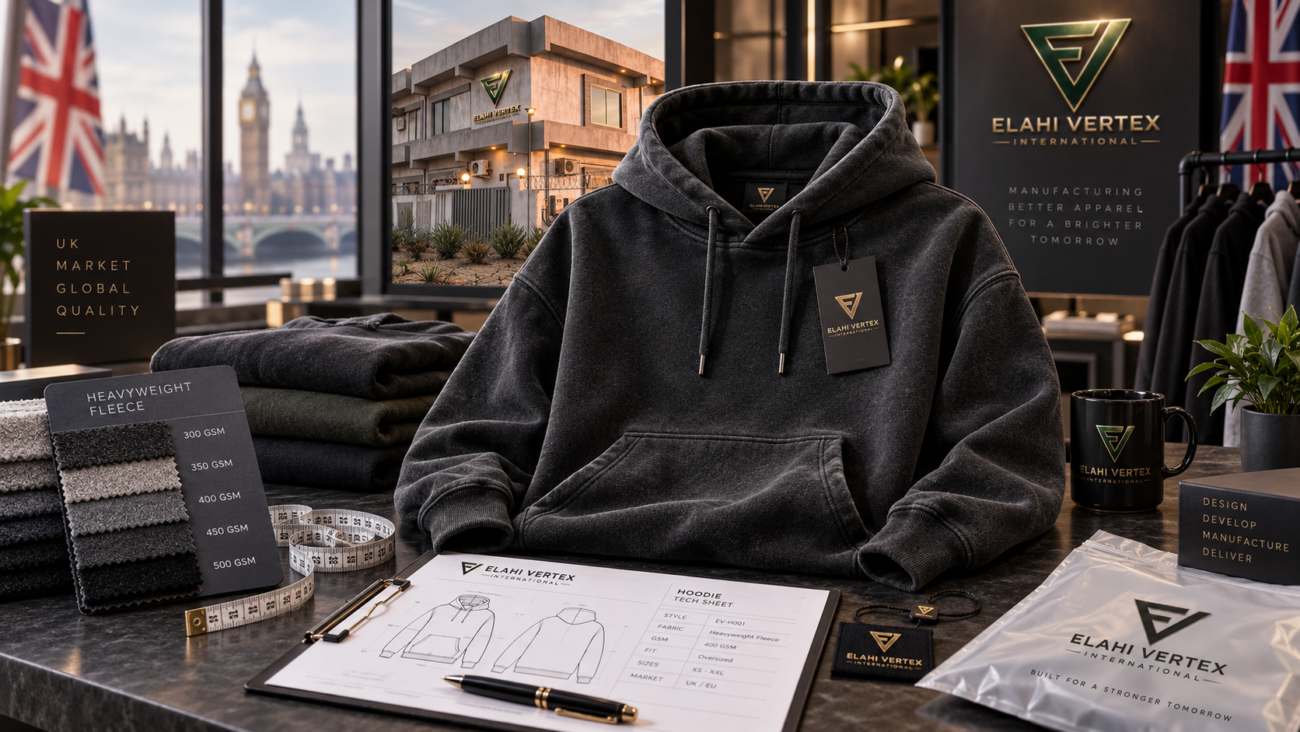

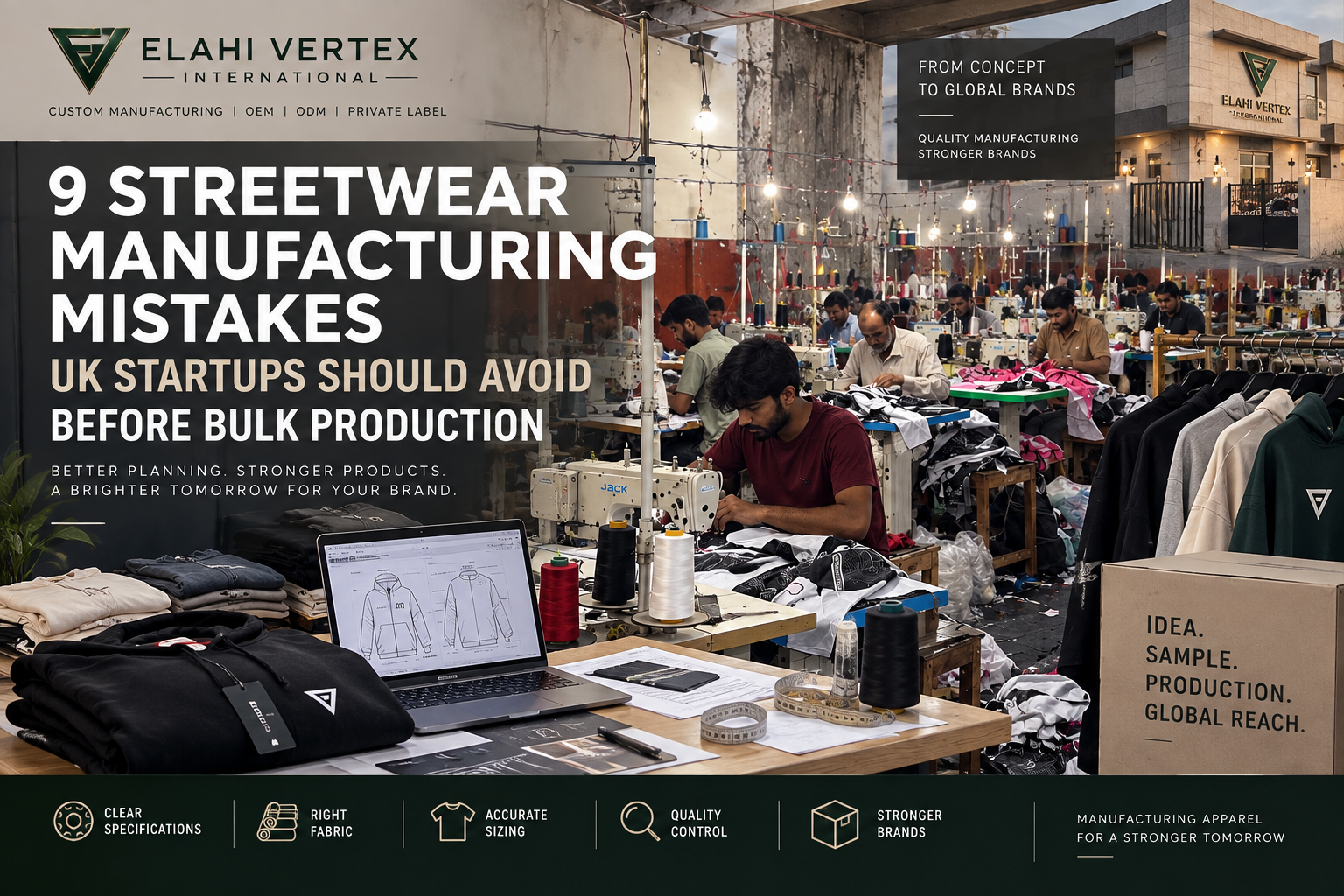
Launching a streetwear brand is exciting. Approving bulk production is where the financial risk becomes real.
A mock-up can look excellent on a screen while the finished hoodie feels completely wrong. An oversized T-shirt can have the right artwork but the wrong proportions. A supplier can quote an attractive unit price that becomes far less attractive once sampling, branding, freight, import costs and other expenses are considered.
Many streetwear manufacturing mistakes happen before the sewing line even starts.
For UK startups, the safest approach is to define the garment properly, develop and inspect a physical sample, understand the complete commercial cost, confirm branding and compliance requirements, and freeze the approved specifications before bulk production begins.
This guide explains nine mistakes worth avoiding before putting serious money into your first streetwear production run.
Table of Contents
- Starting Bulk Production Without a Proper Specification
- Choosing Fabric by GSM Alone
- Treating “Oversized” as a Complete Fit Instruction
- Approving Bulk Production Too Quickly After Sampling
- Choosing a Manufacturer Mainly by Unit Price
- Ignoring Labels, Branding and UK Requirements
- Ordering Too Much Inventory Before Proving Demand
- Ignoring Shipping, Import Costs and Landed Cost
- Failing to Freeze the Final Approved Sample and Specifications
- Streetwear Pre-Bulk Production Checklist
- Why UK Startups Can Consider Elahi Vertex International
- Frequently Asked Questions
- Conclusion
What Are the Biggest Streetwear Manufacturing Mistakes?
The biggest streetwear manufacturing mistakes usually involve unclear specifications, poor fabric decisions, vague fit instructions, rushed sample approval, price-only supplier selection, excessive opening quantities, incomplete cost calculations and weak control of the final approved production standard.
The important lesson is simple:
Do not treat bulk production as the stage where the product is developed.
The important product decisions should be made and documented before bulk manufacturing starts.
1. Starting Bulk Production Without a Proper Specification
One of the most expensive mistakes a new streetwear founder can make is assuming a reference image communicates everything a manufacturer needs.
It does not.
A photograph can show the aesthetic direction of a hoodie, but it may not define:
- Fabric composition
- Fabric weight
- Measurements
- Shoulder drop
- Body length
- Sleeve length
- Rib construction
- Hood construction
- Stitching
- Artwork dimensions
- Print method
- Embroidery position
- Labels
- Trims
- Packaging
- Size grading
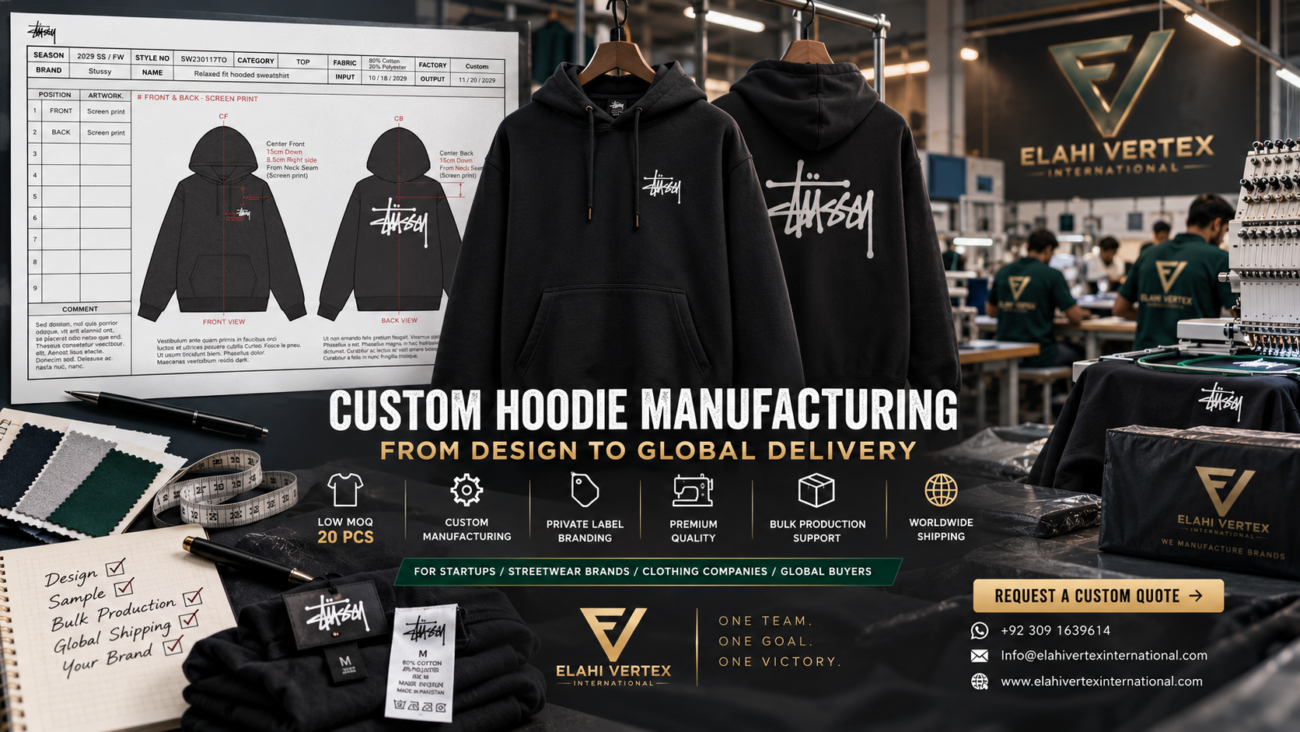
A clothing tech pack or another clearly documented specification gives both the buyer and manufacturer a common production reference.
For an oversized T-shirt, for example, simply saying:
“Make it oversized like this photo”
leaves too much open to interpretation.
A better specification identifies the actual measurements and construction details required.
What should UK streetwear startups provide?
At minimum, prepare:
| Requirement | What to Define |
|---|---|
| Product | Hoodie, T-shirt, jogger, sweatshirt, etc. |
| Fabric | Composition and construction where known |
| Weight | Target GSM where relevant |
| Fit | Oversized, boxy, relaxed, regular, etc. |
| Measurements | Chest, length, shoulders, sleeves and relevant POMs |
| Colour | Defined colour/reference |
| Artwork | File, dimensions and placement |
| Decoration | Screen print, embroidery, transfer, etc. |
| Branding | Neck label, care label, size label, hangtag |
| Trims | Drawcords, zippers, eyelets and other details |
| Packaging | Required presentation |
| Quantity | Planned production quantity |
| Size range | Required sizes and intended ratio |
The specification does not need to become unnecessarily complicated. It needs to remove important ambiguity.
Practical rule: if a detail could change the appearance, fit, function, cost or customer experience of the garment, discuss it before production.
2. Choosing Fabric by GSM Alone
GSM matters in streetwear, but GSM is not the complete fabric specification.
This is another common source of streetwear manufacturing mistakes.
Two fabrics can have similar weight while feeling, stretching, shrinking, draping and wearing differently.
A founder might request:
“400 GSM premium cotton.”
That sounds specific, but important questions remain.
What fibre composition is required?
What knit construction?
What finish?
What hand feel?
How should the fabric drape?
Is stretch required?
What shrinkage performance is acceptable?
What is the intended season and retail positioning?
Fabric should support the actual product
A heavyweight oversized hoodie and a summer oversized T-shirt solve completely different product problems.
Streetwear founders should consider:
Composition → construction → GSM → finish → hand feel → performance → intended use
rather than:
GSM = quality
A heavier fabric is not automatically a better fabric.
A 500 GSM hoodie that is uncomfortable, badly constructed or unsuitable for the intended customer is not superior simply because the GSM number is larger.
[IMAGE 2 — PLACE AFTER H2: Choosing Fabric by GSM Alone]
Better approach
Ask for an appropriate fabric based on:
- Garment type
- Season
- Desired silhouette
- Retail positioning
- Comfort
- Durability expectations
- Decoration method
- Target price
- Wash behaviour
Then evaluate the physical fabric and sample rather than making the decision from a number alone.
3. Treating “Oversized” as a Complete Fit Instruction
“Make it oversized.”
That is creative direction, not a complete manufacturing specification.
Oversized streetwear can involve changes to:
- Chest width
- Shoulder width
- Shoulder drop
- Body length
- Sleeve length
- Sleeve width
- Armhole
- Hood proportions
- Hem
- Overall silhouette
Two manufacturers can interpret “oversized” differently and both believe they followed the request.
This makes vague fit communication one of the most preventable streetwear manufacturing mistakes.
Turn fit into measurements
Instead of relying only on S, M, L and XL, define points of measurement.
For an oversized T-shirt, these could include:
| Point of Measurement | Why It Matters |
|---|---|
| Half chest | Controls body width |
| Body length | Controls overall proportion |
| Shoulder width | Major influence on oversized silhouette |
| Sleeve length | Changes visual balance |
| Sleeve opening | Influences shape |
| Neck width/drop | Affects neckline appearance |
The exact points required depend on the garment.
Use a reference garment intelligently
If you already own a garment with the exact silhouette you want, it can provide useful development direction.
But do not simply say:
“Copy this.”
Identify what you actually like about it.
Maybe the shoulders are perfect but the body is too long.
Maybe the sleeve width is right but the neckline is wrong.
The objective is to develop your brand’s product, not blindly duplicate another garment.
4. Approving Bulk Production Too Quickly After Sampling
Sampling is not a box that needs to be ticked before production.
It is your opportunity to discover problems while they are still relatively contained.
A sample should answer:
Is this the garment we actually want reproduced in bulk?
Inspect more than the front appearance.
Check:
- Measurements
- Fit
- Fabric
- Weight
- Stitching
- Seams
- Rib
- Hood shape
- Pockets
- Zippers
- Embroidery
- Logo dimensions
- Logo placement
- Labels
- Trims
- Finishing
- Colour
- Packaging where applicable
Wear the sample
A hoodie sitting on a table cannot tell you everything about the fit.
Put it on.
Move in it.
Look at the shoulders.
Check the sleeve position.
Check the hood.
Check the body length.
Compare the actual measurements with the agreed size specification.
If appropriate for the product, evaluate how it performs after care or washing before approving a large commercial run.
Do not let a launch date force bad approval
Founders sometimes create the launch date first and then pressure manufacturing to meet it.
That reverses the correct order.
If the sample has an important problem, fix the problem.
Launching a few days or weeks later may be commercially painful.
Receiving an entire bulk order with the same unresolved defect can be worse.
Bulk production should begin from approval, not impatience.
[IMAGE 3 — PLACE AFTER H2: Approving Bulk Production Too Quickly After Sampling]
5. Choosing a Manufacturer Mainly by Unit Price
Suppose Manufacturer A quotes £11 per hoodie.
Manufacturer B effectively costs £14.
Manufacturer A looks cheaper.
But what exactly is included?
Until you know that, the comparison is incomplete.
The quotations could differ in:
- Fabric
- GSM
- Construction
- Rib
- Printing
- Embroidery
- Labels
- Trims
- Packaging
- Sampling
- Freight
- Incoterms
- Quality-control expectations
The cheapest number on a quotation is not necessarily the lowest commercial cost.
This is one of the most dangerous streetwear manufacturing mistakes because startups naturally want to protect limited cash.
Compare equivalent specifications
Send competing suppliers substantially the same RFQ.
Then compare:
Product specification + sample + MOQ + manufacturing price + branding + quality process + shipping + import implications + payment terms + communication
A £3 saving means little if the cheaper garment is not what your customers will pay for.
Price matters — but after specification
Streetwear brands still need healthy margins.
You should negotiate.
You should understand cost drivers.
You should compare suppliers.
But compare like with like.
Otherwise, you are comparing numbers rather than manufacturing offers.
6. Ignoring Labels, Branding and UK Requirements
A streetwear product is not finished merely because the garment has your logo on it.
Labels and product information need attention before production.
For businesses placing textile products on the Great Britain market, UK government guidance requires textile labels to show fibre content, including relevant information where different components have different fibre compositions. Businesses importing or selling consumer products also need to consider applicable product-safety and labelling responsibilities.
Requirements can differ according to product and destination, so founders should verify the rules applicable to their exact products rather than relying solely on a supplier’s general statement.
Branding details to confirm
Depending on your product, your production specification may need to address:
- Main brand label
- Size label
- Fibre information
- Care information
- Hangtag
- Packaging
- Barcode requirements
- Product identification
- Other required information
Do not design these after the garments have already entered production.
Manufacturer and buyer responsibilities must be clear
A manufacturer can produce labels according to agreed artwork and information.
That does not remove the UK business’s responsibility to make sure products placed on its market satisfy the applicable legal requirements.
For imported products, founders should understand their role rather than assuming:
“My factory handles everything.”
That assumption can create unnecessary compliance risk.
7. Ordering Too Much Inventory Before Proving Demand
Your first production quantity should not be based on optimism alone.
A startup can love its product and still misjudge customer demand.
This is where MOQ becomes a commercial risk-management decision.
Imagine launching:
- 5 designs
- 3 colours each
- 5 sizes
- Large quantities of every variation
The collection suddenly creates dozens of inventory combinations.
Some will sell.
Some may barely move.
Cash becomes trapped in the slow-moving combinations.
Start with what you can realistically sell
Ask:
How much evidence do we have that customers want this exact product?
Not streetwear generally.
Not hoodies generally.
This product.
At this price.
From this brand.
A smaller controlled first production run can sometimes produce valuable information about:
- Best-selling sizes
- Best-selling colours
- Customer feedback
- Fit
- Returns
- Retail price acceptance
- Repeat demand
- Reorder potential
Low MOQ does not automatically mean better manufacturing
This distinction matters.
A low MOQ can reduce inventory exposure.
It does not guarantee quality.
A manufacturer with a 20-piece MOQ is not automatically better than one requiring 50 pieces.
Likewise, a 50-piece manufacturer is not automatically better than one requiring 200.
The right MOQ depends on your product, economics and confidence in demand.
8. Ignoring Shipping, Import Costs and Landed Cost
UK founders sourcing internationally should not compare manufacturers using factory price alone.
This is a major commercial mistake.
Your relevant calculation is closer to:
Manufacturing + branding + packaging + freight + insurance where applicable + duty where applicable + import VAT treatment + customs/clearance costs + other applicable charges = landed commercial cost
The exact calculation depends on the product, shipment and agreed trade terms.
UK businesses importing goods should identify the relevant commodity code because it affects customs treatment, and businesses importing into Great Britain generally need an appropriate GB EORI number.
Example
Supplier A:
Garment = £10
Supplier B:
Garment = £12
You cannot conclude that Supplier A is cheaper without understanding the complete landed picture.
Freight structure, shipment size, commodity classification, import charges and what is included in each quotation can change the result.
Ask what the quotation actually includes
Before paying, clarify:
- Is shipping included?
- Which Incoterm applies?
- Who arranges customs clearance?
- Who pays import duty?
- How is import VAT handled?
- What destination is included?
- Is delivery door-to-door or airport/port only?
- What documentation will accompany the shipment?
For small streetwear runs, shipping can have a meaningful effect on cost per garment.
Do this calculation before approving production.
9. Failing to Freeze the Final Approved Sample and Specifications
You approve Sample 1.
Then request a different rib.
Then change the embroidery from 80 mm to 70 mm.
Then alter the sleeve length.
Then change the neck label.
Then approve production through several WhatsApp messages.
Which version is the factory manufacturing?
This is exactly how preventable disputes begin.
One of the most important streetwear manufacturing mistakes to avoid is allowing bulk production to start without a clear final production reference.
Create an approval checkpoint
Before bulk production, confirm the final version of:
- Fabric
- Composition
- GSM where applicable
- Colour
- Measurements
- Size chart
- Construction
- Stitching
- Rib
- Artwork
- Embroidery
- Labels
- Trims
- Packaging
- Quantity
- Size breakdown
- Final sample revisions
The final approved sample and documented specifications should work together.
Why this matters
A strong sample does not automatically guarantee consistent bulk production.
The manufacturing process needs a reference against which production can be checked.
That is why quality control should begin before the finished garments reach the packing table.
[INFOGRAPHIC — PLACE AFTER H2: Failing to Freeze the Final Approved Sample and Specifications]

Streetwear Pre-Bulk Production Checklist for UK Startups
Before approving your bulk order, check the following:
Product
- Product design finalized
- Fabric confirmed
- GSM confirmed where relevant
- Colour confirmed
- Measurements finalized
- Size chart finalized
- Construction confirmed
Branding
- Artwork finalized
- Print dimensions confirmed
- Embroidery dimensions confirmed
- Placement confirmed
- Main label confirmed
- Size label confirmed
- Required textile information confirmed
- Hangtag confirmed if required
- Packaging confirmed
Sampling
- Physical sample reviewed
- Fit checked
- Measurements checked
- Fabric checked
- Construction checked
- Branding checked
- Corrections documented
- Final version approved
Commercial
- MOQ understood
- Quantity confirmed
- Size breakdown confirmed
- Unit price confirmed
- Sampling costs understood
- Shipping responsibility confirmed
- Payment terms confirmed
- Import responsibilities understood
- Landed cost estimated
Production
- Final specifications frozen
- Approved reference established
- Production timeline confirmed
- Quality expectations documented
- Pre-shipment/final inspection arrangements discussed
If several of these remain unanswered, you may not be ready for bulk production.
Why Consider Elahi Vertex International for UK Streetwear Manufacturing?
Elahi Vertex International is a B2B custom clothing manufacturer and exporter based in Sialkot, Pakistan.
It is not a UK manufacturer.
For UK streetwear brands comfortable sourcing internationally, it provides another manufacturing model to compare with domestic UK factories and UK-managed overseas production businesses.
Relevant custom manufacturing categories include streetwear, hoodies, sweatshirts, oversized T-shirts, joggers, matching sets and private-label clothing.
The working MOQ starts at 20 pieces per product/category.
That can be useful for a startup trying to control the amount of capital committed to an untested product.
Development before bulk
The manufacturing workflow can include:
Requirements → product development → sampling → approval → bulk manufacturing → quality control → packaging → international shipping
The objective should not be to make the largest first order possible.
It should be to manufacture a product worth reordering.
Quality control
Elahi Vertex International’s published quality-control process identifies areas such as:
- Fabrics and materials
- Measurements
- Stitching
- Garment construction
- Printing
- Embroidery
- Colours
- Labels and branding
- Finishing
- Final appearance
The objective is to keep finished production aligned as closely as possible with the approved sample and agreed specifications.
Project-specific tolerances, fabrics, decoration methods, prices, production schedules and shipping costs should still be confirmed for the individual order.
A Better Streetwear Manufacturing Process
Instead of:
Idea → Quote → Bulk Order → Hope
use:
Idea → Specification → Manufacturer Evaluation → Sample → Review → Corrections → Final Approval → Commercial Confirmation → Bulk Production → Quality Control → Shipment → Customer Feedback → Reorder
That extra work before production is not bureaucracy.
It is risk control.
The stronger your first manufacturing record becomes, the easier it can be to improve later orders.
20 Frequently Asked Questions About Streetwear Manufacturing Mistakes
1. What are the most common streetwear manufacturing mistakes?
Common streetwear manufacturing mistakes include unclear specifications, vague fit instructions, selecting fabric only by GSM, rushing sample approval, comparing suppliers only on price and starting bulk production before final requirements are frozen.
2. Should a UK streetwear startup order a sample before bulk production?
Usually, yes. A physical sample allows the buyer to evaluate fit, measurements, fabric, construction and branding before committing more capital to production.
3. Is GSM enough to choose streetwear fabric?
No. GSM measures fabric weight per square metre. Composition, knit construction, finishing, stretch, shrinkage, hand feel and intended use can also matter.
4. What is a tech pack?
A clothing tech pack is a technical document communicating garment requirements such as measurements, materials, construction, artwork, colours, trims, labels and packaging.
5. Can reference pictures replace a tech pack?
Reference images can communicate aesthetic direction but may leave technical information undefined. The important production requirements should still be documented.
6. What should I inspect on a streetwear sample?
Check measurements, fit, fabric, construction, stitching, rib, print or embroidery, labels, trims, colour and finishing against the agreed specification.
7. Should I choose the cheapest streetwear manufacturer?
Not automatically. Compare suppliers using equivalent product specifications and consider sample quality, communication, MOQ, branding, quality control, shipping and total landed economics.
8. What does oversized fit mean in manufacturing?
There is no universal oversized measurement. The desired silhouette should be converted into measurable dimensions such as chest, shoulders, length and sleeves.
9. How can startups reduce streetwear inventory risk?
One approach is to limit the initial product range and quantity until demand becomes clearer, then use real sales data to plan reorders.
10. Is a low MOQ always better?
No. Low MOQ can reduce inventory exposure but does not guarantee better quality or better economics.
11. What should be finalized before bulk streetwear production?
Fabric, measurements, colours, construction, branding, artwork, labels, trims, packaging, quantity, size breakdown and relevant commercial terms should be clearly confirmed.
12. Why should UK brands calculate landed cost?
Because the manufacturing price alone does not represent the complete cost of internationally sourced inventory. Freight, customs and other applicable costs can affect commercial viability.
13. Does a UK startup need an EORI number?
Businesses importing goods into England, Wales or Scotland generally need a GB EORI number. Founders should check the current government requirements for their specific import situation.
14. Do clothing labels need fibre composition in the UK?
For textile products covered by the relevant rules, UK guidance requires fibre-content information. The exact requirements should be checked for the specific product and market.
15. When should bulk production begin?
After the physical product and relevant specifications have been reviewed, required corrections have been resolved, commercial terms are understood and final production approval has been given.
16. How do streetwear manufacturing mistakes affect a startup?
They can create rework, delayed launches, poor customer feedback, unsold inventory, reduced margins and disputes over what was originally approved.
17. How should artwork placement be specified?
Provide the artwork file together with required dimensions and measurable placement references rather than relying only on a mock-up.
18. How should UK startups compare streetwear manufacturers?
Give shortlisted manufacturers substantially the same product brief and compare the resulting sample, specification, MOQ, cost structure, communication, quality process and logistics.
19. What happens after a successful first production run?
Record customer feedback, returns, size demand, colour demand and product performance. Use that information to improve the reorder rather than simply repeating the first quantity blindly.
20. What is the best way to avoid streetwear manufacturing mistakes?
Reduce assumptions. Define the product, document important requirements, test it physically, confirm the commercial structure and approve a clear final production reference before bulk manufacturing.
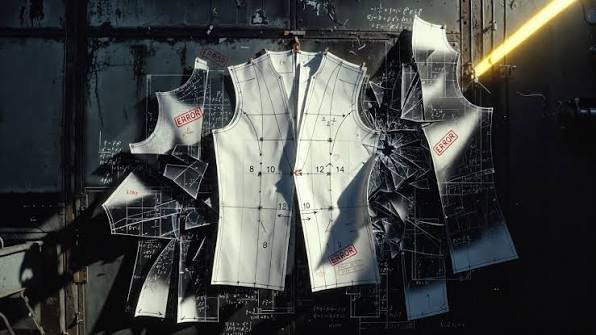
Conclusion: Bulk Production Should Confirm Your Product, Not Discover It
Most costly streetwear manufacturing mistakes are easier to prevent before bulk production than to repair afterwards.
Do not manufacture from vague instructions.
Do not choose fabric from GSM alone.
Do not define fit with one adjective.
Do not approve a sample because you are impatient to launch.
Do not select a manufacturer solely because the first unit price looks cheap.
Do not ignore UK labelling, product-safety and import responsibilities.
Do not lock too much startup capital into inventory without evidence.
And most importantly, do not start bulk production while the final product is still changing.
A strong first production run gives your streetwear startup more than inventory.
It gives you data.
You learn what customers buy, which sizes move, how they react to the fit, whether the product justifies its retail price and whether the garment deserves a larger reorder.
That is the foundation of a more sustainable manufacturing relationship.
Ready to Develop Your UK Streetwear Product Before Going Bulk?
If you are developing custom hoodies, oversized T-shirts, sweatshirts, joggers, matching sets or other private-label streetwear, discuss your specifications with Elahi Vertex International before committing to a larger production run.
Send:
- Product/design reference
- Intended quantity
- Fabric or GSM preference if known
- Size requirements
- Colours
- Printing or embroidery requirements
- Branding requirements
- UK delivery postcode
- Target timeline
Elahi Vertex International’s starting MOQ is 20 pieces per product/category, allowing suitable brands to begin with a controlled production quantity before considering larger reorders.
Develop the product. Approve the sample. Control the specifications. Then scale what actually works.
Avoiding streetwear manufacturing mistakes starts before a UK startup sends its first bulk-production payment. Strong UK streetwear manufacturing depends on clear product specifications, realistic sampling, measurable fit standards, appropriate fabric selection and a documented production reference. A professional streetwear manufacturer UK buyers source from domestically or internationally should be evaluated on more than price alone.
For founders preparing for streetwear bulk production, the objective is not simply to get garments manufactured. The objective is to develop a commercially viable product that can be reproduced consistently. Many clothing manufacturing mistakes happen because founders move from design concept to bulk manufacturing without creating enough technical control between those stages.
Brands that need made-to-specification production can review Elahi Vertex International’s custom clothing manufacturing service before comparing manufacturing options.
STARTING WITHOUT PROPER SPECIFICATIONS
Poor specifications are among the most preventable streetwear manufacturing mistakes. In UK streetwear manufacturing, visual references should support technical information rather than replace it. A manufacturer needs enough information to understand what the finished garment is expected to be.
Startups preparing for streetwear bulk production should document measurements, fabric requirements, artwork dimensions, branding, colours, trims and packaging before final approval. This reduces interpretation during manufacturing and creates a stronger reference if corrections become necessary.
Brands that already have finished designs and specifications can also review the OEM clothing manufacturing process offered by Elahi Vertex International. OEM production is particularly relevant when the buyer controls the design and expects manufacturing to follow approved specifications.
Fabric misunderstanding causes many clothing manufacturing mistakes, especially when founders assume that a higher GSM automatically means higher quality.
For UK streetwear manufacturing, the right fabric depends on the product being developed. Heavyweight hoodies, oversized T-shirts, sweatshirts and joggers may require different combinations of composition, construction, GSM, finish and hand feel.
A reliable streetwear manufacturer UK brands evaluate should therefore be able to discuss the garment’s intended result rather than simply offering the highest available GSM.
Before streetwear bulk production, confirm the selected fabric against the physical sample whenever practical. Elahi Vertex International’s custom clothing manufacturing information explains how fabric selection forms part of the wider development process.
Oversized fit is one of the areas where streetwear manufacturing mistakes can become visible immediately to the final customer.
For a UK streetwear startup, a product may technically fit the labelled size while still failing to achieve the intended silhouette. Shoulder drop, body width, body length, sleeve dimensions and neckline construction can determine whether the garment actually looks like the product envisioned by the founder.
During streetwear bulk production, subjective instructions such as “make it more oversized” should therefore be replaced with measurable revisions.
This is particularly important when working with an overseas streetwear manufacturer UK brands are evaluating, because written measurements provide a clearer reference than subjective descriptions communicated across different teams.
Sampling is one of the strongest opportunities to prevent streetwear manufacturing mistakes before they spread across an entire order.
A UK startup should treat its sample as a development and approval tool rather than a marketing preview. Before approving streetwear bulk production, compare the garment against the agreed measurements, materials, artwork, construction and branding.
Elahi Vertex International’s How to Order process follows a sequence from design and fabric selection through specification confirmation, sampling and sample approval before production.
This type of staged process is valuable because many clothing manufacturing mistakes become considerably harder to resolve once cutting, printing, embroidery or assembly has started across the bulk quantity.
Price-only sourcing is one of the recurring streetwear manufacturing mistakes startups should avoid.
A low quotation can be commercially attractive, but UK streetwear manufacturing decisions should compare equivalent specifications. If one quotation includes a different fabric, decoration method, branding package or shipping arrangement, the two prices are not directly comparable.
Before selecting a streetwear manufacturer UK founders should examine the sample, specifications, communication, MOQ, quality-control process and total cost alongside the quoted garment price.
Elahi Vertex International publishes its manufacturing capabilities, including OEM, ODM, private-label and cut-and-sew manufacturing, allowing potential buyers to examine the production model before discussing a project.
Branding should be incorporated into product development rather than added as an afterthought.
In UK streetwear manufacturing, neck labels, size labels, care information, hangtags and packaging can influence both product presentation and compliance considerations. Startups entering streetwear bulk production should therefore finalize the relevant branding files and information before approving production.
Elahi Vertex International’s private-label manufacturing service covers custom product requirements including branding, labels and packaging.
Private-label development can help reduce clothing manufacturing mistakes when the buyer clearly documents each branding component before bulk production.
Inventory risk is one reason startups should understand MOQ before committing to streetwear bulk production.
Ordering more garments does not automatically make a startup stronger. If demand has not been demonstrated, excessive stock can convert available cash into unsold sizes, colours and designs.
This is especially important for UK streetwear manufacturing, where a startup may be testing multiple products simultaneously.
Elahi Vertex International has published a detailed guide to low MOQ clothing manufacturing for London brands, explaining how smaller starting quantities can help brands test products while controlling inventory exposure.
Reducing quantity does not eliminate streetwear manufacturing mistakes, but it can limit the financial exposure of an early production decision.
International sourcing requires founders to think beyond the factory quotation.
A UK startup comparing a domestic streetwear manufacturer UK option against an overseas manufacturer should compare the commercial result after relevant logistics and import costs rather than simply comparing garment prices.
This matters because streetwear bulk production economics can change once freight and other applicable import costs are included.
One of the most common clothing manufacturing mistakes is calculating the target retail margin using only the factory price.
Before production, request enough information to estimate the realistic landed cost per unit.
Final approval is where the development phase should stop and controlled streetwear bulk production should begin.
Repeatedly changing artwork, measurements, labels or trims after approval increases confusion and creates avoidable streetwear manufacturing mistakes.
The final approved sample should be supported by documented specifications.
Elahi Vertex International’s published quality-control process covers fabrics and materials, measurements, stitching, construction, printing, embroidery, colours, labels, branding, finishing and final appearance.
Startups can also review the company’s detailed guide to custom clothing quality control, which discusses GSM, colour and size consistency during custom apparel manufacturing.
For UK streetwear manufacturing, this type of documented reference is especially valuable when production is being handled internationally.
How UK Streetwear Startups Can Reduce Manufacturing Risk
The easiest way to reduce streetwear manufacturing mistakes is to create checkpoints where mistakes can be discovered before more money is committed.
For UK streetwear manufacturing, a practical sequence is:
Concept → Tech Pack/Specifications → Supplier Evaluation → Sample → Fit Review → Corrections → Final Approval → Streetwear Bulk Production → Quality Inspection → Shipping → Customer Feedback → Reorder
Each stage should answer a different question.
The specification establishes what needs to be manufactured.
The sample shows whether those instructions produced the intended garment.
Final approval establishes the production reference.
Quality control checks whether finished production remains aligned with that reference.
This process cannot eliminate every manufacturing risk, but it reduces unnecessary clothing manufacturing mistakes caused by ambiguity.
UK buyers considering Elahi Vertex International can examine the company’s streetwear and apparel portfolio to understand the types of custom projects represented on the website.
They can also review the custom clothing manufacturing service for the broader production workflow and the OEM clothing manufacturing service when designs and specifications are already prepared.
Choosing a Streetwear Manufacturer: UK vs Overseas Production
Searching for a streetwear manufacturer UK startups can work with does not necessarily mean the production facility itself must be located in Britain.
The commercial question is:
Which manufacturing arrangement best fits the brand’s product, quantity, budget, quality requirements, communication needs and supply-chain strategy?
Domestic UK streetwear manufacturing can offer advantages for certain brands, including proximity and potentially simpler communication or logistics.
Overseas production may offer different manufacturing capabilities and commercial structures, but the buyer must account for international shipping, import procedures, communication and supplier verification.
Neither model is automatically superior.
Before streetwear bulk production, compare manufacturers using the same specification and evaluate:
- Sample quality
- Fabric suitability
- Fit accuracy
- Decoration quality
- MOQ
- Unit economics
- Branding capabilities
- Communication
- Quality-control process
- Shipping structure
- Landed cost
- Reorder capability
Choosing based only on geography can be another form of streetwear manufacturing mistakes.
Choose according to the complete manufacturing requirement.
Conclusion: Avoid Streetwear Manufacturing Mistakes Before Your Money Is Committed
Most serious streetwear manufacturing mistakes begin before bulk production, not after it.
For startups navigating UK streetwear manufacturing, the strongest protection is preparation: define the product, document the specifications, select the appropriate fabric, convert fit into measurements, inspect the sample and freeze the approved requirements.
Do not choose a streetwear manufacturer UK brands can access—or an overseas manufacturer—solely because the quotation looks inexpensive.
Compare what is actually being manufactured.
Before streetwear bulk production, understand your branding, quality requirements, quantity, shipping responsibility and expected landed cost.
These steps cannot remove every production risk, but they can prevent many avoidable clothing manufacturing mistakes.
Elahi Vertex International provides custom clothing manufacturing for international B2B buyers across streetwear, hoodies, sweatshirts and private-label apparel. Buyers can examine the company’s custom clothing manufacturing, quality control, portfolio, private-label manufacturing and OEM manufacturing information before discussing a project.
The objective of a startup’s first production run should not simply be to manufacture stock.
It should be to establish a product that customers want enough to reorder.
Specify carefully. Sample properly. Approve clearly. Produce deliberately. Scale from evidence.

Useful External Resources for UK Streetwear Startups
1. UK Textile Labelling Requirements
Before streetwear bulk production, UK startups should understand fibre-content labelling requirements. The official UK Government Textile Labelling Guidance explains the rules applicable to textile products sold in Great Britain.
External resource: UK Government — Textile Labelling Guidance
2. UK Product Safety Guidance
Avoiding streetwear manufacturing mistakes also means considering product safety before garments reach customers. The UK Office for Product Safety and Standards explains the responsibilities of businesses that manufacture, import, distribute or sell consumer products.
External resource: UK Government — Product Safety Advice for Businesses
3. UK Product-Specific Safety Regulations
Different products can fall under different safety requirements. UK startups can use the government’s Product Safety A–Z Guidance to identify regulations that may apply to the products they intend to place on the UK market.
External resource: UK Government — Product Safety A–Z
4. Importing Clothing Into the UK
International UK streetwear manufacturing requires founders to understand the import process as well as production. The UK Government’s step-by-step import guidance covers customs declarations, commodity codes, valuation and other import considerations.
External resource: UK Government — Import Goods Into the UK
5. UK Trade Tariff
Before calculating the economics of streetwear bulk production, check the applicable commodity classification. The official UK Trade Tariff can be used to research commodity codes and applicable duty and VAT information.
External resource: UK Government — UK Trade Tariff
6. Finding the Correct Commodity Code
Garment construction and material can affect customs classification. HMRC’s commodity-code guidance explains how businesses can identify the appropriate classification for imported goods and why it matters for duty and VAT.
External resource: HMRC — Finding Commodity Codes
7. Understanding Customs Value
One of the important clothing manufacturing mistakes is calculating margins from factory price alone. HMRC explains how customs value is established when goods are imported into the UK.
External resource: HMRC — Customs Valuation Guidance
8. Transaction Value for Imported Goods
The purchase price can form the starting point for customs valuation under the transaction-value method, subject to applicable adjustments. UK streetwear startups importing production can review HMRC’s official explanation before estimating landed cost.
External resource: HMRC — Transaction Value Method
9. Import VAT and Landed Cost
Shipping and related expenses can influence the value used for import VAT calculations. HMRC provides dedicated guidance explaining how customs value is used when determining the VAT value of imported goods.
External resource: HMRC — Import VAT Valuation
10. Foreign-Currency Import Calculations
A UK startup paying an overseas manufacturer in another currency should understand how foreign-currency amounts are treated for customs valuation. HMRC explains the exchange-rate approach for invoices, freight and insurance expressed in foreign currencies.
External resource: HMRC — Customs Exchange Rates
11. ISO Clothing Body Measurements
Poor measurement communication is one of the most avoidable streetwear manufacturing mistakes. ISO 8559-1 provides standardized anthropometric definitions that can support clearer body-measurement terminology in clothing development.
External resource: International Organization for Standardization — ISO 8559-1
12. ISO Textile Colour-Fastness Principles
Colour consistency matters when developing streetwear for repeat production. ISO 105-A01 provides general principles for textile colour-fastness testing and explains the framework behind the associated test methods.
External resource: International Organization for Standardization — ISO 105-A01
13. Colour Fastness to Washing
Print and fabric colour should not be judged only when a sample is new. ISO 105-C06 describes methods for determining textile colour resistance to domestic and commercial laundering.
External resource: International Organization for Standardization — ISO 105-C06
14. Colour Fastness to Water
For startups evaluating fabric performance before streetwear bulk production, ISO 105-E01 provides a standardized method for determining the resistance of textile colour to water.
External resource: International Organization for Standardization — ISO 105-E01
15. Colour Fastness to Hot Pressing
Heat can matter during garment finishing and decoration processes. ISO 105-X11 addresses textile colour resistance to hot pressing under dry, damp or wet conditions depending on the intended end use.
External resource: International Organization for Standardization — ISO 105-X11
16. OEKO-TEX® STANDARD 100
Startups researching textile safety can review OEKO-TEX® STANDARD 100, which covers testing textile products for harmful substances from yarn through finished articles. Certification should never be assumed unless the relevant material or product is actually certified.
External resource: OEKO-TEX® — STANDARD 100
17. Textile Material Market Research
Fabric selection should go beyond appearance and GSM. Textile Exchange’s Materials Market Report 2025 provides industry-level information about global fibre production and material trends relevant to sourcing decisions.
External resource: Textile Exchange — Materials Market Report 2025
18. Better Cotton Standard
UK brands researching cotton sourcing can review the Better Cotton Principles and Criteria, which define Better Cotton’s farm-level environmental, social and economic requirements. Claims should only be made when the applicable sourcing requirements are actually satisfied.
External resource: Better Cotton — Principles and Criteria
19. Better Cotton Sourcing and Traceability
Brands considering Better Cotton should also understand its sourcing system rather than using sustainability terminology loosely. Better Cotton explains its Chain of Custody models and sourcing approaches for textile and apparel organizations.
External resource: Better Cotton — Cotton Sourcing
20. Unsafe or Non-Compliant Product Responsibilities
Quality control does not end when garments leave the factory. UK Government guidance explains business notification responsibilities when products supplied to the UK market are found to pose safety risks or fail relevant compliance requirements.
External resource: UK Government — Unsafe and Non-Compliant Product Guidance
Recommended Reading Before Your First Bulk Order
These external resources should not make a startup’s sourcing process unnecessarily complicated. Their purpose is to help founders avoid streetwear manufacturing mistakes by making better decisions about specifications, textile performance, product safety, labelling, importing and landed cost before streetwear bulk production begins.
For UK streetwear manufacturing, combine authoritative regulatory guidance with a properly developed tech pack, physical sampling, measurable fit standards and documented production approval. Whether choosing a domestic streetwear manufacturer UK brands can visit locally or working with an international supplier, informed sourcing reduces preventable clothing manufacturing mistakes.
Essential UK Resources Before Streetwear Bulk Production
UK streetwear startups should check official UK textile labelling guidance before approving labels for bulk production. The guidance explains fibre-content labelling requirements for textile products sold in Great Britain.
When importing garments from an overseas manufacturer, use the official UK Government import process to understand customs declarations, commodity codes, valuation, duty and VAT considerations before calculating your landed cost.
Before streetwear bulk production, UK brands can also check the UK Trade Tariff to identify relevant commodity codes and investigate applicable Customs Duty and VAT. Correct classification matters when calculating the real cost of imported clothing.
UK Streetwear Startups
1. UK Textile Labelling Requirements
Before streetwear bulk production, UK startups should understand fibre-content labelling requirements. The official UK Government Textile Labelling Guidance explains the rules applicable to textile products sold in Great Britain.
External resource: UK Government — Textile Labelling Guidance
2. UK Product Safety Guidance
Avoiding streetwear manufacturing mistakes also means considering product safety before garments reach customers. The UK Office for Product Safety and Standards explains the responsibilities of businesses that manufacture, import, distribute or sell consumer products.
External resource: UK Government — Product Safety Advice for Businesses
3. UK Product-Specific Safety Regulations
Different products can fall under different safety requirements. UK startups can use the government’s Product Safety A–Z Guidance to identify regulations that may apply to the products they intend to place on the UK market.
External resource: UK Government — Product Safety A–Z
4. Importing Clothing Into the UK
International UK streetwear manufacturing requires founders to understand the import process as well as production. The UK Government’s step-by-step import guidance covers customs declarations, commodity codes, valuation and other import considerations.
External resource: UK Government — Import Goods Into the UK
5. UK Trade Tariff
Before calculating the economics of streetwear bulk production, check the applicable commodity classification. The official UK Trade Tariff can be used to research commodity codes and applicable duty and VAT information.
External resource: UK Government — UK Trade Tariff
6. Finding the Correct Commodity Code
Garment construction and material can affect customs classification. HMRC’s commodity-code guidance explains how businesses can identify the appropriate classification for imported goods and why it matters for duty and VAT.
External resource: HMRC — Finding Commodity Codes
7. Understanding Customs Value
One of the important clothing manufacturing mistakes is calculating margins from factory price alone. HMRC explains how customs value is established when goods are imported into the UK.
External resource: HMRC — Customs Valuation Guidance
8. Transaction Value for Imported Goods
The purchase price can form the starting point for customs valuation under the transaction-value method, subject to applicable adjustments. UK streetwear startups importing production can review HMRC’s official explanation before estimating landed cost.
External resource: HMRC — Transaction Value Method
9. Import VAT and Landed Cost
Shipping and related expenses can influence the value used for import VAT calculations. HMRC provides dedicated guidance explaining how customs value is used when determining the VAT value of imported goods.
External resource: HMRC — Import VAT Valuation
10. Foreign-Currency Import Calculations
A UK startup paying an overseas manufacturer in another currency should understand how foreign-currency amounts are treated for customs valuation. HMRC explains the exchange-rate approach for invoices, freight and insurance expressed in foreign currencies.
External resource: HMRC — Customs Exchange Rates
11. ISO Clothing Body Measurements
Poor measurement communication is one of the most avoidable streetwear manufacturing mistakes. ISO 8559-1 provides standardized anthropometric definitions that can support clearer body-measurement terminology in clothing development.
External resource: International Organization for Standardization — ISO 8559-1
12. ISO Textile Colour-Fastness Principles
Colour consistency matters when developing streetwear for repeat production. ISO 105-A01 provides general principles for textile colour-fastness testing and explains the framework behind the associated test methods.
External resource: International Organization for Standardization — ISO 105-A01
13. Colour Fastness to Washing
Print and fabric colour should not be judged only when a sample is new. ISO 105-C06 describes methods for determining textile colour resistance to domestic and commercial laundering.
External resource: International Organization for Standardization — ISO 105-C06
14. Colour Fastness to Water
For startups evaluating fabric performance before streetwear bulk production, ISO 105-E01 provides a standardized method for determining the resistance of textile colour to water.
External resource: International Organization for Standardization — ISO 105-E01
15. Colour Fastness to Hot Pressing
Heat can matter during garment finishing and decoration processes. ISO 105-X11 addresses textile colour resistance to hot pressing under dry, damp or wet conditions depending on the intended end use.
External resource: International Organization for Standardization — ISO 105-X11
16. OEKO-TEX® STANDARD 100
Startups researching textile safety can review OEKO-TEX® STANDARD 100, which covers testing textile products for harmful substances from yarn through finished articles. Certification should never be assumed unless the relevant material or product is actually certified.
External resource: OEKO-TEX® — STANDARD 100
17. Textile Material Market Research
Fabric selection should go beyond appearance and GSM. Textile Exchange’s Materials Market Report 2025 provides industry-level information about global fibre production and material trends relevant to sourcing decisions.
External resource: Textile Exchange — Materials Market Report 2025
18. Better Cotton Standard
UK brands researching cotton sourcing can review the Better Cotton Principles and Criteria, which define Better Cotton’s farm-level environmental, social and economic requirements. Claims should only be made when the applicable sourcing requirements are actually satisfied.
External resource: Better Cotton — Principles and Criteria
19. Better Cotton Sourcing and Traceability
Brands considering Better Cotton should also understand its sourcing system rather than using sustainability terminology loosely. Better Cotton explains its Chain of Custody models and sourcing approaches for textile and apparel organizations.
External resource: Better Cotton — Cotton Sourcing
20. Unsafe or Non-Compliant Product Responsibilities
Quality control does not end when garments leave the factory. UK Government guidance explains business notification responsibilities when products supplied to the UK market are found to pose safety risks or fail relevant compliance requirements.
External resource: UK Government — Unsafe and Non-Compliant Product Guidance
Recommended Reading Before Your First Bulk Order
These external resources should not make a startup’s sourcing process unnecessarily complicated. Their purpose is to help founders avoid streetwear manufacturing mistakes by making better decisions about specifications, textile performance, product safety, labelling, importing and landed cost before streetwear bulk production begins.
For UK streetwear manufacturing, combine authoritative regulatory guidance with a properly developed tech pack, physical sampling, measurable fit standards and documented production approval. Whether choosing a domestic streetwear manufacturer UK brands can visit locally or working with an international supplier, informed sourcing reduces preventable clothing manufacturing mistakes.

Ready to Start Streetwear Production Without the Expensive Mistakes?
A strong streetwear collection starts long before bulk production. It starts with clear specifications, the right fabric, accurate sizing, an approved sample and a manufacturer that understands what your brand is trying to build.
If you’re launching or growing a UK streetwear brand, Elahi Vertex International can help you move from concept and specifications to sampling and custom production with a clear B2B manufacturing process.
Before making a decision, explore our Custom Clothing Manufacturing service to understand how we handle made-to-order apparel development.
Building hoodies, sweatshirts, oversized T-shirts, joggers or matching streetwear sets? Review our Manufacturing Capabilities and see examples of previous apparel development in our Streetwear & Apparel Portfolio.
Already have your designs, measurements and technical specifications prepared? Our OEM Clothing Manufacturing service is designed for brands that want production developed around their own specifications.
If you need your own labels, branding and packaging, explore our Private Label Manufacturing capabilities before finalising your collection.
Quality should also be checked before scaling. See our Quality Control Process and our guide to Custom Clothing Quality Control to understand the checkpoints that matter between sampling and bulk production.
For startups concerned about committing too much capital to their first collection, read our guide to Low MOQ Clothing Manufacturing for London Brands and consider starting with a controlled quantity before scaling successful products.
Your Next Step
Don’t let preventable streetwear manufacturing mistakes consume the budget that should be growing your brand.
Send Elahi Vertex International your product reference, tech pack or design, required quantity, fabric preference, branding requirements and delivery destination. We can review the project requirements and discuss the appropriate next step.
See How to Order → Contact Elahi Vertex International
Start carefully. Approve confidently. Scale what works.