

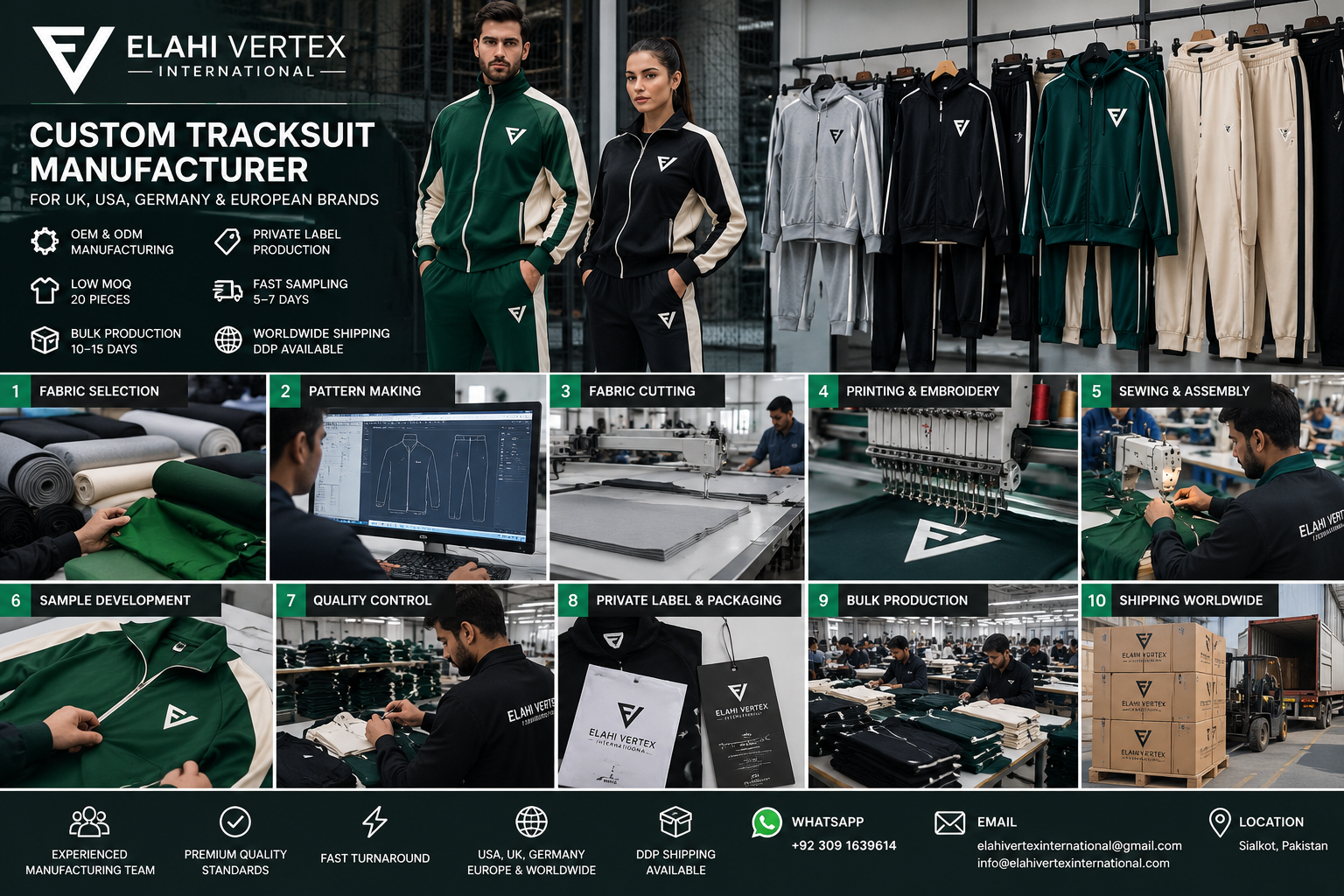
Choosing a custom tracksuit manufacturer is not simply a matter of finding a factory that can sew a jacket and matching trousers. For streetwear brands, sportswear labels, private-label businesses, wholesalers and growing fashion companies, a tracksuit is a coordinated product system. Fabric weight, stretch, surface feel, pattern balance, jacket length, trouser shape, rib construction, zipper quality, embroidery, printing, labels, packaging and bulk consistency all influence whether the finished tracksuit feels genuinely premium.
That becomes even more important when sourcing internationally for the UK, USA, Germany and wider European market.
A brand may have excellent artwork but still receive a disappointing tracksuit if the fabric is wrong. A strong fabric can still produce a weak product if the pattern is poorly balanced. A perfect sample can become commercially useless if bulk production drifts away from the approved measurements, colours, trims or branding.
A capable custom tracksuit manufacturer therefore needs to understand the entire product—not just stitching.
Elahi Vertex International is a B2B custom clothing manufacturer, exporter, OEM, ODM and private-label manufacturing partner based in Sialkot, Pakistan. The manufacturing workflow covers product development, fabric sourcing, pattern development, sampling, customization, bulk production, quality control, packaging and preparation for international shipment.
For buyers developing streetwear, sportswear or private-label tracksuits, the objective should be clear:
Create one accurately specified product, approve it properly, reproduce it consistently in bulk and prepare it correctly for the destination market.
This guide explains nine manufacturing details that matter when selecting a custom tracksuit manufacturer, especially for brands sourcing for the United States, United Kingdom, Germany and Europe.
Table of Contents
- What Is a Custom Tracksuit Manufacturer?
- Fabric, Composition and GSM Selection
- Tracksuit Fit, Pattern Making and Sizing
- Jacket Construction and Premium Details
- Jogger and Trouser Construction
- Printing, Embroidery and Custom Decoration
- Private Label Tracksuit Manufacturing
- Sampling Before Bulk Production
- Bulk Production and Quality Control
- Packaging, DDP, DPD and International Shipping
- Custom Tracksuit Manufacturing for USA Brands
- Custom Tracksuit Manufacturing for UK Brands
- Custom Tracksuit Manufacturing for Germany
- Custom Tracksuit Manufacturing for European Brands
- Why Choose Elahi Vertex International?
- Custom Tracksuit RFQ Checklist
- Common Tracksuit Manufacturing Mistakes
- Frequently Asked Questions
- Conclusion and Request a Quote
What Is a Custom Tracksuit Manufacturer?
A custom tracksuit manufacturer produces tracksuits according to buyer-defined requirements rather than forcing a brand to select only from generic finished stock.
Depending on the project, those requirements can include:
- Fabric type
- Fabric composition
- GSM
- Colour
- Pantone reference
- Jacket silhouette
- Trouser silhouette
- Oversized or regular fit
- Pattern measurements
- Rib construction
- Cuffs
- Waistbands
- Drawcords
- Zippers
- Pockets
- Panels
- Piping
- Printing
- Embroidery
- Sublimation
- Reflective applications
- Labels
- Hangtags
- Packaging
- Size range
- Quantity
- Destination-market requirements
This distinction matters.
A generic supplier may show a finished tracksuit and ask the buyer which colour and logo they want.
A genuine custom tracksuit manufacturer should instead be able to work from a tech pack, reference garment, measurements, artwork or clearly developed product concept.
For established labels, this is typically an OEM manufacturing relationship: the buyer controls the product specification and the manufacturer produces according to the approved requirements.
For newer brands without a complete technical package, ODM-style product development may involve more assistance with fabric selection, construction, fit, decoration and production preparation.
A private label tracksuit manufacturer adds another commercial layer by integrating the buyer’s brand identity through custom labels, branding, hangtags and packaging.
The correct model depends on how developed the product already is.
Buyer takeaway: Do not begin by asking only, “How much is a tracksuit?” Begin by defining exactly what tracksuit you want manufactured.
1. Fabric, Composition and GSM Can Determine the Entire Tracksuit
[IMAGE 2 — PLACE AFTER THIS HEADING: REALISTIC FABRIC SELECTION AND GSM INSPECTION]
The first major decision for any custom tracksuit manufacturer project is fabric.
Two tracksuits can look nearly identical in a photograph while feeling completely different when handled. Fabric composition, weight, knit structure, surface finish, stretch, recovery and inner construction all affect the finished garment.
Common Fabric Directions for Custom Tracksuits
Depending on the intended product, tracksuits may use:
| Fabric Direction | Typical Product Character | Buyer Consideration |
|---|---|---|
| Cotton-rich fleece | Soft, substantial, streetwear-focused | Weight, shrinkage, brushing and surface quality |
| French terry | Cleaner loop-back interior | Suitable for transitional or premium casual products |
| Cotton/polyester blend | Balance of comfort and stability | Exact ratio should be confirmed |
| Polyester interlock | Smooth athletic appearance | Useful for sports and training applications |
| Tricot | Traditional track-jacket character | Surface and structure matter |
| Performance polyester | Athletic and functional | Stretch, moisture handling and print method matter |
| Stretch blend | More movement and recovery | Elastane percentage and recovery should be tested |
| Heavyweight fleece | Structured premium streetwear | Pattern must account for fabric bulk |
There is no universal “best tracksuit fabric.”
The correct fabric depends on the product the brand is trying to sell.
A heavyweight streetwear tracksuit and a football training tracksuit solve completely different problems.
Heavyweight Streetwear Tracksuits
A heavyweight tracksuit usually needs enough body to maintain the intended silhouette. If the brand wants an oversized jacket, wide-leg trousers or a structured premium look, a fabric that is too light may collapse instead of holding the shape.
But heavier does not automatically mean better.
Increasing GSM without considering drape, breathability, softness and seasonality can create a garment that feels impressive in the hand but uncomfortable in actual use.
A professional custom streetwear tracksuit manufacturer should therefore consider GSM together with:
- Fibre composition
- Knit construction
- Surface finish
- Interior finish
- Stretch
- Recovery
- Shrinkage
- Pattern
- Intended season
- Target retail positioning
French Terry Tracksuits
French terry can work particularly well when a brand wants a substantial cotton-rich feel without the same brushed interior associated with fleece.
The loop-back interior can provide a cleaner construction for certain spring, autumn and transitional collections.
Performance Tracksuits
For teams, training collections and performance-oriented brands, polyester-based fabrics can make more commercial sense.
The fabric can be selected around:
- Movement
- Weight
- Breathability
- Durability
- Sublimation compatibility
- Stretch
- Ease of care
This is why a custom tracksuit manufacturer should not quote a serious project purely from a photograph when fabric requirements remain unknown.
Why GSM Matters
GSM means grams per square metre.
It describes fabric weight, not overall fabric quality.
A higher GSM can contribute to a heavier garment, but it does not automatically guarantee better yarn, better knitting, better finishing or better durability.
A buyer should specify either:
- A target GSM;
- A commercially acceptable GSM range; or
- A reference fabric/garment whose hand feel and structure should be approximated.
The final GSM should be confirmed before production.
What Brands Should Ask Before Approving Tracksuit Fabric
Ask your custom tracksuit manufacturer:
- What is the exact fibre composition?
- What is the GSM?
- Is the GSM measured before or after finishing?
- Is the inside brushed or loop-back?
- Does the fabric contain elastane?
- How much stretch is expected?
- How does it recover?
- What shrinkage should be expected?
- Is the fabric suitable for the selected print method?
- Is it suitable for embroidery?
- Will the same fabric source be maintained for bulk production?
- How will colour be controlled?
A fabric swatch can answer some questions.
A finished sample answers many more.
Commercial rule: Approve the actual product construction, not only a fabric photograph.

2. Tracksuit Fit, Pattern Making and Sizing Must Be Engineered Before Bulk Production
A premium tracksuit can fail even when the fabric is excellent.
The reason is often fit.
Pattern making translates a design concept into actual garment geometry. This determines how the jacket sits on the shoulders, where the hem finishes, how the sleeves fall, how the trouser rises, how much room exists through the thigh and how the leg tapers or falls.
For a custom tracksuit manufacturer, pattern accuracy is one of the most important foundations of repeatable production.
Common Tracksuit Fit Directions
Brands may request:
- Regular fit
- Slim fit
- Athletic fit
- Relaxed fit
- Oversized fit
- Boxy jacket
- Cropped jacket
- Straight-leg trousers
- Tapered joggers
- Wide-leg trousers
- Stacked trousers
- Open-hem trousers
Each requires a different pattern strategy.
Oversized Does Not Mean “Use a Bigger Size”
This is a common streetwear mistake.
Taking a normal medium and simply grading everything larger does not necessarily create a deliberate oversized fit.
An oversized product may require controlled changes to:
- Shoulder width
- Chest
- Body length
- Sleeve width
- Sleeve length
- Armhole
- Cuff
- Trouser rise
- Seat
- Thigh
- Knee
- Leg opening
The result should look intentional.
A good custom streetwear tracksuit manufacturer should work from actual target measurements rather than vague descriptions such as “make it baggy.”
Build a Measurement Chart
Before sample approval, brands should establish a measurement specification.
Example Jacket Measurement Points
- Chest width
- Body length
- Shoulder width
- Sleeve length
- Bicep
- Cuff opening
- Bottom opening
- Hood height
- Hood width
- Pocket position
Example Trouser Measurement Points
- Waist relaxed
- Waist stretched
- Front rise
- Back rise
- Hip
- Thigh
- Knee
- Inseam
- Outseam
- Leg opening
The actual measurements depend on the design.
Size Grading
Once the base sample is approved, the pattern needs to be graded across the intended size range.
For example:
XS → S → M → L → XL → 2XL
A buyer should not assume every measurement increases by exactly the same amount.
Different garment areas can require different grade rules.
For brands selling internationally, this is particularly important because a generic “medium” is not a universal physical measurement.
Recommendation: Put actual garment measurements into the tech pack or approved size chart.
3. Premium Jacket Construction Requires More Than a Logo
[IMAGE 3 — PLACE AFTER THIS HEADING: TRACKSUIT JACKET CONSTRUCTION CLOSE-UP]
The jacket is usually the visual anchor of a tracksuit.
Small construction decisions can significantly change the perceived quality.
A custom tracksuit manufacturer should therefore clarify the jacket construction before cutting the sample.
Zip-Through Tracksuit Jackets
A zip-through design may require decisions about:
- Main zipper type
- Zipper gauge
- Metal vs moulded zipper
- One-way vs two-way zipper
- Custom zipper pull
- Zipper colour
- Zipper tape
- Internal zipper guard
- Collar construction
- Hood construction
- Pocket zipper
- Exposed vs concealed zipper
A cheap zipper can undermine an otherwise premium garment.
If custom hardware is required, this should be specified early because custom trims may affect cost, MOQ and production timing.
Collar Options
Tracksuit jackets may use:
- Stand collar
- Rib collar
- Funnel neck
- Hood
- Double-layer hood
- Panelled hood
The correct option depends on whether the product is positioned as athletic wear, retro sportswear, luxury streetwear or casual apparel.
Ribbing
Rib quality affects both appearance and recovery.
Brands should specify:
- Rib composition
- Rib weight
- Stretch
- Recovery
- Width
- Stripe design if applicable
- Colour matching
Poor rib recovery can make cuffs and waistbands look tired quickly.
Pockets
Options include:
- Welt pockets
- Side-seam pockets
- Zipped pockets
- Patch pockets
- Kangaroo-style construction
- Hidden internal pockets
Pocket placement should be part of the pattern—not guessed during sewing.
Panels and Piping
Contrast panels, shoulder panels, side panels and piping can turn a simple tracksuit into a distinctive branded product.
But every additional seam creates another construction variable.
The tech pack should define:
- Panel shape
- Panel measurements
- Colour
- Fabric
- Stitching
- Piping width
- Placement
This is especially important for colour-blocked tracksuits.
4. Jogger and Trouser Construction Can Make or Break the Set
Streetwear buyers often spend more time discussing the jacket, but trousers can cause just as many fit problems.
A strong custom tracksuit manufacturer should treat the lower garment as its own engineered product.
Waistband Construction
Possible approaches include:
- Elasticated waistband
- Elastic plus drawcord
- Internal drawcord
- External drawcord
- Rib waistband
- Encased elastic
Brands should specify drawcord:
- Material
- Thickness
- Colour
- Length
- Tip finish
- Eyelets
- Branded hardware if required
Tapered Joggers
For a classic jogger silhouette, the relationship between thigh, knee and leg opening is critical.
Too much taper can restrict movement.
Too little taper can make the product look shapeless.
Wide-Leg Tracksuit Trousers
Wide-leg silhouettes require different balance.
The designer should consider:
- Hip ease
- Thigh width
- Knee width
- Hem width
- Inseam
- Outseam
- Fabric drape
Heavy fabric combined with excessive width can create unnecessary bulk.
Open Hem vs Cuffed Hem
Cuffed hems produce a more traditional jogger look.
Open hems can support retro, football-inspired or contemporary streetwear styling.
Other possibilities include:
- Adjustable drawcord hem
- Zipped ankle
- Snap opening
- Elasticated hem
The construction should be selected before sample development.

5. Printing, Embroidery and Decoration Should Be Chosen for the Fabric and Design
[IMAGE 4 — PLACE AFTER THIS HEADING: PRINTING AND EMBROIDERY APPLICATION ON TRACKSUITS]
Branding is where many tracksuits become commercially distinctive.
But selecting a decoration method because it is fashionable is a mistake.
A custom tracksuit manufacturer should consider artwork, fabric, placement, quantity, durability expectations and desired surface effect before finalizing the technique.
Elahi Vertex International’s published manufacturing capabilities include sublimation, embroidery, screen printing, heat-transfer techniques and other custom branding processes. Project-specific suitability should be confirmed against the fabric and artwork.
Screen Printing
Screen printing can work well for:
- Logos
- Text
- Graphic artwork
- Larger production runs
- Streetwear graphics
The exact ink system and print setup should be selected according to the fabric and required finish.
DTF Printing
DTF can be useful for detailed multicolour artwork and lower-volume custom applications.
Brands should still evaluate:
- Hand feel
- Stretch
- Surface compatibility
- Placement
- Wash durability requirements
A sample test is preferable before bulk production.
DTG Printing
Direct-to-garment printing can be appropriate for certain cotton-rich products and artwork types.
It is not automatically the correct process for every polyester tracksuit.
Fabric composition matters.
Embroidery
Embroidery can create a premium dimensional appearance for:
- Chest logos
- Monograms
- Brand names
- Small artwork
- Badges
However, stitch density and backing should be appropriate for the fabric.
Heavy embroidery on lightweight fabric can distort the garment.
Puff Printing
Puff print creates raised texture and can be useful for streetwear branding.
The artwork needs to be designed with the process in mind.
Extremely fine details may not behave like standard flat printing.
Sublimation
Sublimation is particularly valuable for compatible polyester sportswear because the design can become part of the fabric rather than sitting as a heavy layer on top.
It can support:
- All-over graphics
- Gradients
- Team colours
- Repeating patterns
- Sponsor artwork
- Complex multicolour designs
A custom tracksuit manufacturer producing performance tracksuits should determine whether sublimation makes more sense than applying multiple separate logos after sewing.
Reflective and Flash-Reactive Applications
Reflective graphics can create a strong effect for modern streetwear.
Brands should specify:
- Daylight appearance
- Reflective behaviour
- Colour
- Placement
- Artwork size
- Desired surface
- Durability expectations
The application should be tested on the intended fabric.
Other Custom Branding Directions
Depending on the project, a brand may discuss:
- Silicone patches
- Rubber patches
- Woven patches
- Chenille
- Appliqué
- Tackle twill
- Embroidered badges
- Custom zipper pulls
- Branded drawcord tips
- Woven labels
- Printed labels
- Hangtags
A good private label tracksuit manufacturer coordinates these elements as one product system.
6. Private Label Tracksuit Manufacturing Should Build the Brand Into the Garment
Private label is more than putting a logo on a blank tracksuit.
A proper private label tracksuit manufacturer should help translate the buyer’s identity into the finished product.
This can include:
- Custom neck labels
- Woven brand labels
- Size labels
- Care labels
- Country-of-origin information
- Hangtags
- Logo embroidery
- Printed branding
- Custom zipper pulls
- Custom drawcords
- Branded patches
- Custom packaging
- Size stickers
- Product identification
- Carton markings
Woven Labels
Woven labels can create a clean premium presentation.
The brand should confirm:
- Label dimensions
- Fold type
- Background colour
- Logo colour
- Placement
Care Labels
Care labels should not be treated as an afterthought.
The final information depends on the garment composition, care requirements and destination market.
For U.S. products, applicable textile and care-labelling requirements need to be considered.
For UK and EU markets, fibre-composition requirements also need attention.
The importer/brand should verify its legal obligations for the destination market before final production.
A hangtag may contain:
- Brand identity
- Product name
- Size
- Barcode
- SKU
- Collection information
- Website
- Price information
- Care messaging
The exact content is controlled by the brand.
Packaging
Private-label packaging options may include:
- Individual polybags
- Branded bags
- Size stickers
- Barcode labels
- Tissue
- Inserts
- Carton labels
Packaging should protect the product while matching the buyer’s fulfilment model.
A wholesale shipment to a distributor may require different preparation from a direct-to-consumer inventory delivery.
7. Sampling Is the Most Important Risk-Control Stage Before Bulk
[IMAGE 5 — PLACE AFTER THIS HEADING: TRACKSUIT SAMPLE INSPECTION]
A serious custom tracksuit manufacturer should not treat sampling as a ceremonial step.
The sample is the physical reference that connects the design specification to bulk production.
At Elahi Vertex International, the standard sample-production baseline is approximately 5–7 days after the necessary specifications and approvals are complete, although complex customization, special materials or custom tooling can change the timeline.
What Should Be Checked on a Tracksuit Sample?
Fabric
Confirm:
- Composition
- GSM
- Colour
- Surface
- Hand feel
- Stretch
- Interior
- Recovery
Fit
Check:
- Chest
- Length
- Shoulder
- Sleeve
- Waist
- Rise
- Hip
- Thigh
- Inseam
- Leg opening
Construction
Inspect:
- Seam quality
- Stitching
- Rib
- Waistband
- Pockets
- Zippers
- Drawcord
- Panels
- Hood/collar
Branding
Review:
- Print dimensions
- Embroidery dimensions
- Placement
- Colour
- Alignment
- Label position
- Hangtags
Overall Product
Ask:
Would you approve this exact product as the reference for your bulk order?
If the answer is no, revise the sample before bulk.
Sample Approval Should Be Written
Do not rely only on:
“Looks good.”
A stronger approval identifies the accepted:
- Fabric
- Colour
- Measurements
- Artwork
- Print method
- Embroidery
- Labels
- Trims
- Packaging
If any correction remains, document it.
Elahi Vertex International Sample Policy
The normal commercial baseline is:
- Buyer pays sample cost upfront.
- Buyer pays sample shipping separately.
- Where commercially agreed, the sample production cost may be credited toward a qualifying bulk order.
- Shipping remains separate and is not credited unless explicitly agreed otherwise.
The exact quotation should state the terms clearly.

8. Bulk Production Must Follow the Approved Reference
A beautiful sample does not prove that 20, 100 or 1,000 garments will automatically match it.
Bulk consistency is where manufacturing discipline becomes commercially important.
The objective should be simple:
Keep bulk production aligned as closely as practical with the approved sample and agreed specifications.
Elahi Vertex International’s published quality-control process includes checks relating to:
- Fabric and materials
- Measurements
- Stitching
- Garment construction
- Printing
- Embroidery
- Colours
- Labels and branding
- Finishing
- Final appearance
Before Cutting Bulk Fabric
Confirm:
- Final purchase order
- Final quantity
- Size breakdown
- Colour breakdown
- Approved fabric
- Approved colour
- Approved measurements
- Approved artwork
- Approved labels
- Approved trims
- Approved packaging
Changing specifications after bulk cutting has started can create cost, waste and production problems.
During Production
Quality control should not wait until the final carton is closed.
Relevant checks can occur during:
- Material preparation
- Cutting
- Sewing
- Printing/embroidery
- Assembly
- Finishing
- Measurement inspection
- Final inspection
- Packing
Measurement Consistency
A custom tracksuit manufacturer should work from the approved measurement specification.
Brands should agree tolerances where important rather than assuming absolute zero variation in sewn apparel.
Colour Consistency
Colour differences can result from:
- Fabric lots
- Dye lots
- Lighting
- Printing
- Sublimation
- Screen settings
- Photography
Physical approval references are more reliable than judging colour only through different phone screens.
Printing and Embroidery QC
Check:
- Position
- Dimensions
- Colour
- Alignment
- Stitch quality
- Print coverage
- Surface defects
Final Appearance
Before shipment, the finished tracksuits should be checked for issues such as:
- Loose threads
- Visible stains
- Construction defects
- Incorrect labels
- Incorrect sizing
- Missing branding
- Packaging mistakes
For brands, the most useful quality question is not simply “Did the factory inspect it?”
Ask:
What exactly is being checked against the approved specification?
9. Packaging, DDP, DPD and International Shipping Need to Be Defined Before the Order Leaves the Factory
[IMAGE 6 — PLACE AFTER THIS HEADING: EXPORT PACKING AND TRACKSUIT CARTONS]
Manufacturing is only part of an international order.
The commercial process also needs a clear shipping plan.
Elahi Vertex International prepares completed orders for international shipment and works with buyers on export arrangements according to the project and destination.
Possible logistics structures can include:
- Express courier
- Air freight
- Sea freight
- Door-to-door service
- DDP where quoted and commercially available
- DAP or other agreed Incoterms
- Direct shipment
- Buyer-appointed forwarder
- Other destination-specific arrangements
What Does DDP Mean?
DDP means Delivered Duty Paid.
Under a DDP arrangement, the seller takes extensive responsibility for delivering the goods to the named destination, including import-related obligations defined by the applicable Incoterm arrangement.
The exact quotation should identify:
- Destination
- Shipping method
- Whether duties are included
- Whether taxes are included
- Any exclusions
- Delivery responsibility
Never assume that a garment unit price automatically includes DDP.
DPD Is Different From DDP
These terms are sometimes confused.
DDP is a commercial delivery term.
DPD is a parcel/logistics network.
A shipment might potentially move through DPD depending on the route and logistics provider, but “DPD” does not describe who pays import duties.
Straight/Direct Shipping
Some buyers prefer inventory to travel directly from the manufacturer to their warehouse, fulfilment centre or commercial address.
This can reduce unnecessary handling, but the receiving requirements need to be confirmed.
For example:
- Carton dimensions
- Carton labels
- SKU labels
- Barcode requirements
- Delivery appointment
- Warehouse instructions
Fast Turnaround
Elahi Vertex International’s standard bulk-production baseline is approximately 10–15 days after final sample approval and confirmation of production requirements for suitable projects.
Urgent orders can be assessed separately and production may be prioritized where capacity, materials, customization and quantity allow.
That is different from promising an unrealistic universal turnaround.
Complex embroidery, custom trims, specialty fabrics, very large orders, tooling, buyer revisions and logistics can affect timing.
For brands operating internationally, the best approach is:
Confirm the production schedule and shipping schedule separately.
Custom Tracksuit Manufacturer for USA Brands
The United States is an important market for streetwear, sportswear, team apparel, fitness clothing and private-label products. American buyers evaluating an overseas custom tracksuit manufacturer should focus on product specification first: fabric composition, GSM, fit, measurements, branding, size range, packaging and order quantity.
A U.S. brand should also plan labelling before bulk production. Textile products sold in the United States can be subject to Federal Trade Commission requirements concerning fibre content, country of origin and responsible business identification, while apparel care instructions are covered by the Care Labeling Rule. Importers should verify the requirements that apply to their particular products.
For startup brands, the objective should not be to order the largest quantity possible. The better objective is to validate the correct product and then create a repeatable manufacturing system. Elahi Vertex International’s standard MOQ is 20 pieces per product/category, which can make controlled product development more practical for smaller brands.
Established U.S. brands can use the same manufacturing process at a different commercial scale: detailed tech pack, approved sample, confirmed bulk specification, QC, packaging and shipping. The manufacturing discipline should not disappear simply because the quantity increases.
If you are sourcing tracksuits for New York, Los Angeles, Miami, Chicago, Houston or another U.S. market, send the design, target quantity, fabric/GSM requirement, size range, branding details and delivery ZIP code when requesting a quotation. That gives the manufacturer enough information to discuss both production and shipping intelligently.
Custom Tracksuit Manufacturer for UK Brands
UK streetwear has strong demand for coordinated sets, heavyweight casualwear, football-influenced fashion, performance apparel and private-label collections.
A UK buyer searching for a custom tracksuit manufacturer should decide whether the product is primarily streetwear, sportswear, lifestyle apparel or performance wear before selecting the fabric.
For premium streetwear, fit and fabric hand feel can be more important than adding excessive decoration.
For sports applications, movement, weight, durability and branding method may take priority.
UK textile products are subject to fibre-content labelling requirements, so the brand/importer should prepare compliant label information before final production.
For a useful quotation, provide the UK delivery postcode together with the product specification. Shipping to London, Manchester, Birmingham, Glasgow or another location should be calculated against the actual shipment rather than guessed from garment price alone.
Custom Tracksuit Manufacturer for Germany
German brands sourcing internationally often benefit from a specification-first approach.
The more precisely a brand defines fabric, measurements, construction, trims, artwork, labels and packaging, the easier it becomes for a custom tracksuit manufacturer to reproduce the approved product consistently.
For German streetwear brands, private-label details can be incorporated during development rather than added at the end. Woven labels, care labels, hangtags, packaging, embroidery, printing and custom trims should form part of the approved specification.
Germany is part of the EU market, so relevant European textile labelling and product-safety responsibilities need to be considered by the economic operators placing products on the market.
Brands should also prepare destination and shipping requirements early so that production and logistics can be quoted separately and transparently.
A useful German RFQ should contain the product reference, quantity, size breakdown, fabric/GSM, branding, required delivery location and target schedule.
Custom Tracksuit Manufacturer for European Brands
Europe is not one uniform fashion market.
Streetwear buyers in France, Italy, the Netherlands, Belgium, Sweden, Spain and other European markets may target very different consumers.
The manufacturing principle remains consistent:
Define the product before comparing the price.
European textile products marketed to consumers are subject to fibre-composition labelling rules, and required information may need to be provided in the official language or languages of the country where the product is offered.
A European buyer working with a private label tracksuit manufacturer should therefore plan labels and market-specific information before bulk production.
The logistics arrangement should also identify the destination country, postcode, order volume and preferred delivery structure so the appropriate shipping option can be discussed.
Five Quick Market-Focused Manufacturing Notes
USA
For USA tracksuit orders, build the RFQ around fabric composition, GSM, exact fit, decoration, label requirements, quantity and delivery ZIP code. Do not wait until production is complete to consider fibre, origin and care-label information.
UK
UK streetwear brands should pay particular attention to fit, heavyweight fabric options, branding and fibre-content labels. Sampling is especially useful when the commercial value of the product depends heavily on hand feel and silhouette.
Germany
German buyers can reduce ambiguity by providing precise technical requirements, measurements, artwork dimensions, packaging instructions and EU-ready label information before sample approval.
European Union
EU buyers should coordinate textile fibre information, destination-language requirements and relevant product-safety responsibilities with their importer or responsible economic operator before products enter the market.
International / Worldwide
For international orders, manufacturing lead time and freight transit time should be treated separately. DDP, courier, air freight, sea freight and other arrangements depend on the destination, shipment size and agreed commercial terms.
Why Choose Elahi Vertex International as Your Custom Tracksuit Manufacturer?
[IMAGE 7 — PLACE AFTER THIS HEADING: REALISTIC TRACKSUIT MANUFACTURING TEAM]
A buyer does not need another manufacturer saying “premium quality” without explaining the process.
The more useful question is:
What parts of the product can the manufacturing partner actually help control?
Elahi Vertex International operates as a B2B custom clothing manufacturer, exporter, OEM supplier, ODM supplier and private-label manufacturing partner from Sialkot, Pakistan.
1. Product Development Around Your Requirements
Tracksuits can be developed around buyer-provided:
- Designs
- Reference images
- Tech packs
- Measurements
- Fabric requirements
- Branding
- Artwork
- Packaging specifications
The objective is not to force every brand into the same generic blank tracksuit.
2. Fabric Sourcing
Fabric can be selected according to:
- Intended use
- Weight
- Composition
- Appearance
- Comfort
- Structure
- Performance
- Budget
Final material specifications should be approved for the individual project.
3. Pattern Making
Patterns are developed around the required design and measurements.
This is particularly important for:
- Oversized tracksuits
- Boxy jackets
- Wide-leg trousers
- Tapered joggers
- Custom streetwear fits
4. Sampling
Sample development allows the buyer to review:
- Fabric
- Fit
- Construction
- Printing
- Embroidery
- Branding
- Trims
- Finishing
before bulk production.
5. Printing and Customization
Depending on fabric, artwork and project requirements, customization can include:
- Screen printing
- Heat transfer
- DTF
- DTG where suitable
- Sublimation
- Embroidery
- Puff print
- Reflective applications
- Patches
- Labels
- Other project-specific decoration
Suitability should be confirmed during development.
6. Private Label Manufacturing
Brand identity can be integrated through:
- Woven labels
- Size labels
- Care labels
- Hangtags
- Packaging
- Logos
- Custom artwork
- Branded trims
7. Quality-Focused Production
Quality checks can cover:
- Materials
- Measurements
- Stitching
- Construction
- Printing
- Embroidery
- Colours
- Labels
- Finishing
- Final appearance
8. MOQ of 20 Pieces
The standard MOQ is 20 pieces per product/category.
This can support both smaller brand launches and controlled initial production without forcing every buyer directly into a very large opening order.
9. Fast Sample Development
Standard sample production is approximately 5–7 days after approval of the necessary specifications, subject to product complexity and material availability.
10. Bulk Production
A typical baseline for suitable bulk projects is approximately 10–15 days after sample approval and final production confirmation.
Urgent production can be discussed where practical.
11. International Export Support
Orders can be prepared for buyers in:
- USA
- UK
- Germany
- Europe
- Canada
- Australia
- Other international destinations
Shipping is quoted according to the actual destination and order.
12. One Manufacturing Relationship From Development to Shipment
The objective is to keep product development connected:
Concept → specifications → fabric → pattern → sample → approval → bulk production → QC → packaging → shipment.
That continuity reduces the risk created when different suppliers work from different assumptions.
Nike and adidas: What Emerging Brands Can Learn From Established Tracksuit Categories
Large sportswear companies such as Nike and adidas demonstrate an important commercial principle: a tracksuit is not restricted to one customer or one use.
Tracksuits can sit across:
- Sportswear
- Football culture
- Training
- Lifestyle
- Streetwear
- Travel
- Athleisure
- Heritage fashion
The lesson for an emerging brand is not to copy Nike or adidas.
It is to define why your own tracksuit deserves to exist.
A custom collection can differentiate through:
- Fabric
- Fit
- Colour
- Panel construction
- Artwork
- Branding
- Embroidery
- Wash
- Trim
- Packaging
- Story
- Target customer
Your custom tracksuit manufacturer should execute your product identity—not reproduce another brand’s protected design.
Custom Tracksuit RFQ Checklist
Before contacting a custom tracksuit manufacturer, prepare as much of the following information as possible.
Product
- Jacket style
- Trouser style
- Men’s/women’s/unisex
- Streetwear/sportswear/performance use
Fabric
- Composition
- GSM
- Finish
- Stretch
- Colour
Fit
- Regular
- Slim
- Oversized
- Boxy
- Relaxed
- Wide leg
- Tapered
Measurements
- Size chart
- Base size
- Grade rules if available
Artwork
- Logo
- Print artwork
- Embroidery artwork
- Placement
- Dimensions
- Colours
Branding
- Neck label
- Size label
- Care label
- Hangtag
- Patch
- Custom hardware
Packaging
- Individual bag
- Branded bag
- Barcode
- SKU sticker
- Carton requirements
Commercial Information
- Quantity
- Size breakdown
- Colour breakdown
- Destination
- Target date
The better the RFQ, the more meaningful the quotation.

Common Custom Tracksuit Manufacturing Mistakes
1. Comparing Prices Before Comparing Specifications
A $20 tracksuit and a $35 tracksuit may not be the same product.
Fabric, GSM, zipper, pattern, decoration, labels and packaging can all change the cost.
2. Selecting Fabric Only From a Photograph
Photographs cannot communicate exact weight, softness, stretch or interior construction.
3. Saying “Oversized” Without Measurements
Give measurable fit requirements.
4. Skipping a Physical Sample
This transfers product-development risk into bulk production.
5. Approving Artwork Without Dimensions
A logo should have defined width, height and placement.
6. Ignoring Labels Until the End
Destination-market information should be planned early.
7. Changing Specifications During Bulk Production
Finalize the product before cutting.
8. Choosing Printing Without Considering Fabric
Decoration must be compatible with the substrate.
9. Treating DDP and DPD as the Same Thing
They are completely different concepts.
Frequently Asked Questions About a Custom Tracksuit Manufacturer
1. What is a custom tracksuit manufacturer?
A custom tracksuit manufacturer develops and produces tracksuits according to buyer-defined specifications such as fabric, GSM, fit, colour, printing, embroidery, labels, trims, packaging and sizing.
2. What is the MOQ for custom tracksuits at Elahi Vertex International?
The standard MOQ is 20 pieces per product/category.
3. Can a startup order custom tracksuits?
Yes. A controlled initial quantity can help a startup test its product before committing to larger repeat production.
4. Can I order one tracksuit sample first?
A physical sample can be developed before bulk production so the product can be evaluated.
5. How long does a tracksuit sample take?
The normal production baseline is approximately 5–7 days after the required specifications and approvals are complete. Complex projects may require additional time.
6. How long does bulk tracksuit production take?
A normal baseline for suitable projects is approximately 10–15 days after sample approval and final production confirmation. Quantity, materials and customization can affect the schedule.
7. Can urgent tracksuit orders be produced?
Urgent orders can be assessed according to quantity, fabric availability, customization and current production capacity.
8. Can Elahi Vertex International manufacture private-label tracksuits?
Yes. Private-label manufacturing can incorporate buyer branding, labels, hangtags, artwork and packaging.
9. What is an OEM tracksuit manufacturer?
An OEM tracksuit manufacturer produces according to specifications supplied or approved by the buyer.
10. What is ODM tracksuit manufacturing?
ODM manufacturing can involve additional product-development support when the buyer begins with an idea or reference rather than a fully completed production specification.
11. Can you manufacture oversized tracksuits?
Tracksuits can be developed around custom measurements and fit requirements, including oversized silhouettes.
12. Can you manufacture heavyweight tracksuits?
Fabric weight can be selected according to the intended product. Exact GSM and composition should be confirmed during development.
13. What GSM is best for a streetwear tracksuit?
There is no universal best GSM. Season, structure, fit, composition and target hand feel should determine the specification.
14. Can you manufacture cotton tracksuits?
Cotton-rich fabric options can be discussed according to the required product.
15. Can you manufacture polyester tracksuits?
Polyester fabrics are commonly relevant for sportswear and performance tracksuits.
16. Can you manufacture French terry tracksuits?
French terry can be considered for appropriate streetwear and casualwear products.
17. Can you manufacture fleece tracksuits?
Brushed fleece and other fleece constructions can be discussed according to weight and composition requirements.
18. Can you make wide-leg tracksuit bottoms?
Yes, provided the required silhouette and measurements are defined.
19. Can you make tapered joggers?
Tapered joggers can be developed using the required thigh, knee and hem measurements.
20. Can you manufacture zip-up tracksuit jackets?
Yes. Zipper style, gauge, colour and other requirements should be specified.
21. Can tracksuits have two-way zippers?
A two-way zipper can be considered where appropriate to the design and sourcing requirements.
22. Can you add custom zipper pulls?
Custom hardware can be discussed. MOQ, tooling, cost and timing depend on the specific trim.
23. Can you embroider logos on tracksuits?
Yes. Elahi Vertex International’s published manufacturing capabilities include embroidery.
24. Can you screen print tracksuits?
Yes. Screen printing is among the published customization capabilities, subject to fabric and design suitability.
25. Can you use DTF on tracksuits?
DTF can be discussed for suitable fabrics and artwork. Testing the intended application is advisable.
26. Can you use DTG on tracksuits?
DTG may suit certain fabric compositions. It should not automatically be selected for every tracksuit.
27. Can you use sublimation on tracksuits?
Yes. Sublimation is particularly relevant to compatible polyester fabrics and all-over sportswear graphics.
28. Can you make puff-print tracksuits?
Puff applications can be discussed according to the artwork and fabric.
29. Can you produce reflective tracksuit graphics?
Reflective or flash-reactive applications can be discussed and should be tested on the intended fabric.
30. Can you add woven patches?
Patch options can be incorporated according to the design.
31. Can you make custom woven labels?
Private-label projects can include custom woven labels.
32. Can you make custom care labels?
Yes. The buyer should provide or approve information appropriate to the product and destination-market requirements.
Yes. Hangtag design and specifications can form part of the private-label package.
34. Can you provide custom packaging?
Packaging can be customized according to the project requirements.
35. Can you manufacture tracksuits for the USA?
Elahi Vertex International works with international B2B buyers and can prepare tracksuit orders for shipment to the United States.
36. Can you manufacture tracksuits for UK brands?
Yes. UK brands can submit custom product specifications and delivery details for quotation.
37. Can you manufacture tracksuits for Germany?
Yes. German buyers can develop custom tracksuits according to their required specifications and branding.
38. Can you manufacture tracksuits for European brands?
Yes. Orders can be prepared for European buyers, subject to project and shipping requirements.
39. Do USA tracksuits need labels?
Textile and apparel products sold in the United States can be subject to federal fibre-content, country-of-origin, responsible-company and care-labelling requirements. Buyers/importers should verify the rules applicable to their products.
40. Do UK tracksuits need fibre labels?
UK textile labelling rules generally require fibre-content information for applicable textile products.
41. Do EU tracksuits need fibre composition labels?
Applicable textile products marketed to EU consumers generally require fibre-composition labelling.
42. Can you ship tracksuits DDP?
DDP can be discussed where commercially and logistically available for the destination. It should be confirmed in the specific quotation.
43. What is DDP shipping?
DDP means Delivered Duty Paid, an Incoterm describing a delivery arrangement with extensive seller responsibilities to the named destination.
44. Is DPD the same as DDP?
No. DPD is a logistics/parcel network. DDP is an Incoterm.
45. Can tracksuits be shipped directly to my warehouse?
Direct delivery can be discussed according to the destination and receiving requirements.
46. Can you ship by air?
Air shipment can be considered according to the order size, destination, cost and required timeline.
47. Can you ship by sea?
Sea freight can be considered for appropriate larger shipments where the economics and timeline make sense.
48. Can I send a tech pack?
Yes. A tech pack is one of the strongest ways to communicate product specifications.
49. Can I send only reference images?
Reference images can help communicate a concept, but additional specifications are usually needed before accurate manufacturing.
50. Can you create a sample from my design?
Yes, once the required construction, fabric, measurements, artwork and other details are sufficiently defined.
51. Can I use my own size chart?
Yes. Custom measurements can be used as the basis for pattern and sample development.
52. Can you match a Pantone colour?
Pantone references can help communicate target colours, but the actual material and production colour should still be physically reviewed where colour accuracy is commercially important.
53. Can one tracksuit have embroidery and printing?
Multiple decoration methods can be combined where the fabric, artwork and construction permit.
54. Can I customize the jacket and trousers separately?
Yes. Each component can have its own construction, artwork and branding requirements while remaining part of a coordinated set.
55. Can I order multiple colours?
Colourways can be developed according to the project. Quantity implications should be confirmed before quotation.
56. Is the MOQ split automatically across colours?
No. Do not assume MOQ splits. The exact quantity structure should be confirmed for the specific project.
57. What information is needed for a tracksuit quotation?
Provide product design, fabric/GSM, quantity, sizes, colours, branding, artwork, packaging and delivery destination.
58. Should I approve a sample before bulk production?
For a genuinely custom product, physical sample approval is one of the strongest ways to reduce bulk-production risk.
59. What happens after sample approval?
The final bulk specifications, quantities, sizes, commercial terms and production requirements are confirmed before bulk manufacturing begins.
60. How is bulk quality checked?
Relevant checks can include fabric, measurements, stitching, construction, printing, embroidery, colour, labels, finishing and final appearance.
61. Can I reorder the same tracksuit later?
Repeat orders can use the approved specifications as the production reference, subject to material availability and any required updates.
62. Can you manufacture tracksuits for wholesale?
Yes. Wholesale and B2B tracksuit projects can be quoted according to specifications and quantity.
63. Can you manufacture tracksuits for streetwear brands?
Yes. Custom streetwear is one of Elahi Vertex International’s manufacturing categories.
64. Can you manufacture tracksuits for sports teams?
Tracksuits can also be developed for teams, clubs and sports organizations.
65. Can you manufacture tracksuits for gym brands?
Activewear and fitness businesses can develop tracksuits according to their product requirements.

Conclusion: Build the Product Before You Compare the Price
The best custom tracksuit manufacturer is not automatically the supplier offering the lowest unit price.
A commercially successful tracksuit depends on the interaction between:
Fabric + GSM + pattern + fit + construction + printing + embroidery + trims + labels + packaging + sampling + bulk quality control + shipping.
If one important specification remains undefined, two manufacturers may be quoting two completely different products.
For UK, USA, Germany and European streetwear brands, the strongest sourcing process is therefore specification-first.
Define the product.
Develop the sample.
Correct the details.
Approve the reference.
Then manufacture the bulk order around that approved standard.
Elahi Vertex International supports OEM, ODM, private-label and custom apparel manufacturing from Sialkot, Pakistan, with a standard MOQ of 20 pieces per product/category.
Whether you are developing an oversized heavyweight streetwear tracksuit, a clean private-label set, a performance tracksuit, a team tracksuit or a complete coordinated collection, start by sending the specifications that actually define the product.
Start Your Custom Tracksuit Project
Send Elahi Vertex International:
- Tracksuit design or reference
- Tech pack if available
- Fabric requirement
- Target GSM
- Quantity
- Colourways
- Size range
- Printing/embroidery artwork
- Labels and packaging requirements
- Delivery country
- Delivery postcode/ZIP code
- Target timeline
Elahi Vertex International
Where Brands Are Made.
WhatsApp / Phone: +92 309 1639614
Primary Email: elahivertexinternational@gmail.com
Secondary Email: info@elahivertexinternational.com
Location: Sialkot, Pakistan
For the fastest commercial assessment, send your design, quantity and destination together rather than asking only for a generic tracksuit price.
Custom Tracksuit Manufacturer
Choosing the right Custom Tracksuit Manufacturer starts with understanding the complete product rather than comparing only unit prices. A professional Custom Tracksuit Manufacturer should work around the required fabric, GSM, fit, pattern, stitching, printing, embroidery, trims, labels and packaging. For brands in the USA, UK, Germany and Europe, working with a Custom Tracksuit Manufacturer also means developing an approved sample that can become the reference for bulk production. Elahi Vertex International supports custom tracksuit development from specifications and sampling through manufacturing, quality control, packing and international shipment.
Private Label Tracksuit Manufacturer
A Private Label Tracksuit Manufacturer should help a brand create a product that carries its own identity rather than simply placing a logo on a generic garment. When working with a Private Label Tracksuit Manufacturer, buyers can specify woven labels, size labels, care labels, hangtags, custom printing, embroidery, trims and packaging. Elahi Vertex International works as a Private Label Tracksuit Manufacturer for brands that need their branding integrated during product development. A capable Private Label Tracksuit Manufacturer should coordinate these details with the approved fabric, fit and construction before bulk production begins.
Custom Streetwear Tracksuit Manufacturer
A Custom Streetwear Tracksuit Manufacturer needs to understand that streetwear fit is different from simply producing standard sportswear in larger sizes. A Custom Streetwear Tracksuit Manufacturer may need to develop oversized jackets, boxy silhouettes, heavyweight fabrics, wide-leg trousers, tapered joggers, custom panels and distinctive branding according to the collection. Brands working with a Custom Streetwear Tracksuit Manufacturer should define the intended silhouette through measurements and references before approving the sample. Elahi Vertex International supports brands looking for a Custom Streetwear Tracksuit Manufacturer for custom collections targeting the USA, UK, Germany and wider European market.
OEM Tracksuit Manufacturer
An OEM Tracksuit Manufacturer is particularly relevant when a brand already has its own design, tech pack, measurement chart, artwork and product specifications. A capable OEM Tracksuit Manufacturer should translate those approved requirements into patterns, samples and repeatable bulk production rather than changing the product without approval. When selecting an OEM Tracksuit Manufacturer, buyers should compare fabric control, sampling, construction, customization, quality control and communication alongside price. Elahi Vertex International works as an OEM Tracksuit Manufacturer for B2B buyers developing custom tracksuits according to their own product requirements.
International Tracksuit Manufacturing
For USA, UK, Germany and European buyers, a Custom Tracksuit Manufacturer should be evaluated on more than manufacturing cost. A Private Label Tracksuit Manufacturer must also understand branding and product presentation, while a Custom Streetwear Tracksuit Manufacturer needs strong control over fit, fabric and decoration. When detailed buyer specifications already exist, an OEM Tracksuit Manufacturer can work from those requirements toward sample approval and bulk production. Elahi Vertex International combines these manufacturing routes according to the individual project rather than forcing every buyer into the same tracksuit specification.

Recommended Internal Links for Custom Tracksuit Manufacturer Article
Use these internal links naturally throughout the article. Do not place all links together in one paragraph.
- Custom Clothing Manufacturing
https://elahivertexinternational.com/custom-clothing-manufacturing/
Placement: Introduction and custom manufacturing section.
Purpose: Connect the article with the main custom clothing manufacturing service. - Manufacturing Process
https://elahivertexinternational.com/manufacturing/
Placement: Manufacturing process and Why Choose Elahi Vertex International sections.
Purpose: Show buyers the wider manufacturing workflow. - OEM Clothing Manufacturing
https://elahivertexinternational.com/oem-clothing-manufacturing/
Placement: OEM tracksuit manufacturing section.
Purpose: Support buyers developing tracksuits from their own specifications, tech packs and designs. - Private Label Manufacturing
https://elahivertexinternational.com/private-label-manufacturing/
Placement: Private-label tracksuit section.
Purpose: Connect labels, branding, packaging and private-label development with the relevant service page. - Quality Control
https://elahivertexinternational.com/quality-control/
Placement: Bulk production and quality-control section.
Purpose: Give buyers a relevant page for manufacturing QC information. - How to Order Custom Clothing
https://elahivertexinternational.com/how-to/
Placement: Sampling, RFQ and ordering section.
Purpose: Move an interested buyer from research toward the ordering process. - Our Manufacturing Work
https://elahivertexinternational.com/our-works-elahi-vertex-international/
Placement: Why Choose Elahi Vertex International section.
Purpose: Give buyers access to manufacturing-related work and proof. - Custom Apparel Portfolio
https://elahivertexinternational.com/portfolio-elahi-vertex-international/
Placement: Manufacturing capability or Why Us section.
Purpose: Allow prospective buyers to explore related custom apparel work. - About Elahi Vertex International
https://elahivertexinternational.com/about-us/
Placement: Company introduction or Why Us section.
Purpose: Strengthen company/entity information and buyer trust. - Custom Soccer Track Suit
https://elahivertexinternational.com/product/custom-soccer-track-suit/
Placement: Sportswear and performance tracksuit section.
Purpose: Connect the guide to a directly related tracksuit product. - Custom Boxing Tracksuits
https://elahivertexinternational.com/product/boxing-tracksuits/
Placement: Teamwear and sports tracksuit discussion.
Purpose: Support the wider custom tracksuit manufacturing cluster. - Custom Sweatpants Manufacturer
https://elahivertexinternational.com/custom-sweatpants-manufacturer/
Placement: Jogger and tracksuit-bottom construction section.
Purpose: Build a semantic connection between tracksuit bottoms and custom sweatpants manufacturing. - Oversized Hoodie Manufacturer
https://elahivertexinternational.com/blog-oversized-hoodie-manufacturer/
Placement: Oversized tracksuit fit section.
Purpose: Support oversized and boxy streetwear-fit information. - Heavyweight Hoodie Manufacturer
https://elahivertexinternational.com/blog-heavyweight-hoodie-manufacturer/
Placement: Heavyweight fabric and GSM discussion.
Purpose: Strengthen the heavyweight streetwear manufacturing content cluster. - Zip-Up Hoodie Manufacturer
https://elahivertexinternational.com/blog-zip-up-hoodie-manufacturer/
Placement: Tracksuit jacket and zipper construction section.
Purpose: Connect readers with related zip-up garment manufacturing information. - Puff Print Hoodie Manufacturer
https://elahivertexinternational.com/blog-puff-print-hoodie-manufacturer/
Placement: Puff-print customization section.
Purpose: Support decoration and printing expertise. - Custom Hoodie Manufacturer USA
https://elahivertexinternational.com/blog-custom-hoodie-manufacturer-usa/
Placement: USA tracksuit manufacturing section.
Purpose: Strengthen the USA manufacturing content cluster. - Custom Hoodie Manufacturer Europe
https://elahivertexinternational.com/custom-hoodie-manufacturer-europe/
Placement: European tracksuit manufacturing section.
Purpose: Connect European buyers with related European sourcing information. - Clothing Manufacturer in Sialkot Pakistan
https://elahivertexinternational.com/clothing-manufacturer-sialkot-pakista/
Placement: Supplier verification and Why Choose Elahi Vertex International sections.
Purpose: Strengthen the relationship between Elahi Vertex International, Sialkot and custom apparel manufacturing. - Request a Custom Tracksuit Quote
https://elahivertexinternational.com/contact-us/
Placement: Final CTA and selected commercial sections.
Purpose: Move qualified readers toward an RFQ.
Recommended External Links and Authoritative References
External links should support specific statements rather than being added only for SEO. Place each relevant source naturally beside the information it supports.
USA — Textile, Apparel and Import Information
- Federal Trade Commission — Apparel Labeling
https://www.ftc.gov/news-events/topics/tools-consumers/apparel-labeling
Recommended anchor: U.S. apparel labeling requirements
Placement: USA tracksuit manufacturing section.
Purpose: Support information concerning textile and apparel labeling. - Federal Trade Commission — Care Labeling Rule
https://www.ftc.gov/legal-library/browse/rules/care-labeling-textile-wearing-apparel-certain-piece-goods-text
Recommended anchor: U.S. Care Labeling Rule
Placement: Private-label and care-label section.
Purpose: Authoritative reference for U.S. garment care-label requirements. - Federal Trade Commission — Clothing and Textiles
https://www.ftc.gov/business-guidance/industry/clothing-and-textiles
Recommended anchor: FTC clothing and textile guidance
Placement: USA compliance section.
Purpose: Give U.S. buyers access to official FTC business guidance. - Federal Trade Commission — Clothes Captioning Guide
https://www.ftc.gov/business-guidance/resources/clothes-captioning-complying-care-labeling-rule
Recommended anchor: complying with garment care labeling
Placement: Care-label section or FAQ.
Purpose: Additional practical guidance on the Care Labeling Rule. - Federal Trade Commission — Textile and Wool Labeling Guide
https://www.ftc.gov/business-guidance/resources/threading-your-way-through-labeling-requirements-under-textile-wool-acts
Recommended anchor: textile fibre and origin labeling
Placement: USA labels section.
Purpose: Support fibre-content and origin-labeling information. - Federal Trade Commission — Made in USA Standard
https://www.ftc.gov/business-guidance/resources/complying-made-usa-standard
Recommended anchor: U.S. country-of-origin guidance
Placement: Country-of-origin discussion.
Purpose: Help distinguish legitimate origin claims from manufacturing location.
UK — Textile and Import Information
- UK Government — Textile Labelling
https://www.gov.uk/guidance/textile-labelling
Recommended anchor: UK textile labelling requirements
Placement: UK tracksuit manufacturing section.
Purpose: Support UK fibre-content labelling information. - HMRC — Classifying Textile Apparel
https://www.gov.uk/guidance/classifying-textile-apparel
Recommended anchor: UK textile apparel classification
Placement: UK shipping/import section.
Purpose: Help buyers understand customs classification of apparel. - UK Government — Trade Tariff
https://www.gov.uk/trade-tariff
Recommended anchor: UK Trade Tariff
Placement: UK import preparation section.
Purpose: Allow importers to investigate commodity codes, duties and applicable import information. - UK Government — Standards and Regulatory Import Requirements
https://www.gov.uk/guidance/uk-standards-and-regulatory-import-requirements
Recommended anchor: UK product import requirements
Placement: UK buyer checklist.
Purpose: Provide an official government reference for import-related requirements.
Germany and European Union
- European Commission — Textile and Clothing Legislation
https://single-market-economy.ec.europa.eu/sectors/fashion/textiles-and-clothing-industries/legislation_en
Recommended anchor: EU textile product rules
Placement: Germany and European market sections.
Purpose: Authoritative European Commission reference for textile legislation. - Your Europe — Textile Label Requirements
https://europa.eu/youreurope/business/product-requirements/labels-markings/textile-label/index_en.htm
Recommended anchor: EU textile labelling rules
Placement: EU fibre-composition section.
Purpose: Explain textile-label requirements to brands selling within the EU. - European Commission — General Product Safety Regulation
https://commission.europa.eu/business-economy-euro/doing-business-eu/eu-product-safety-and-labelling/product-safety/general-product-safety-regulation_en
Recommended anchor: EU General Product Safety Regulation
Placement: European product-safety section.
Purpose: Provide an authoritative reference concerning general product-safety obligations. - EUR-Lex — Regulation (EU) No 1007/2011
https://eur-lex.europa.eu/eli/reg/2011/1007/oj
Recommended anchor: EU Textile Fibre Regulation
Placement: Technical textile-labelling discussion.
Purpose: Link directly to the relevant EU textile fibre regulation. - European Chemicals Agency — REACH
https://echa.europa.eu/regulations/reach/understanding-reach
Recommended anchor: EU REACH requirements
Placement: Materials and European compliance section.
Purpose: Give buyers an authoritative source concerning EU chemical regulation. - European Commission — Access2Markets
https://trade.ec.europa.eu/access-to-markets/en/home
Recommended anchor: EU import duties and product requirements
Placement: Germany/EU import-preparation section.
Purpose: Help buyers research tariffs, procedures and market-access information.
International Shipping and Trade
- International Chamber of Commerce — Incoterms Rules
https://iccwbo.org/business-solutions/incoterms-rules/
Recommended anchor: Incoterms rules
Placement: DDP shipping section.
Purpose: Authoritative reference for international commercial delivery terms. - World Customs Organization
https://www.wcoomd.org/
Recommended anchor: international customs classification
Placement: International shipping/customs section.
Purpose: Support discussion of international customs and Harmonized System classification.
Tracksuit Market References
- Nike — Tracksuits
https://www.nike.com/w/tracksuits-1ll2w
Recommended anchor: Nike tracksuit category
Placement: Market-reference section.
Purpose: Show how an established sportswear brand positions tracksuits across sportswear and lifestyle categories.
Important: Nike should be referenced only as a public market/product example. Never state or imply that Nike is a customer, partner or buyer of Elahi Vertex International.
- adidas — Tracksuits
https://www.adidas.com/us/track_suits
Recommended anchor: adidas tracksuit category
Placement: Market-reference section.
Purpose: Provide another established-market reference for coordinated tracksuit products.
Important: adidas should be referenced only as a public market/product example. Never state or imply that adidas has a manufacturing or commercial relationship with Elahi Vertex International.
Recommended Internal Linking Flow
For the strongest SEO and buyer-conversion structure, use this internal path throughout the article:
Custom Tracksuit Manufacturer Guide → Custom Clothing Manufacturing → OEM / Private Label Manufacturing → Related Tracksuit Product → Manufacturing Process → Quality Control → Manufacturing Work → Contact / RFQ
Do not force all 20 internal links into one section.
Spread them across relevant paragraphs using descriptive anchor text.
Recommended External Linking Flow
Use authoritative sources immediately beside the relevant factual claim.
For example:
Brands selling tracksuits in the United States should prepare required product information before bulk production. Applicable textile products can require fibre-content, country-of-origin and responsible-company identification, while garment care instructions are covered separately by the FTC Care Labeling Rule.
Reference:
https://www.ftc.gov/news-events/topics/tools-consumers/apparel-labeling
For UK buyers, textile fibre information should be prepared before production of final labels.
Reference:
https://www.gov.uk/guidance/textile-labelling
For Germany and other EU markets, brands should review applicable textile fibre labelling requirements and relevant EU product-safety obligations before placing products on the market.
For DDP and other international commercial delivery terms, use the International Chamber of Commerce as the primary authoritative reference.
Reference:
https://iccwbo.org/business-solutions/incoterms-rules/
SEO Rule for These 40 Links
Do not write:
“Click here.”
“Read more.”
“Visit this page.”
Use descriptive contextual anchors such as:
- custom clothing manufacturing
- OEM clothing manufacturing
- private label manufacturing
- tracksuit quality control
- custom sweatpants manufacturer
- heavyweight streetwear manufacturing
- USA apparel labeling requirements
- UK textile labelling requirements
- EU textile labelling rules
- Incoterms rules
- EU product safety requirements
- request a custom tracksuit quote
The purpose is to make every link understandable to the buyer, Google and AI search systems from the surrounding context.
Ready to Develop Your Custom Tracksuit Collection?
If you are searching for a Custom Tracksuit Manufacturer for your streetwear, sportswear or private-label brand, the next step is not another generic price comparison. Send us the actual product you want to manufacture.
Elahi Vertex International works with brands and B2B buyers developing custom tracksuits for the USA, UK, Germany, Europe and other international markets.
Whether you need an oversized heavyweight streetwear tracksuit, premium hoodie-and-jogger set, zip-up tracksuit, performance set, team tracksuit or completely custom private-label collection, we can discuss the project from development through production.
What We Can Develop for Your Brand
Depending on your design and fabric requirements, your custom tracksuit project can include:
- Custom fabric and GSM
- Cotton-rich fleece
- French terry
- Polyester and performance fabrics
- Oversized, regular, relaxed or custom fits
- Custom patterns and size grading
- Screen printing
- DTF printing
- DTG where suitable
- Sublimation
- Embroidery
- Puff printing
- Reflective / flash-reactive applications
- Custom patches
- Woven labels
- Size and care labels
- Custom hangtags
- Branded packaging
- Custom zippers, drawcords and trims
- Sample development
- Bulk manufacturing
- Quality control
- Export packing
- International shipping
- DDP where available for the destination
- Direct/straight shipment to the agreed destination
Our standard MOQ is 20 pieces per product/category.
Standard sample production is approximately 5–7 days after specifications and approvals are complete, subject to material availability and product complexity.
For suitable projects, standard bulk production is approximately 10–15 days after sample approval and final production confirmation. If you have an urgent launch or restock, tell us the required date so we can assess what is realistically possible.
See How We Manufacture Before You Order
Want to understand the production process first?
Explore our Custom Clothing Manufacturing service:
https://elahivertexinternational.com/custom-clothing-manufacturing/
See our Manufacturing Process:
https://elahivertexinternational.com/manufacturing/
Developing your own specifications or tech pack? Explore our OEM Clothing Manufacturing service:
https://elahivertexinternational.com/oem-clothing-manufacturing/
Building your own brand? Explore our Private Label Manufacturing service:
https://elahivertexinternational.com/private-label-manufacturing/
Want to understand how we approach production inspection? See our Quality Control Process:
https://elahivertexinternational.com/quality-control/
Want to see manufacturing-related work before discussing your order?
https://elahivertexinternational.com/our-works-elahi-vertex-international/
Ready to discuss your project?
https://elahivertexinternational.com/contact-us/
Get a Custom Tracksuit Quote
For a useful quotation, send us:
1. Your design, tech pack or reference images
2. Required quantity
3. Fabric composition or preferred GSM
4. Colours
5. Size range
6. Printing, embroidery or other branding requirements
7. Private-label and packaging requirements
8. Delivery country and postcode / ZIP code
9. Required delivery timeline
The more complete your specifications are, the more accurately we can evaluate the product, manufacturing method, sample requirements and shipping.
Contact Elahi Vertex International
Elahi Vertex International
Where Brands Are Made.
Website:
https://www.elahivertexinternational.com/
WhatsApp:
https://wa.me/message/OWIPAIXYWHTPI1
Phone / WhatsApp:
+92 309 1639614
Primary Email:
elahivertexinternational@gmail.com
Business Email:
info@elahivertexinternational.com
LinkedIn:
https://www.linkedin.com/company/elahi-vertex-international?trk=profile-position
Instagram:
https://www.instagram.com/elahivertex_mfg/
Facebook:
https://www.facebook.com/elahivertexinternational/
TikTok:
https://www.tiktok.com/@elahivertex_mfg
X:
https://x.com/elahivertex_mfg
Threads:
https://www.threads.com/@elahivertex_mfg
Manufacturing Base:
Sialkot, Pakistan
Start With the Product, Not a Generic Price
If you are comparing Custom Tracksuit Manufacturers, send the same specifications to every supplier. Compare the fabric, GSM, construction, customization, sample quality, bulk-production controls, shipping terms and communication—not just the lowest unit price.
If your priority is building a tracksuit that can become a repeat product for your brand, send your design and requirements to Elahi Vertex International.
Send your tracksuit design on WhatsApp today:
https://wa.me/message/OWIPAIXYWHTPI1
Or submit your requirements through our Contact / RFQ page:
https://elahivertexinternational.com/contact-us/

One thought on “Custom Tracksuit Manufacturer: 9 Powerful Custom Tracksuit Manufacturing Details for UK, USA, Germany & European Streetwear Brands”
Comments are closed.