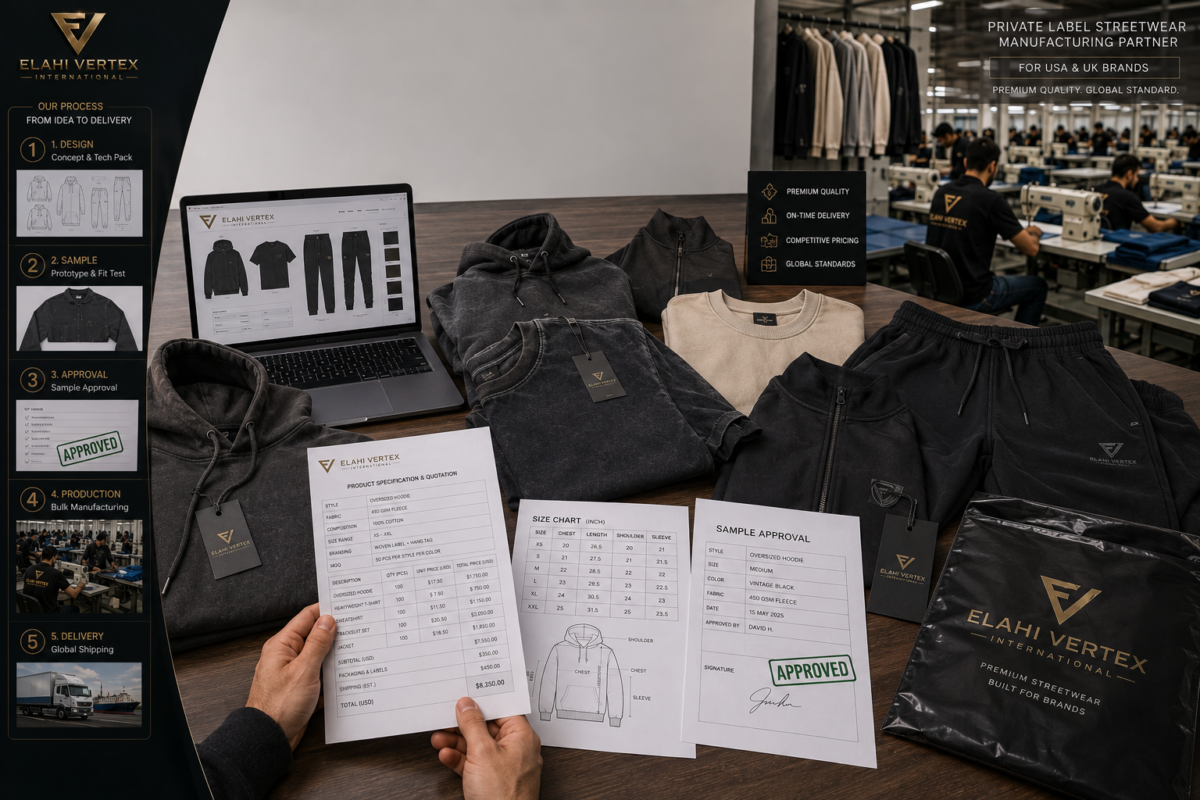

Finding the right private label hoodie manufacturer USA partner is an important decision for clothing brands, streetwear brands, startups, wholesalers, and e-commerce businesses.
A hoodie is not simply a blank garment with a logo added to it. Your supplier can influence fabric quality, fit, construction, branding, packaging, production consistency, communication, and ultimately your customer’s experience.
For U.S.-focused brands sourcing internationally, supplier selection also requires attention to apparel labeling and care-label requirements. The U.S. Federal Trade Commission provides specific guidance covering textile labeling and care instructions.
This guide explains how to choose a private label hoodie manufacturer USA supplier, what to ask before placing an order, how to compare quotations, and which mistakes to avoid.
Table of Contents
- What Is a Private Label Hoodie Manufacturer?
- Private Label vs. Custom Hoodie Manufacturing
- Why Choosing the Right Manufacturer Matters
- 10 Things to Check Before Choosing a Supplier
- What to Include in Your Hoodie RFQ
- How to Compare Hoodie Manufacturers
- U.S. Apparel Labeling Considerations
- The Private Label Hoodie Manufacturing Process
- Common Buyer Mistakes
- Private Label Hoodie Supplier Checklist
- Why Work With Elahi Vertex International?
- Frequently Asked Questions
- Final Thoughts
What Is a Private Label Hoodie Manufacturer?
A private label hoodie manufacturer produces hoodies that are sold under your brand name rather than the manufacturer’s consumer brand.
Depending on the manufacturing arrangement, private label production can include:
- Custom hoodie designs
- Fabric selection
- Custom colors
- Size specifications
- Custom measurements
- Logo application
- Printing
- Embroidery
- Woven labels
- Care labels
- Hangtags
- Packaging
- Other finishing requirements
The key difference is brand ownership and product specification.
Instead of selling a manufacturer’s existing consumer product, your business can develop or specify a hoodie that is produced for your brand.
However, private label does not automatically mean unlimited customization. Every manufacturer has different capabilities, materials, processes, MOQs, and production terms. These should be confirmed before you place an order.
Private Label vs. Custom Hoodie Manufacturing
These terms are often used together, but they can describe different levels of customization.FactorPrivate Label HoodieCustom Hoodie ManufacturingBrandBuyer’s brandBuyer’s brandDesignExisting base or customizedDeveloped around buyer specificationsLabelsCustomizableCustomizablePackagingCan be customizedCan be customizedFitDepends on projectCan be specifiedFabricDepends on projectCan be specifiedArtworkBuyer brandingBuyer artwork/specificationsDevelopmentMay be simplerMay require more developmentProduct controlDepends on manufacturerGenerally greater specification control
The important question is not which term a supplier uses.
The important question is:
Can the manufacturer produce the exact hoodie your brand needs?
Why Choosing the Right Manufacturer Matters
Choosing a supplier based only on unit price is one of the biggest mistakes apparel buyers make.
Consider the complete production chain:
Design → Specifications → Materials → Sample → Approval → Production → Quality Control → Packaging → Shipment
A problem at any stage can affect the final product.
For example:
- Incorrect measurements can affect fit.
- Incorrect fabric specifications can change the garment’s feel.
- Poor artwork preparation can cause branding problems.
- Unclear label instructions can result in incorrect labeling.
- Unclear packaging requirements can affect presentation.
- Poor communication can cause expensive production misunderstandings.
For that reason, supplier selection should consider total manufacturing value, not just the quoted price.
10 Things to Check Before Choosing a Private Label Hoodie Manufacturer
1. Manufacturing Capability
First, confirm that the manufacturer actually handles the type of hoodie project you need.
Ask:
- Do you manufacture hoodies?
- Do you provide private label manufacturing?
- Can you manufacture according to buyer specifications?
- What customization options are available?
- Can you produce my required branding?
- What production quantities do you support?
- What information do you need for a quotation?
Do not assume that a company advertising “custom apparel” can automatically provide every customization option.
Your specific project should be discussed and confirmed.
2. Product Specifications
A professional B2B hoodie project should be based on clear specifications.
Your specifications may include:
- Hoodie style
- Fit
- Size range
- Garment measurements
- Fabric composition
- Fabric weight
- Color
- Hood construction
- Pocket design
- Cuffs
- Hem
- Stitching
- Drawcords
- Branding placement
- Artwork
- Labels
- Packaging
Avoid relying on vague descriptions such as “premium quality hoodie.”
Instead, define what you actually want.
For example, instead of saying:
“I need a heavy premium hoodie.”
You could specify the required fabric characteristics, construction, measurements, fit, color and finishing requirements.
This makes supplier communication much more precise.
3. Fabric and Material Requirements
Fabric has a major effect on the final hoodie.
Depending on your product, you may need to discuss:
- Fiber composition
- Fabric weight
- Hand feel
- Thickness
- Structure
- Stretch
- Warmth
- Surface finish
- Shrinkage considerations
- Pilling considerations
- Color consistency
The correct fabric depends on your product positioning and target customer.
A heavyweight streetwear hoodie, for example, may require different specifications from a lightweight promotional hoodie.
Do not let the manufacturer guess what your brand means by “premium.”
Put the important requirements into your specification package.
4. Sample Development and Approval
A sample gives you an opportunity to evaluate the product before committing to bulk production.
Depending on your project, review:
- Overall fit
- Measurements
- Fabric
- Color
- Hood shape
- Pocket construction
- Stitching
- Artwork
- Embroidery
- Printing
- Labels
- Finishing
A sample should not simply be viewed as a visual preview.
It should be evaluated against your specifications.
Buyer Tip
Keep a record of the approved specifications and sample so that the production team has a clear reference.
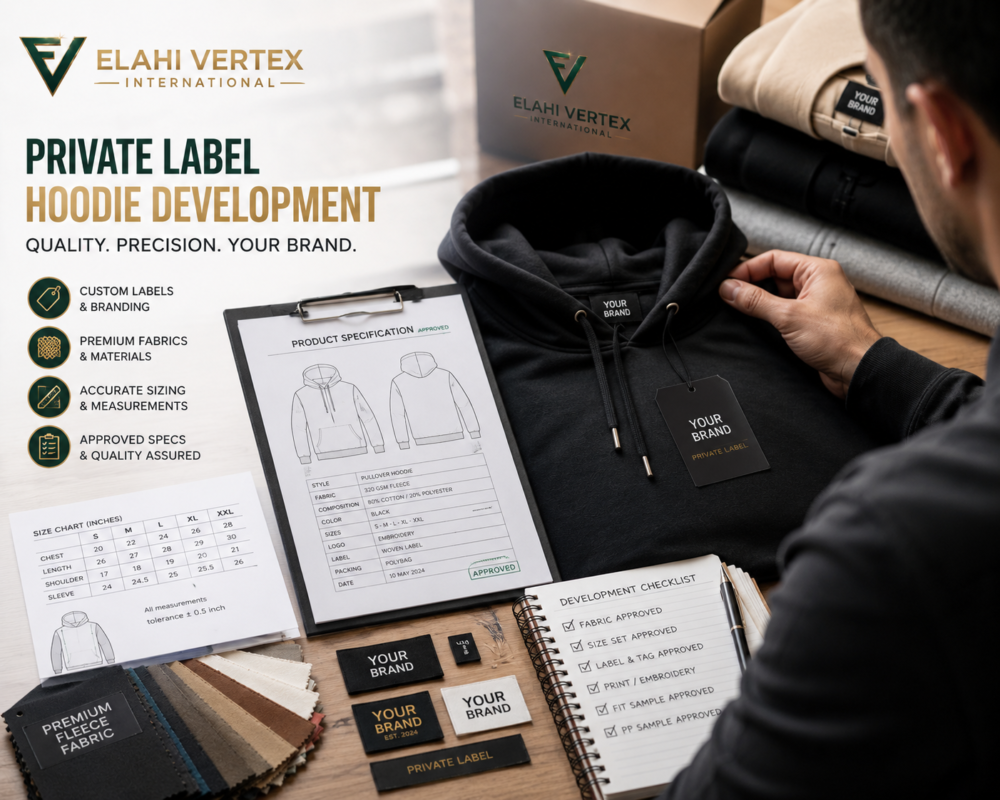
Professional private label hoodie specification and sample approval workflow.
5. Branding and Private Label Requirements
Private label manufacturing involves more than putting a logo on a hoodie.
Depending on your project, branding can include:
- Main neck label
- Size label
- Care label
- Country-of-origin information
- Hangtag
- Logo
- Embroidery
- Printing
- Packaging
- SKU/barcode information
Discuss these requirements before production.
For U.S.-market apparel, labeling requirements can include information such as fiber content, country of origin, and the identity of the manufacturer, importer, or other responsible business depending on the applicable rules.
Do not assume your manufacturer automatically takes responsibility for every regulatory requirement. Confirm responsibilities between buyer, importer and manufacturer.
6. Quality-Control Process
Ask your supplier:
How will you check my hoodies before shipment?
Do not settle for a simple answer such as “We have quality control.”
Ask about the actual process.
Quality-control considerations can include:
- Measurements
- Stitching
- Garment construction
- Fabric
- Color
- Artwork placement
- Embroidery
- Printing
- Labels
- Finishing
- Packaging
- Final inspection
A practical control sequence is:
Specification → Sample → Approval → Production → Inspection → Packing
The exact inspection procedure should be agreed according to your project.
[INFOGRAPHIC — PLACE HERE]
Private Label Hoodie Quality-Control Workflow
Specification Approval → Sample → Production → Inspection → Packing
7. Communication and Technical Support
Communication is particularly important when sourcing internationally.
Evaluate how a manufacturer responds to:
- Technical questions
- Measurement specifications
- Artwork files
- Sample feedback
- Design revisions
- Production questions
- Packaging requirements
- Shipping requirements
A manufacturer that responds quickly but cannot answer technical questions may still create problems.
What you want is clear technical communication, not merely fast replies.
Red Flag
Be cautious when a supplier gives extremely vague answers to important production questions but immediately pushes you toward placing an order.
8. MOQ and Commercial Terms
Before ordering, confirm the commercial terms for your exact product.
Ask about:
- MOQ
- Sample cost
- Unit price
- Branding costs
- Packaging costs
- Payment terms
- Production timeline
- Shipping
- Documentation
- Revision costs
Do not compare two manufacturers using unit price if their quotations cover different specifications.
For example:
Supplier A: lower unit price but basic packaging.
Supplier B: higher unit price including customized labels and packaging.
Those are not equivalent quotations.
Always compare like-for-like specifications.
9. Packaging
Packaging is often overlooked during apparel sourcing.
Depending on your business model, you may require:
- Individual garment bags
- Branded packaging
- Hangtags
- Size stickers
- Carton markings
- SKU information
- Barcodes
- Specific folding instructions
This can be particularly important for e-commerce brands because packaging contributes to the customer’s first physical experience with your product.
Your packaging requirements should be discussed before production rather than added at the last minute.
10. Export and U.S.-Market Requirements
If you are importing hoodies into the United States, clarify the applicable requirements before production.
The FTC’s apparel guidance addresses requirements involving textile labeling, including fiber content and country of origin.
The FTC also provides specific guidance regarding care instructions for covered textile apparel under its Care Labeling Rule.
Your sourcing checklist should therefore include:
- Fiber information
- Country-of-origin requirements
- Responsible company information
- Care instructions
- Label placement
- Packaging
- Import documentation
- Shipping responsibilities
The exact legal requirements depend on the product and business arrangement, so buyers should verify the requirements applicable to their specific products.
What to Include in Your Hoodie RFQ
A strong Request for Quotation (RFQ) makes supplier comparison much easier.
Before contacting manufacturers, prepare the following information.
Product Information
- Hoodie style
- Quantity
- Size range
- Fit
- Colorways
- Intended market
- Target customer
Fabric Information
- Fiber composition
- Fabric type
- Target weight
- Hand feel
- Performance requirements
Construction
- Hood
- Cuffs
- Hem
- Stitching
- Drawcords
- Hardware
Branding
- Logo
- Artwork
- Embroidery
- Neck label
- Care label
- Hangtag
- Packaging
Commercial Information
- Quantity
- Sample requirement
- Delivery destination
- Target timeline
- Packaging requirements
- Shipping requirements
The more complete your RFQ, the more useful the quotation will be.
How to Compare Private Label Hoodie Manufacturers
Create a supplier comparison instead of choosing based on price alone.Evaluation AreaWhat to CheckManufacturing capabilityCan they produce your exact product?SpecificationsCan they work from detailed requirements?SamplingIs there a clear approval process?FabricCan required materials be confirmed?BrandingAre labels, printing and embroidery supported?Quality controlIs there a defined inspection process?MOQIs the MOQ suitable for your business?PricingAre quotations comparable?PackagingCan your requirements be followed?CommunicationAre technical questions answered clearly?TimelineIs production timing clearly defined?ComplianceAre responsibilities understood?ShippingAre shipping responsibilities clear?
A Simple Supplier Scorecard
Score each supplier from 1 to 5 for:
- Manufacturing capability
- Product quality
- Specification control
- Sampling
- Branding
- Quality control
- Communication
- Commercial transparency
- Packaging
- Overall suitability
This gives you a more objective basis for supplier selection.
The Private Label Hoodie Manufacturing Process
A typical project can follow this sequence:
Step 1: Define Your Hoodie
Determine the product you want to manufacture.
Step 2: Prepare Specifications
Document measurements, materials, construction and branding.
Step 3: Shortlist Manufacturers
Evaluate suppliers according to your actual requirements.
Step 4: Request Quotations
Send the same core specifications to each shortlisted supplier.
Step 5: Compare Quotations
Compare pricing, MOQ, inclusions, sampling, packaging and commercial terms.
Step 6: Develop a Sample
Review the sample against your specifications.
Step 7: Approve the Product
Confirm the final specifications before bulk production.
Step 8: Confirm Production Terms
Finalize quantity, pricing, payment, production timing, packaging and shipping responsibilities.
Step 9: Production and Quality Control
Manufacturing proceeds according to the approved specifications.
Step 10: Shipment
Confirm packaging, documentation and shipping arrangements before dispatch.
Common Buyer Mistakes
1. Choosing Only the Cheapest Supplier
Low price does not automatically mean low total cost.
A cheaper supplier can become expensive if quality problems, rework, delays or communication failures occur.
2. Using Vague Specifications
“Premium hoodie” is not a technical specification.
Define what you actually require.
3. Skipping Sample Approval
Bulk production before adequate product approval increases risk.
4. Ignoring Measurements
Small measurement differences can significantly affect garment fit.
5. Treating Branding as an Afterthought
Labels, artwork and packaging should be part of the production specification.
6. Not Comparing Equivalent Quotations
A $10 quotation and a $12 quotation are not necessarily comparable if they include different fabrics, branding or packaging.
7. Changing Specifications Too Late
Late changes can affect production timing and cost.
8. Not Clarifying Responsibilities
Make sure everyone understands who is responsible for specifications, labels, documentation, packaging and shipping.
9. Assuming All Manufacturers Offer the Same Services
Manufacturing capabilities vary.
Ask specifically about the services required for your project.
10. Ordering Before the Product Is Properly Defined
The manufacturer cannot reliably produce a product that the buyer has not clearly specified.
Private Label Hoodie Supplier Checklist
Before choosing your manufacturer, confirm:
- Hoodie style defined
- Quantity defined
- Size range defined
- Measurements prepared
- Fit defined
- Fabric requirements defined
- Color requirements defined
- Construction requirements defined
- Artwork prepared
- Logo placement defined
- Printing requirements defined
- Embroidery requirements defined
- Neck label defined
- Care label requirements reviewed
- Hangtag requirements defined
- Packaging defined
- Sample requirements defined
- MOQ confirmed
- Pricing confirmed
- Production timeline discussed
- Shipping responsibilities confirmed
- U.S. labeling responsibilities reviewed
Why Choose Elahi Vertex International for Private Label Hoodies?


Elahi Vertex International operates as a B2B manufacturer, exporter, OEM/ODM supplier, and private label manufacturing partner for international buyers.
Its business model focuses on custom manufacturing rather than operating as a consumer retail clothing brand.
For brands looking for a private label hoodie manufacturer USA partner, the right approach is to provide detailed product requirements and discuss the exact manufacturing scope before placing an order.
Depending on the project, buyers can discuss requirements such as:
- Custom hoodie specifications
- Private labeling
- Branding
- Printing
- Embroidery
- Packaging
- OEM manufacturing
- ODM manufacturing
- Custom apparel production
Elahi Vertex International can discuss your hoodie requirements and confirm the applicable manufacturing options, MOQ, pricing, sampling, production timeline and packaging based on your specific project.
If you are sourcing custom or private label hoodies for a clothing brand, streetwear brand, startup, wholesale business or e-commerce brand, send your specifications to Elahi Vertex International for a project-specific discussion.
WhatsApp: +92 309 1639614
Email: elahivertexinternational@gmail.com
Frequently Asked Questions
What is a private label hoodie manufacturer?
A private label hoodie manufacturer produces hoodies for a buyer’s brand. Depending on the supplier, the project can include custom garments, labels, branding, packaging and other specifications.
How do I choose a private label hoodie manufacturer USA supplier?
Evaluate manufacturing capability, specifications, fabric, sampling, branding, quality control, MOQ, pricing, packaging, communication, production timing and applicable U.S. requirements.
What should I send to a hoodie manufacturer for a quotation?
Provide the hoodie design, measurements, fabric requirements, colors, quantity, artwork, branding, labels, packaging and delivery requirements wherever possible.
Can private label hoodies have custom labels?
Yes. Depending on the manufacturer and project, custom labels can include brand labels, size labels, care labels and other required information.
Should I request a sample before bulk production?
For many custom apparel projects, reviewing a sample before bulk production is a sensible way to identify specification or construction issues before committing to the full order.
What is the difference between private label and custom hoodies?
Private label focuses on producing apparel under the buyer’s brand. Custom manufacturing can involve a broader level of design and specification control. The exact scope depends on the manufacturer’s service model.
What should I ask a private label hoodie manufacturer?
Ask about:
- MOQ
- Fabric
- Measurements
- Sampling
- Branding
- Labels
- Packaging
- Quality control
- Production timeline
- Payment terms
- Shipping
- Applicable compliance requirements
Are care labels required for hoodies sold in the USA?
Covered textile apparel can be subject to U.S. care-label requirements. The FTC’s Care Labeling Rule provides requirements for manufacturers and importers of covered products.
What information may be required on U.S. apparel labels?
Depending on the product, U.S. textile labeling requirements can include fiber content, country of origin and responsible-company identification. Buyers should verify the rules applicable to their specific product.
Should I choose a hoodie manufacturer based on price?
No. Price should be evaluated alongside product specifications, quality, sampling, communication, packaging, MOQ, production terms and overall supplier reliability.
Can startups work with private label hoodie manufacturers?
Potentially. However, startups should confirm MOQ, sampling requirements, customization options, pricing and production terms before selecting a supplier.
Does Elahi Vertex International offer private label clothing manufacturing?
Yes. Elahi Vertex International operates as a B2B private label, OEM/ODM and custom manufacturing partner. The exact hoodie manufacturing options and commercial terms should be confirmed according to the buyer’s requirements.
Final Thoughts
Choosing the right private label hoodie manufacturer USA supplier is ultimately a procurement decision.
The cheapest quotation is not necessarily the best option, and the most impressive product catalog does not automatically indicate manufacturing suitability.
A better approach is to evaluate the complete supplier relationship:
Specifications → Fabric → Sample → Approval → Branding → Production → Quality Control → Packaging → Shipping
For clothing brands, streetwear businesses, startups, wholesalers and e-commerce companies, this structured approach can make supplier comparisons more objective and reduce avoidable production problems.
If your business is planning a private label hoodie collection, start by defining the product properly.
Then compare manufacturers based on their ability to deliver your specifications, not simply their ability to offer a low price.
Ready to discuss your private label hoodie project?
Contact Elahi Vertex International with your product specifications, quantity, branding requirements and target market to discuss the appropriate manufacturing solution.
WhatsApp: +92 309 1639614
Email: elahivertexinternational@gmail.com
Website: https://www.elahivertexinternational.com/
Useful External Resources
- CFDA Production Directory: Provides a directory of fashion manufacturing and production resources that can help clothing brands research U.S. manufacturers and production partners. CFDA Production Directory
- Thomasnet — Private Label & Custom Clothing Suppliers: Helps businesses research U.S. suppliers offering contract-manufactured, private-label, and custom clothing production services. Thomasnet Private Label & Custom Clothing Suppliers
- Maker’s Row: Provides a platform for fashion brands to discover apparel manufacturers offering services such as contract, cut-and-sew, custom, and private-label manufacturing. Maker’s Row
- U.S. Department of Commerce — Made in the USA Directory: Provides a sourcing resource for researching U.S. textile and apparel companies, including manufacturers and other supply-chain partners. Made in the USA Directory
- YC Apparels — Hoodie Manufacturers USA: Provides additional market information about hoodie manufacturing, customization, and supplier options for brands researching hoodie production. Hoodie Manufacturers USA
- LeeLine Apparel — USA Hoodie Manufacturers: Provides additional industry information for businesses researching hoodie manufacturers and private-label apparel production. USA Hoodie Manufacturers
Why these resources matter: Before choosing a private label hoodie manufacturer USA supplier, buyers should compare manufacturing capabilities, customization options, MOQ, sampling, branding, quality control, packaging, production requirements, and supplier experience. These directories and industry resources can help clothing brands, streetwear brands, startups, wholesalers, and e-commerce businesses conduct broader supplier research before making a commercial manufacturing decision.