
Choosing between a 20-piece, 100-piece, or 500-piece clothing order is not simply a question of finding the lowest price per garment. The right order quantity depends on how much demand your brand has proven, how much capital you can safely commit, how many styles or sizes you need, and how quickly you can sell and reorder inventory.
For clothing brands, understanding clothing manufacturer MOQ can prevent two expensive mistakes: ordering too much before demand is proven or ordering too little when demand is already established.
A 20-piece production run can make sense when testing a new product. A 100-piece order can support a brand that has stronger demand evidence. A 500-piece production run may make more commercial sense when sales are sufficiently predictable to justify a larger inventory commitment.
The key principle is simple:
The best MOQ is not automatically the lowest or highest quantity. It is the quantity your brand can justify with evidence.
What Does Clothing Manufacturer MOQ Mean?
MOQ means Minimum Order Quantity.
A clothing manufacturer MOQ is the minimum production quantity a manufacturer is willing to accept for a particular manufacturing project, product, style, or other agreed production basis.
The exact way an MOQ is calculated can vary between manufacturers and projects.
Factors that may affect MOQ include:
- Fabric sourcing
- Fabric availability
- Dyeing requirements
- Printing or embroidery
- Pattern development
- Cutting setup
- Labels and trims
- Packaging
- Product complexity
- Number of colors
- Number of sizes
- Production setup
- Supplier minimums
This is why buyers should never assume that an advertised MOQ automatically applies to every possible garment configuration.
Before placing an order, confirm exactly what the MOQ applies to.
20 vs 100 vs 500 Pieces: Quick Comparison
| Factor | 20 Pieces | 100 Pieces | 500 Pieces |
|---|---|---|---|
| Inventory commitment | Low | Moderate | High |
| Demand evidence needed | Limited | Stronger | Substantial |
| Market testing | Excellent use case | Possible | Usually less suitable |
| Capital exposure | Lower | Moderate | Higher |
| Dead-stock exposure | Lower | Moderate | Higher |
| Production efficiency | Lower | Better | Potentially stronger |
| Unit-cost potential | Usually weaker | Potentially better | Often stronger |
| Best suited to | Testing | Early scaling | Proven demand |
| Forecasting importance | Lower | Important | Critical |
| Reorder planning | Useful | Important | Essential |
Important: This table is a general decision framework, not a promise of pricing or production economics for every manufacturer. Actual quotations depend on the garment and production requirements.
When Does a 20-Piece Clothing Order Make Sense?
A 20-piece order can be commercially sensible when uncertainty is still high.
For example, imagine a new streetwear brand has developed an oversized hoodie but does not yet know whether customers will actually buy it.
Ordering hundreds of units immediately creates inventory before the market has validated the product.
Starting smaller allows the brand to learn.
The initial production can help answer questions such as:
- Does the product attract buyers?
- Which sizes sell?
- Is the fit receiving positive feedback?
- Does the color work commercially?
- Does the retail price work?
- Are customers satisfied with the garment?
- Should the product be reordered?
- What should change before scaling?
This changes the purpose of the first production run.
Instead of trying to maximize unit-cost efficiency immediately, the brand is purchasing information as well as inventory.
Why Small Orders Can Reduce Inventory Risk
Suppose a brand launches a completely new hoodie.
The founder believes it will sell.
That belief is not the same as demonstrated demand.
If the brand orders 500 pieces and sales are weak, substantial capital can become trapped in unsold inventory.
If the brand starts with a much smaller quantity, the financial exposure is more contained.
That does not mean a 20-piece order will have better unit economics.
Usually, manufacturing economics improve as production quantities increase because certain setup and sourcing costs can be spread across more garments.
The trade-off therefore looks more like this:
Smaller quantity → less inventory exposure, potentially higher unit cost
Larger quantity → potentially better unit economics, but greater inventory exposure
Good sourcing decisions balance both sides.
When a 20-Piece MOQ Can Be the Wrong Choice
Low MOQ should not become a permanent strategy simply because it feels safer.
If a brand already has reliable sales data showing that it can sell hundreds of units, repeatedly placing extremely small orders may create unnecessary inefficiency.
A small production run may be less attractive when:
- Demand has already been demonstrated
- The product sells consistently
- Retailers have committed quantities
- Preorders provide credible demand information
- Reorders are predictable
- The brand can safely finance larger inventory
- Higher production quantities materially improve the commercial model
Low MOQ is most valuable when it solves an actual uncertainty problem.
Once that uncertainty disappears, the order strategy should be reconsidered.
When Is a 100-Piece Clothing Order Better?
A 100-piece order can represent the transition between product testing and meaningful scaling.
Imagine the first small release sells successfully.
Customers like the product.
Size information begins to emerge.
The brand receives requests for restocks.
Now the founder has more evidence than before.
Moving from 20 pieces toward 100 pieces may allow the business to carry more inventory while still avoiding the commitment associated with several hundred units.
A 100-piece order may make sense when:
- A smaller launch performed successfully
- Customers are requesting a restock
- Sales history exists
- The brand understands its size distribution better
- Product specifications have stabilized
- The business can support a larger cash commitment
- Marketing plans justify additional inventory
The important difference is evidence.
The brand is no longer ordering solely because it hopes the product will sell.
It has some reason to believe it will.
When Does a 500-Piece Clothing Order Make Sense?
A 500-piece order changes the commercial equation significantly.
At this quantity, buyers should think beyond manufacturing price.
They should consider:
- Expected sales velocity
- Inventory holding period
- Warehouse capacity
- Cash-flow requirements
- Size distribution
- Color distribution
- Product lifecycle
- Seasonal timing
- Freight
- Duties and taxes where applicable
- Reorder timing
- Quality-control requirements
A larger production run can potentially improve manufacturing efficiency and per-unit economics.
But there is another side.
If the product does not sell as expected, the brand owns significantly more unsold inventory.
Therefore, 500 pieces generally make more sense when the buyer has stronger evidence of demand.
Examples could include:
- Historical sales
- Reliable wholesale commitments
- Confirmed retailer demand
- Strong preorder information
- Successful previous production runs
- Predictable recurring requirements
Large production should follow evidence rather than optimism.
The Real Cost of MOQ Is Not Just Unit Price
One of the biggest mistakes clothing brands make is evaluating production entirely by price per piece.
Imagine two hypothetical offers:
Manufacturer A offers a lower unit price but requires 500 pieces.
Manufacturer B charges more per garment but allows the buyer to start with 20 pieces.
Which manufacturer is cheaper?
You cannot answer that question from unit price alone.
You need to consider the total commercial exposure.
A useful framework is:
Total inventory commitment = unit manufacturing cost × quantity
Then consider additional project costs such as sampling, freight, duties where applicable, packaging, warehousing, fulfillment and other landed-cost components.
The cheapest garment can become expensive if it never sells.
MOQ and Dead Stock
Dead stock is inventory that a business cannot sell within the expected commercial period.
For fashion brands, this can be especially damaging because demand may change with:
- Trends
- Seasons
- Colors
- Fits
- Product launches
- Customer preferences
- Marketing performance
A brand ordering 500 units of an untested design is making a much larger demand forecast than a brand ordering 20.
That forecast can be correct.
It can also be wrong.
MOQ therefore functions partly as an inventory-risk decision.
MOQ and Cash Flow
Inventory consumes cash before it generates revenue.
When a clothing brand pays for manufacturing, shipping and other supply-chain expenses, that money becomes tied to inventory until customers purchase the garments.
This matters particularly for growing brands.
Capital committed to excess stock cannot simultaneously fund:
- Marketing
- New product development
- Sampling
- Photography
- Content creation
- Packaging
- Operations
- Another collection
- Reorders of better-selling products
The question should therefore not be:
“Can we afford 500 pieces?”
A stronger question is:
“Is committing this amount of working capital to 500 pieces the best use of our cash?”
MOQ and Unit Cost
This is where buyers need a balanced view.
Higher production quantities can create manufacturing efficiencies.
Fixed or semi-fixed production costs may be distributed across more garments.
Material purchasing can also behave differently at larger quantities.
Therefore:
20 pieces should not automatically be expected to cost the same per unit as 500 pieces.
A brand choosing a low MOQ may be accepting weaker unit economics in exchange for lower initial exposure.
That can still be commercially intelligent.
If spending slightly more per unit prevents thousands of dollars from being locked into unwanted stock, the higher unit cost may be justified.
But once demand becomes predictable, continually paying a small-batch premium can become inefficient.
MOQ and SKU Complexity
Quantity becomes more complicated when a product has multiple:
- Sizes
- Colors
- Designs
- Fits
- Fabrics
- Prints
- Embroidery options
Consider 500 garments spread across many sizes and colors.
That is not the same inventory problem as 500 identical garments.
Each variation creates an SKU.
More SKUs can make forecasting harder because customers rarely purchase every size and color at identical rates.
A brand might sell out of medium black hoodies while still holding extra-small hoodies in another color.
This is why buyers should discuss the structure of the MOQ with their manufacturer instead of looking only at the headline number.
Should Startup Clothing Brands Begin With 20 Pieces?
For an unproven product, a small initial run can be a rational way to test demand.
But “startup” does not automatically mean “20 pieces.”
Some startups launch with substantial preorders, retail commitments or existing audiences.
Others have no customers yet.
Those situations should not use the same purchasing strategy.
A better question is:
How much demand evidence does the brand currently possess?
If the answer is “very little,” minimizing inventory exposure becomes more important.
20 Pieces: Test
The purpose of a small production run should be learning.
Test:
- Product-market response
- Fit
- Customer feedback
- Pricing
- Sizing
- Colors
- Content performance
- Conversion
- Repeat demand
Do not judge success only by whether the garments sell.
Use the launch to gather information that improves the next order.
100 Pieces: Validate
Once a product has demonstrated demand, the brand can consider a larger quantity.
At this stage, focus on:
- Sales velocity
- Size ratios
- Best-selling colors
- Returns
- Customer feedback
- Gross margin
- Restock demand
- Marketing performance
The purpose changes from testing whether the product works to determining whether the product can scale.
500 Pieces: Scale
A larger order should generally be supported by stronger forecasting.
Before scaling, ask:
- How quickly did previous stock sell?
- What sizes sold fastest?
- Which colors underperformed?
- How much cash will this inventory consume?
- What is the expected reorder cycle?
- Is demand seasonal?
- Are wholesale orders confirmed?
- What happens if sales are 30% below forecast?
That final question is especially important.
A good inventory decision should survive a weaker-than-expected sales scenario.
20 → 100 → 500: A Smarter Scaling Model
Instead of treating MOQ as one permanent number, brands can think in stages.
Stage 1 — Test
Start with a controlled production quantity when demand is uncertain.
Stage 2 — Measure
Collect actual sales and customer information.
Stage 3 — Improve
Adjust the product, specifications, sizing or color strategy where necessary.
Stage 4 — Validate
Place a larger order once the first production provides useful demand evidence.
Stage 5 — Scale
Move toward larger quantities when sales history justifies the additional inventory.
This creates a simple principle:
Test → Learn → Validate → Scale
How Elahi Vertex International’s 20-Piece MOQ Fits This Model
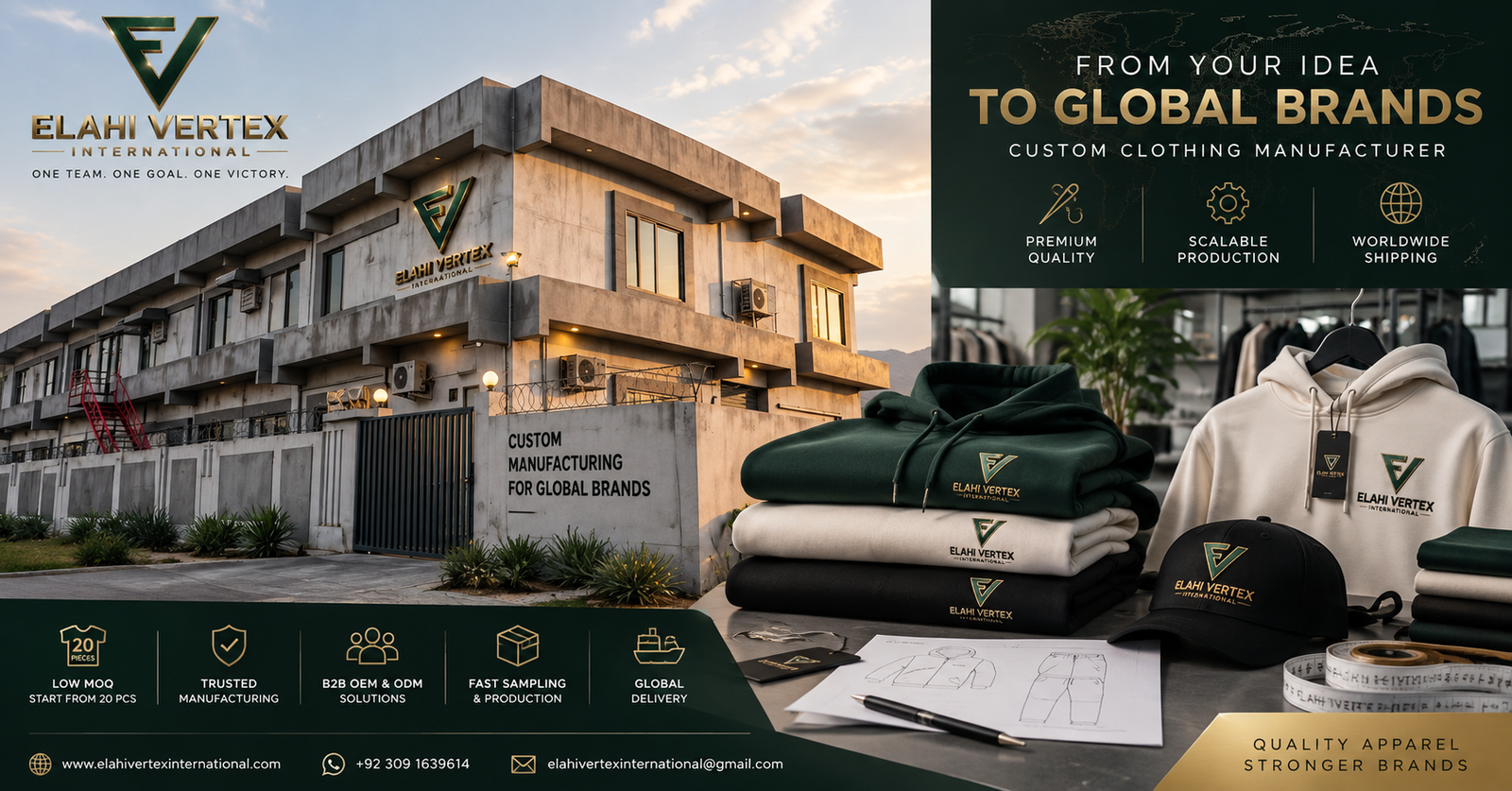
Elahi Vertex International is a B2B manufacturer, exporter, OEM/ODM supplier and private-label manufacturing partner serving clothing brands and other commercial buyers.
For applicable custom manufacturing projects, Elahi Vertex International’s standard MOQ is 20 pieces per product/category.
This lower starting quantity can be useful for buyers who want to begin with a controlled production commitment before considering larger quantities.
However, buyers should not assume that 20 pieces automatically creates the lowest possible unit cost.
The commercial advantage is the ability to start at a lower quantity.
Project-specific pricing depends on the garment specifications, materials, customization, quantity, destination and other manufacturing requirements.
Sample Before You Scale
MOQ reduces quantity risk.
It does not eliminate product risk.
Before committing to production, sampling can help buyers evaluate:
- Fabric
- Construction
- Measurements
- Fit
- Colors
- Artwork
- Printing
- Embroidery
- Labels
- Trims
- Overall appearance
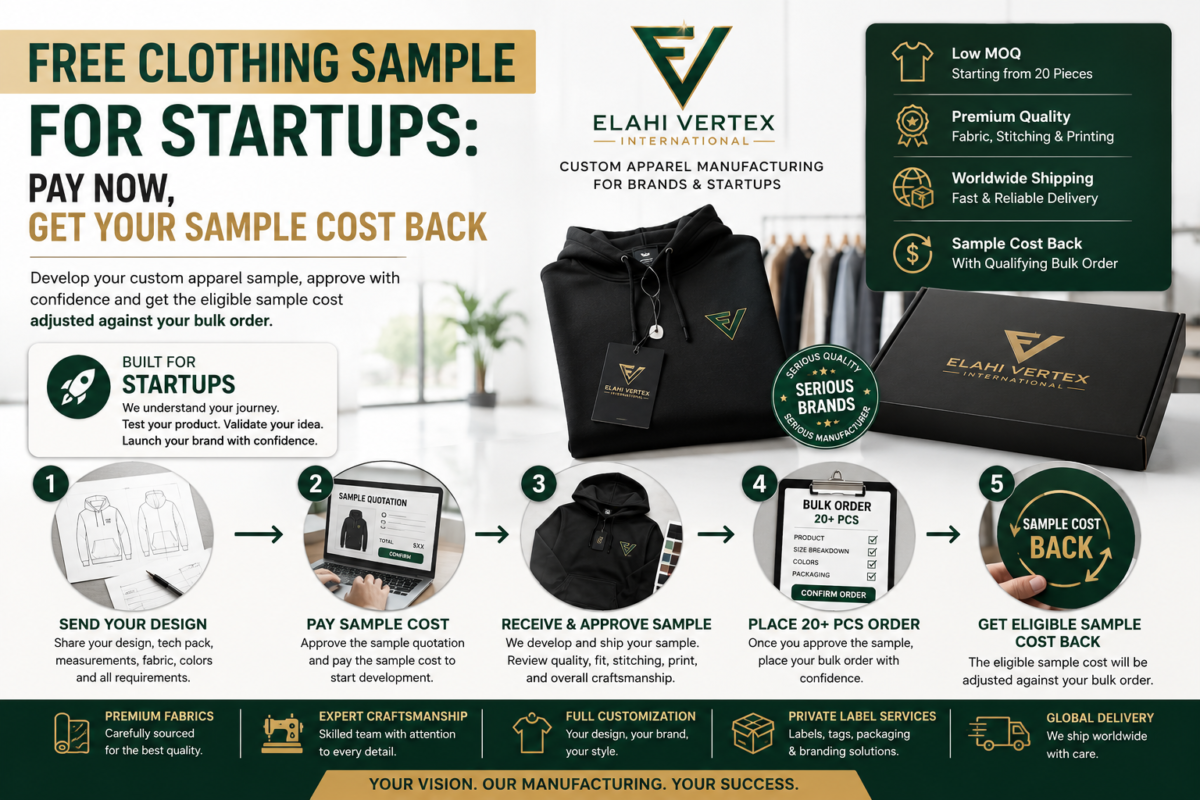
For Elahi Vertex International projects, the buyer pays the agreed sample cost and shipping upfront. Where agreed for a qualifying subsequent bulk order, the sample cost may be credited toward the bulk-order invoice; shipping remains separate.
Specific terms should always be confirmed for the individual project.
A sample should be treated as a risk-control step, not merely another purchasing expense.
Why a Sample and Low MOQ Solve Different Problems
These two concepts are sometimes confused.
A sample answers:
“Can this product be made to the required specification?”
A low MOQ production run helps answer:
“Can our market sell this product?”
A brand can approve an excellent sample and still launch a product customers do not want.
Likewise, strong demand cannot compensate for poor production quality.
Both risks need to be managed separately.
Common MOQ Mistakes Clothing Brands Should Avoid
1. Choosing the Lowest Unit Price
Low price does not automatically mean low total risk.
2. Ordering 500 Pieces Without Demand Evidence
Confidence is not a sales forecast.
3. Assuming Low MOQ Means Cheap Manufacturing
Small production can carry higher per-unit costs.
4. Ignoring Size Distribution
Selling 100 pieces does not mean every size will sell equally.
5. Ignoring Color Distribution
The same forecasting problem applies to colors.
6. Skipping Sampling
A low MOQ does not remove the need to validate the physical product.
7. Scaling Too Quickly
One successful launch does not automatically justify dramatically increasing inventory.
8. Never Scaling
The opposite mistake also exists. Brands with reliable demand can lose efficiency by remaining permanently in tiny production runs.
9. Comparing Manufacturers Only by MOQ
Quality, communication, sampling, specifications, pricing, production requirements and shipping matter too.
Clothing Order Quantity Checklist
Before deciding between 20, 100 and 500 pieces, answer these questions:
Demand
- Have we sold this product before?
- Do we have preorder data?
- Do we have wholesale commitments?
Inventory
- How long can we hold the stock?
- What happens if it sells slowly?
- How many SKUs are involved?
Cash
- How much working capital will be tied up?
- What other business activities need that cash?
Product
- Has the sample been approved?
- Are measurements finalized?
- Are materials and colors finalized?
- Are branding requirements confirmed?
Economics
- What is the manufacturing cost?
- What is the estimated landed cost?
- What gross margin remains?
- How does quantity affect the quotation?
Scaling
- When would we reorder?
- How quickly can we detect a successful product?
- What evidence would justify the next quantity?
Which MOQ Is Right for Your Clothing Brand?
There is no universal answer.
Choose 20 pieces when controlling exposure and learning from a new product is more important than maximizing production efficiency.
Consider 100 pieces when early demand has been validated and the brand needs more inventory without making a very large commitment.
Consider 500 pieces when demand evidence, cash flow and forecasting justify scaling.
The correct MOQ changes as the business changes.
A successful brand does not necessarily search forever for the lowest MOQ.
It searches for the right quantity at the right stage.
Frequently Asked Questions
What is clothing manufacturer MOQ?
Clothing manufacturer MOQ is the minimum quantity a manufacturer accepts for a production order under its specified terms.
Is a 20-piece MOQ good for a new clothing brand?
It can be useful when a brand wants to limit initial inventory exposure while testing a product. Whether it is appropriate depends on the project and the brand’s demand evidence.
Is 100 pieces considered a small clothing order?
That depends on the manufacturer, product and production model. Different manufacturers have different minimums and production structures.
Is ordering 500 pieces cheaper?
A larger quantity can potentially improve per-unit manufacturing economics, but buyers should compare actual quotations rather than assume a fixed saving.
Why do clothing manufacturers have MOQs?
Manufacturing requires production setup, material sourcing, labor planning and other fixed or semi-fixed activities. Minimum quantities help manufacturers operate those processes economically.
Does lower MOQ mean lower total cost?
It reduces the number of garments purchased, but it does not necessarily produce the lowest cost per garment.
Does Elahi Vertex International accept 20-piece orders?
Elahi Vertex International’s standard MOQ is 20 pieces per product/category for applicable custom manufacturing orders. Project requirements should be confirmed before ordering.
Should I order a sample before 20 pieces?
Sampling is a practical way to evaluate the product before bulk production. The appropriate process should be agreed for the specific project.
When should I move from 20 to 100 pieces?
Consider increasing quantity when actual sales, preorder information, wholesale commitments or other credible evidence shows that additional inventory is justified.
When should I move from 100 to 500 pieces?
Move toward larger quantities when demand becomes sufficiently predictable and the economics justify the additional inventory and cash commitment.
Does MOQ include different colors and sizes?
MOQ structures vary between manufacturers. Do not assume how a quantity can be divided across colors, sizes or designs unless the manufacturer confirms it.
Is the lowest MOQ always the best manufacturer?
No. MOQ is only one supplier-selection criterion. Buyers should also evaluate product capability, sample quality, communication, specifications, commercial terms and production requirements.
Final Decision: Don’t Buy Quantity—Buy According to Evidence
The difference between 20, 100 and 500 pieces is not simply 80 or 480 extra garments.
Each level represents a different amount of inventory exposure, working capital and confidence in future demand.
A 20-piece production run can protect a brand from making a large bet before the market responds.
A 100-piece order can support early growth once evidence begins accumulating.
A 500-piece order can improve the economics of a proven product—but only when the brand has enough demand confidence to justify carrying that inventory.
Low MOQ reduces commitment. Higher MOQ can improve scale. Neither is automatically better.
The strongest purchasing strategy is:
Test small → measure real demand → improve → reorder intelligently → scale proven products.
Start With the Quantity Your Evidence Supports
Planning a custom clothing order?
Send Elahi Vertex International your reference design or tech pack, product type, specifications, estimated quantity, size requirements, customization requirements and destination.
Clothing Order Quantity Guide: Why Quantity Matters
A clothing order quantity guide helps brand owners decide how much inventory to manufacture without relying only on the lowest unit price. The right quantity should reflect proven demand, available working capital, expected sales speed, SKU complexity and the amount of inventory risk a business can reasonably carry.
Clothing Order Quantity Guide for 20-Piece Orders
For an untested collection, a clothing order quantity guide can point brands toward a smaller initial production run. Starting with 20 pieces can allow a business to evaluate product quality, customer response, sizing, colors and selling price before committing substantially more capital to inventory.
A practical clothing order quantity guide should make clear that a small order is not automatically the cheapest option per piece. Its main commercial advantage is lower initial inventory exposure while a brand collects real information about demand.
Clothing Order Quantity Guide for 100-Piece Orders
A clothing order quantity guide becomes especially useful when a brand has moved beyond its first test order. Around 100 pieces may make sense when previous sales, preorder activity, customer feedback or restock demand show that the product has started to prove itself in the market.
Using a clothing order quantity guide at this stage helps the buyer compare the benefits of holding more stock against the additional cash committed to production. The goal is to increase quantity because demand evidence has improved, not simply because a larger order sounds more professional.
Clothing Order Quantity Guide for 500-Piece Orders
For larger production planning, a clothing order quantity guide should focus heavily on forecasting. A 500-piece order can create stronger production economics in some projects, but it also exposes the buyer to substantially more inventory if demand is weaker than expected.
A reliable clothing order quantity guide therefore encourages brands to review historical sales, size ratios, color performance, wholesale commitments, seasonal demand and available working capital before moving toward a 500-piece production order.
Clothing Order Quantity Guide and Inventory Risk
The purpose of a clothing order quantity guide is not to tell every business to buy the smallest possible quantity. Instead, it helps buyers understand the relationship between order size and inventory exposure. Small batches may reduce the financial impact of a failed product, while larger batches can become more appropriate once demand is sufficiently predictable.
When following a clothing order quantity guide, brands should also consider how many different sizes, colors and designs are included in the order. A large number of SKUs can increase inventory complexity even when the total garment quantity appears manageable.
Clothing Order Quantity Guide and Cash Flow
A good clothing order quantity guide must include cash flow because inventory uses working capital before it generates revenue. Money tied up in unsold garments cannot simultaneously be used for marketing, sampling, product development, packaging or reordering products that are already selling successfully.
This is why a clothing order quantity guide should help brands evaluate total financial commitment rather than only the manufacturing price per piece. A lower unit price does not always represent the lowest commercial risk.
Clothing Order Quantity Guide: Test, Validate and Scale
The simplest way to use a clothing order quantity guide is to think in three stages: test, validate and scale. A brand can begin with a controlled production run, measure actual customer response and then increase the quantity when real demand supports the decision.
This clothing order quantity guide approach allows purchasing decisions to become progressively more evidence-based. Instead of guessing how many garments customers might buy, the brand uses actual sales data to improve each subsequent production order.
Clothing Order Quantity Guide for Clothing Brands
Every brand will reach a different answer because there is no universal production quantity that works for every product. A clothing order quantity guide should therefore be used as a decision framework rather than a fixed rule.
For some brands, the right first step may be 20 pieces. For others with validated demand, the clothing order quantity guide may support 100 or 500 pieces. What matters is matching the production commitment to genuine commercial evidence.
Clothing Order Quantity Guide for Elahi Vertex International Buyers
This clothing order quantity guide also explains why Elahi Vertex International offers a standard MOQ of 20 pieces per product/category for applicable custom manufacturing projects. The lower entry quantity gives qualifying buyers an opportunity to begin with a controlled production commitment before deciding whether larger production is commercially justified.
A buyer can use this clothing order quantity guide to compare 20, 100 and 500-piece orders while considering design requirements, product specifications, inventory needs and destination. Final production pricing and project terms should always be based on the actual order requirements.
Final Clothing Order Quantity Guide
The strongest conclusion from this clothing order quantity guide is that the right MOQ is not automatically the smallest or largest number available. It is the quantity that fits your demand evidence, working capital, product maturity and ability to sell or reorder inventory.
We can review the project information and determine the appropriate next step for sampling or quotation.
Elahi Vertex International
Custom B2B Manufacturing | OEM | ODM | Private Label
Website: https://www.elahivertexinternational.com/
Email: elahivertexinternational@gmail.com
Alibaba: https://elahivertexinternational.trustpass.alibaba.com/