
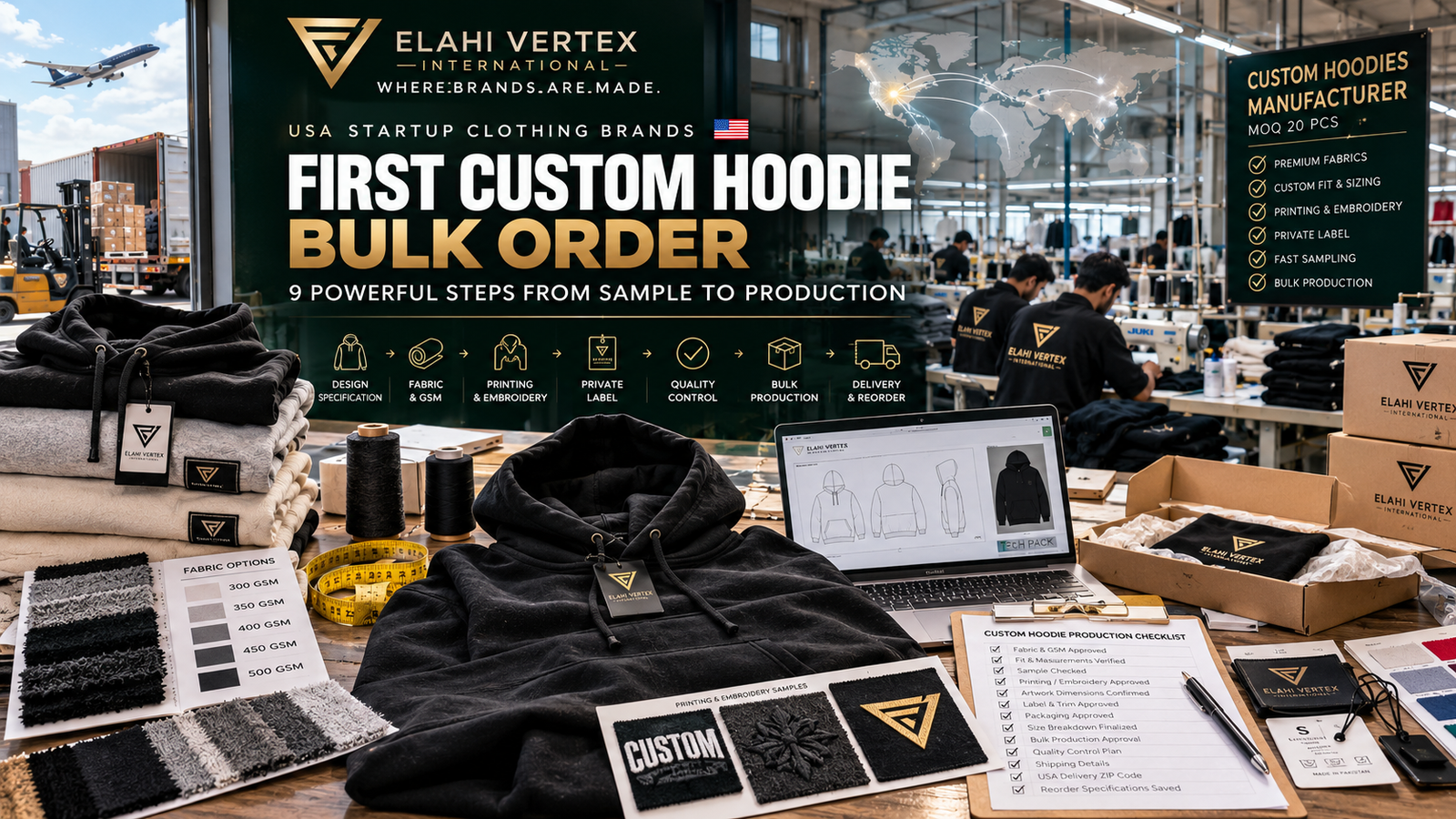
A USA clothing startup can have a strong logo, professional website, good mockups and a promising launch plan—and still lose money on its first hoodie production.
The problem often begins before bulk manufacturing starts.
Wrong fabric. Wrong GSM. An oversized fit that was never properly measured. Artwork that was approved digitally but never tested physically. Labels left until the last minute. A sample that was accepted without checking measurements. A bulk order placed before the product was completely defined.
For a startup, those mistakes matter because the first production run is usually being financed before the brand has years of sales data to rely on.
The better approach is:
Design → Specification → Sample → Inspection → Approval → Bulk Production → QC → Delivery → Market Feedback → Reorder
This guide explains 9 practical steps USA startup clothing brands should complete before their first custom hoodie bulk order.
Elahi Vertex International is a B2B custom clothing manufacturer, OEM/ODM and private-label manufacturing partner based in Sialkot, Pakistan. Our standard MOQ starts from 20 pieces per product/category, allowing qualifying startup projects to begin with a controlled quantity rather than automatically committing to hundreds of garments.
But low MOQ alone does not protect a startup.
The product still needs to be developed correctly.
Table of Contents
1. Define the Hoodie Before Asking for a Price
One of the weakest first messages a startup can send a manufacturer is:
“How much for 50 hoodies?”
There is no single meaningful price for a custom hoodie.
Consider these two products:
| Hoodie A | Hoodie B |
|---|---|
| Standard fit | Custom oversized pattern |
| Midweight fabric | Heavyweight fleece |
| Basic print | Multi-position embroidery + puff print |
| Standard color | Custom-developed color |
| Basic labels | Complete private-label branding |
| Simple construction | Custom hood, rib and panel construction |
Both are “hoodies.”
They are not the same manufacturing job.
What Should You Define First?
Before requesting a serious quotation, establish as much of the following as possible:
- Pullover or zip-up
- Target quantity
- Fabric type
- Fabric composition
- Target GSM
- Fit
- Measurements
- Colors
- Hood construction
- Pocket design
- Rib requirements
- Printing
- Embroidery
- Wash or finish
- Labels
- Hangtags
- Packaging
- Size range
- USA delivery ZIP code
- Target delivery period
You do not need to know every technical answer.
If you do not know something, say:
“Manufacturer recommendation required.”
That is much better than guessing.
Better First RFQ
Instead of:
“Price for hoodie?”
Send:
“We are developing a 50-piece oversized pullover hoodie for a USA streetwear launch. We want a heavyweight feel, black color, front embroidery, back puff print, custom woven neck label and sizes S–2XL. Please recommend an appropriate fabric/GSM. Delivery ZIP: XXXXX.”
Now the manufacturer has something meaningful to evaluate.
Expert Tip
Price the specification, not the word “hoodie.”
A quotation becomes more useful when the product becomes more specific.
[IMAGE — Hoodie specification sheet beside finished sample]
2. Choose Fabric and GSM Around the Customer
GSM matters.
But GSM alone does not define quality.
GSM means grams per square metre. It measures fabric mass per unit area.
Two fabrics with the same headline GSM can still feel different because of:
- Fiber composition
- Yarn
- Knitting/construction
- Density
- Brushing
- Finishing
- Washing
- Compactness
- Surface texture
That is why asking only:
“Do you have 400 GSM?”
is not enough.
Start With the Product Experience
Ask what the customer should feel when wearing the hoodie.
Do you want:
Soft and warm?
A brushed fleece direction may make sense.
Loopback interior and a different seasonal feel?
French terry may deserve consideration.
Structured streetwear silhouette?
Fabric, pattern, rib and garment construction need to work together.
Athletic or lighter layering product?
Automatically choosing the heaviest fabric may be a mistake.
Practical Fabric Development Questions
Ask:
- What is the intended season?
- Where will customers wear it?
- Should it feel soft or structured?
- Is the interior brushed or loopback?
- What composition is required?
- What is the target GSM?
- Does the decoration work with this fabric?
- What shrinkage behavior needs to be considered?
- How should the garment drape?
Don’t Use GSM as a Luxury Score
A 500 GSM hoodie is not automatically better than a 350 GSM hoodie.
If the product is badly patterned, uncomfortable, poorly finished or unsuitable for the customer’s climate, extra weight does not rescue it.
Product purpose → Fabric → GSM.
Not:
Highest GSM → “Premium.”
For a deeper discussion of heavyweight-specific risks, see Elahi Vertex International’s existing guide on heavyweight hoodie manufacturing.
3. Build the Fit With Measurements, Not Adjectives
“Make it oversized.”
That sounds clear to a founder.
It is not a complete production specification.
Oversized could mean:
- Wider chest
- Dropped shoulder
- Wider sleeve
- Longer sleeve
- Shorter body
- Longer body
- Larger hood
- Boxier body
- Different armhole
- Wider rib
- Combination of several changes
This is why the pattern and measurement chart matter.
Example Hoodie Measurement Points
A hoodie specification may include:
| Measurement | Why It Matters |
|---|---|
| Chest width | Controls overall body volume |
| Body length | Changes proportion and silhouette |
| Shoulder width/drop | Critical to oversized appearance |
| Sleeve length | Influences balance and fit |
| Armhole | Affects mobility and sleeve shape |
| Hood height | Influences hood volume |
| Hood width | Influences shape and coverage |
| Pocket width/height | Affects function and visual balance |
| Cuff height | Changes finishing proportion |
| Waist rib height | Influences hem appearance |
Exact measurement points and tolerances should be agreed for the project.
Never Create “Oversized” by Simply Relabeling a Larger Size
Taking a standard XL and calling it M does not automatically create a well-designed oversized M.
A deliberate oversized pattern controls the proportions together.
Startup Shortcut When You Don’t Have a Tech Pack
If you own a hoodie whose fit you genuinely like:
- Identify the size.
- Measure the garment.
- Photograph it clearly.
- Explain what you want changed.
- Send the reference and measurements.
- Develop a sample.
- Refine from the physical result.
Do not blindly copy another brand’s protected design or branding. Use legitimate references to communicate fit direction and develop your own product.

4. Develop a Physical Sample Before Bulk Production
This is one of the most important steps in the entire article.
A mockup approves an idea. A physical sample helps approve a product.
Sampling should be treated as risk reduction, not as an annoying expense delaying the order.
Your master manufacturing process should be:
Specifications → Sample → Review → Revision if required → Written Approval → Bulk
What Should You Check on a Hoodie Sample?
Fabric
- Composition
- Weight/GSM against specification
- Hand feel
- Surface appearance
- Inner finish
- Structure
Fit
- Chest
- Length
- Shoulder
- Sleeve
- Hood
- Overall silhouette
Construction
- Seams
- Stitching
- Hood
- Rib
- Zipper, if applicable
Decoration
- Position
- Dimensions
- Colors
- Embroidery appearance
- Print appearance
- Alignment
Branding
- Neck label
- Size label
- Care label
- Hangtag
- Other approved trims
Appearance
Put the hoodie on a person or appropriate form.
Photograph it.
Measure it.
Handle it.
If appropriate for the product, assess how it behaves after the agreed care/wash evaluation.
Then compare the result with the approved specification.
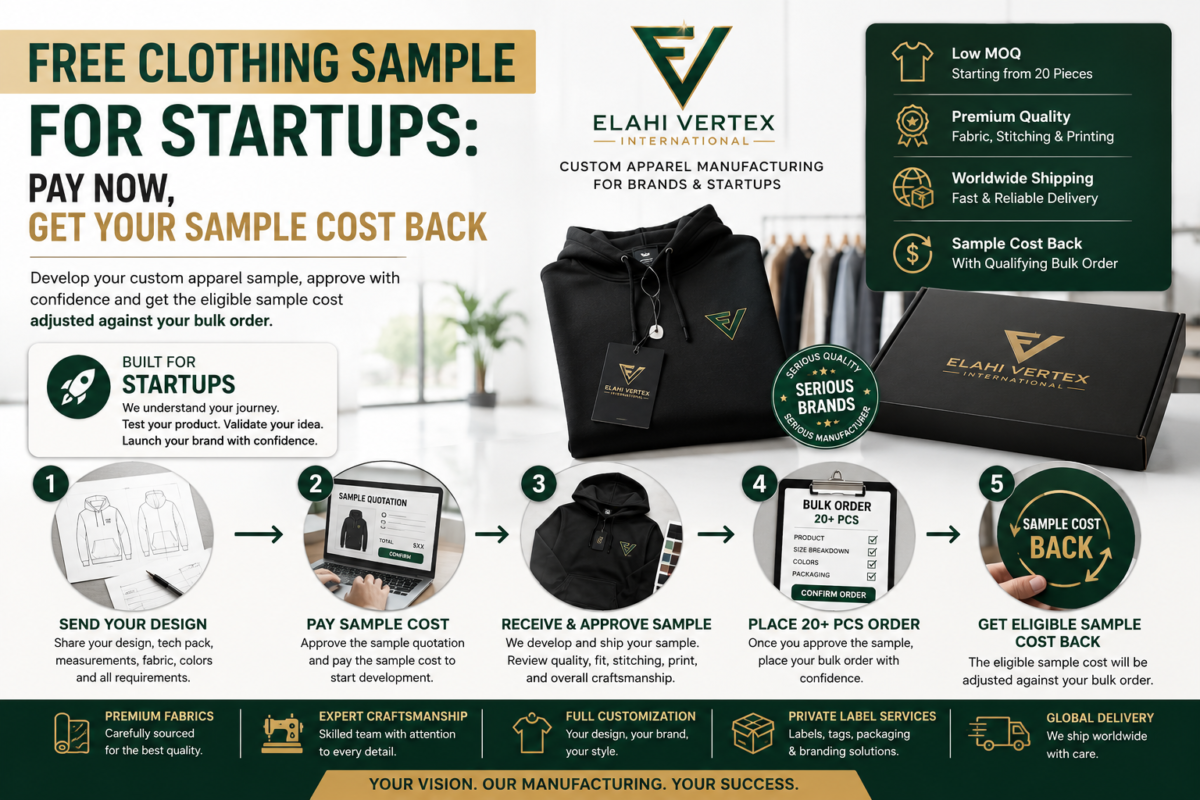
Elahi Vertex International Sample Route
For new sample development, the normal baseline is that the buyer pays the sample cost and shipping upfront.
Where specifically agreed for a qualifying bulk order, the sample product cost may later be credited toward that bulk order.
Shipping remains separate and is not credited.
Specific sample pricing and terms must be confirmed for the project.
Important
Do not authorize bulk merely because:
“It looks good in the photo.”
Approve what matters:
Fabric + Fit + Measurements + Construction + Decoration + Branding + Overall Appearance.
[IMAGE — Physical hoodie sample being measured before approval]
5. Test Printing and Embroidery on the Actual Product
A design that looks excellent on a computer screen can behave differently on fabric.
This becomes particularly important with:
- Fine embroidery
- Large embroidery
- Puff print
- DTF
- DTG
- Screen printing
- Appliqué
- Mixed decoration
- Specialty effects
The decoration method should follow:
Artwork + Fabric + Placement + Quantity + Desired Effect + Durability Requirement
—not simply whatever technique is trending.
Example
Imagine a startup wants:
- Small embroidered chest logo
- Large puff-print back graphic
The chest embroidery needs to be evaluated for:
- Thread appearance
- Detail
- Size
- Placement
- Fabric interaction
The back puff print needs evaluation for:
- Artwork suitability
- Expansion/effect
- Position
- Size
- Surface behavior
Those are two different manufacturing problems on the same hoodie.
Ask These Questions Before Approval
- Is the artwork production-ready?
- What are the exact dimensions?
- Where is it positioned?
- What color references are being used?
- Has the application been tested?
- Does the fabric support the intended result?
- Does the application distort or pull the fabric?
- Is the result acceptable across required sizes?
Expert Tip
For technically demanding decoration, approve an actual application, not just a digital mockup.
6. Finalize Private Labels, Trims and Packaging Early
Private label should not mean:
“We’ll think about the labels when the hoodies are finished.”
Your brand presentation needs to be considered during product development.
Depending on the project, private-label requirements may include:
- Woven neck label
- Printed neck label
- Size label
- Care label
- Country-of-origin information
- Hangtag
- Custom patch
- Branded zipper pull
- Drawcord
- Eyelet
- Packaging
- Barcode/SKU label
Not every project needs every item.
The important point is to decide what the product actually requires.
Elahi Vertex International Private-Label Approach
Suitable custom projects can incorporate buyer-approved branding and labeling requirements into the manufacturing specification rather than treating them as an afterthought.
For Elahi Vertex International custom manufacturing projects, approved standard woven labels and normal branding requirements can be incorporated according to the agreed quotation/specification rather than surprising the buyer with arbitrary add-on charges later.
However, unusual premium trims, specialty hardware, complex packaging or other non-standard requirements should be identified and quoted before approval.
That is fairer for both sides.
Startup Rule
Ask for the complete quotation scope.
Know what is included.
Know what is not.
Get it in writing.
7. Build USA Labeling Requirements Into Product Development
If you are selling apparel in the United States, your labels are not only a branding decision.
They can also carry required consumer information.
The U.S. Federal Trade Commission provides official guidance for textile products covering matters including fiber-content identification, country-of-origin disclosure and identification of the manufacturer or another responsible business. Covered textile wearing apparel is also subject to care-labeling requirements.
Before approving labels, USA brands should check the current official requirements for their specific product.
Useful Official Resources
Federal Trade Commission — Clothing & Textiles
Use the FTC’s official clothing and textile guidance when reviewing U.S. textile-labeling obligations.
FTC — Textile and Wool Labeling
Check the FTC’s official guidance concerning fiber content, origin and responsible-business identification.
FTC — Care Labeling Rule
Covered textile wearing apparel must carry appropriate care information under applicable FTC requirements.
If children’s hoodies are involved, additional product-safety considerations may apply. For example, the U.S. Consumer Product Safety Commission has specific guidance concerning drawstrings in children’s upper outerwear.
Important Distinction
The manufacturer can produce labels according to the buyer’s approved specification.
The USA brand/importer should independently make sure those specifications satisfy the requirements applicable to the product.
Do not wait until hundreds of garments are finished before asking:
“What needs to go on my label?”
[IMAGE — Private-label hoodie neck, size and care-label close-up]
8. Approve a Written Bulk Production Standard
This is where many startups become too casual.
They approve a sample and say:
“Make the bulk exactly like this.”
The approved sample is important.
But the stronger approach is:
Approved physical sample + approved written specifications.
Your Bulk Standard Should Identify
- Product/style
- Approved fabric
- Composition
- GSM
- Color
- Measurements
- Size chart
- Fit
- Construction
- Rib
- Hood
- Artwork
- Artwork dimensions
- Artwork placement
- Printing method
- Embroidery specifications
- Labels
- Trims
- Packaging
- Quantity
- Size breakdown
- Agreed tolerances where applicable
Why?
Because bulk production needs repeatability.
If the first order succeeds and you return three months later asking for another 200 pieces, you want a clear reference.
Not:
“Remember that black hoodie we made?”
You want:
Style + specifications + approved sample/reference + size chart + artwork + branding.
That makes reordering more controlled.
9. Plan the First Order for Reorders, Not Just Launch Day
Many founders think only about the first drop.
A manufacturer should be thinking one stage further.
What happens if it sells?
Can you reproduce the hoodie?
Can you add another color?
Can you reorder the same fit?
Can you develop matching joggers?
Can you preserve the artwork placement?
Can you increase quantities without rebuilding the product from zero?
A Better Startup Manufacturing Model
Stage 1 — Develop
Turn the concept into specifications.
Stage 2 — Sample
Build and physically evaluate the product.
Stage 3 — Approve
Lock the important manufacturing details.
Stage 4 — Controlled Production
Manufacture a commercially sensible first quantity.
Stage 5 — Sell and Learn
Identify customer response, sizing behavior and winning products.
Stage 6 — Reorder
Replenish proven products.
Stage 7 — Expand
Add colors, related products or larger quantities when demand justifies it.
This is much healthier than:
Order huge quantity → hope it sells → discount unsold inventory.
How Many Hoodies Should a USA Startup Order First?
There is no universal answer.
The right quantity depends on:
- Existing audience
- Preorders
- Available capital
- Customer demand
- Number of sizes
- Number of colors
- Target price
- Marketing plan
- Reorder capability
- Inventory risk
Elahi Vertex International’s standard starting MOQ is:
20 Pieces Per Product/Category
That creates a lower-volume route for qualifying startup manufacturing projects.
For eligible USA startup brands prepared for a larger hoodie launch, Elahi Vertex International also has a 50 + 3 launch offer:
Order 50 Custom Hoodies → Receive 3 Additional Hoodies at No Extra Garment Cost
Garments charged: 50
Garments supplied: 53
Shipping is quoted separately according to the destination and order specifications.
The additional three pieces can be allocated to uses such as:
- Photography
- Founder content
- Creator seeding
- Wear testing
- Giveaways
- Promotional activity
- Additional sales
The point is not to encourage a startup to order 50 when it only needs 20.
The quantity should still make commercial sense.
First Custom Hoodie Bulk Order Checklist
Before authorizing bulk, a USA startup should be able to answer:
Product
- Is the hoodie style finalized?
- Is the fabric finalized?
- Is composition finalized?
- Is GSM finalized?
- Is color approved?
- Is fit approved?
Measurements
- Is the size chart approved?
- Was the physical sample measured?
- Are key measurement points defined?
Decoration
- Is final artwork supplied?
- Is decoration method confirmed?
- Are dimensions confirmed?
- Is placement confirmed?
- Are colors confirmed?
Branding
- Neck label approved?
- Size label approved?
- Care label approved?
- Country-of-origin information checked?
- Hangtag approved?
- Packaging agreed?
Commercial
- Quantity confirmed?
- Size breakdown confirmed?
- Quote scope understood?
- Payment terms understood?
- Shipping scope understood?
- Delivery destination confirmed?
Production
- Physical sample approved?
- Revisions completed?
- Written specification approved?
- Bulk production authorization given in writing?
If several of these answers are no, you may not be ready for bulk.
Common First-Order Hoodie Manufacturing Mistakes
Mistake 1 — Starting With Price Instead of Product
A meaningless low quote for an undefined garment is not a sourcing advantage.
Mistake 2 — Assuming More GSM Always Means Better
Fabric suitability matters more than chasing the largest number.
Mistake 3 — Saying “Oversized” Without Measurements
Turn aesthetic language into measurable specifications.
Mistake 4 — Skipping the Physical Sample
Saving sample cost can expose much more money in bulk.
Mistake 5 — Approving Artwork Only on a Mockup
Test technically demanding applications physically.
Mistake 6 — Forgetting Labels Until the End
USA labeling requirements should be considered before bulk completion.
Mistake 7 — Not Confirming What the Quote Includes
Labels, packaging, special trims, freight and other costs need clear scope.
Mistake 8 — Changing the Product During Bulk Production
Late changes increase confusion and production risk.
Mistake 9 — Keeping No Reorder Specification
Your first successful hoodie should become a repeatable SKU, not a manufacturing mystery.
Startup Hoodie Size Planning: Don’t Guess Your Size Ratio
A manufacturer can produce the sizes you request.
That does not mean the manufacturer can magically know your customer’s size distribution.
A hypothetical first run might be divided across:
XS / S / M / L / XL / 2XL
But there is no universal size ratio suitable for every USA startup.
Your audience matters.
A men’s oversized streetwear audience may behave differently from a women’s cropped collection or a unisex gymwear audience.
Use:
- Preorder information
- Existing customer data
- Previous sales
- Audience surveys
- Fit testing
- Comparable products
- Your intended fit
If you do not have reliable sales data, keep the first run controlled and learn from actual customer demand.
Hoodie Color Planning for a First Drop
Do not create six colors simply because six colors look good in a mockup.
Each additional color can fragment inventory across:
Color × Size × Quantity
For example, the operational complexity of one color across five sizes is very different from five colors across five sizes.
For a startup, a tighter launch can make inventory easier to understand.
Consider:
- Brand identity
- Audience
- Season
- Artwork compatibility
- Photography
- Planned marketing
- Existing preorder/customer signals
Then expand winning colors based on evidence.
Why Work With Elahi Vertex International?
Elahi Vertex International is based in Sialkot, Pakistan and works as a B2B custom clothing manufacturer, exporter, OEM/ODM and private-label manufacturing partner.
For USA startup brands, the value proposition should not be:
“We will manufacture anything cheaply.”
That is not a good manufacturing strategy.
The better proposition is:
Start at a Commercially Sensible Level
Standard MOQ:
20 pieces per product/category.
This gives qualifying startups a route to test a product without automatically committing to a very large production run.
Develop Before Bulk
The preferred commercial path is:
Requirements → Quote → Paid Sample → Approval → Bulk → QC → Delivery → Reorder
Custom Product Development
Depending on the approved project, hoodie development can involve:
- Fabric
- GSM
- Fit
- Measurements
- Patterns
- Printing
- Embroidery
- Labels
- Hangtags
- Packaging
- Private-label branding
Sampling as Risk Reduction
The sample exists to help the buyer check the physical product before bulk authorization.
Startup to Reorder
A successful small order should have a pathway toward repeat production rather than forcing the brand to rebuild its supply chain after the first launch.
Clearer Commercial Scope
The objective is to agree what the buyer is receiving before production rather than repeatedly introducing unexpected extras after the project has begun.
20 FAQs About First Custom Hoodie Bulk Orders for USA Startups
1. What should a USA startup prepare before its first custom hoodie bulk order?
Prepare your design, estimated quantity, fabric/GSM direction, fit, measurements, colors, artwork, branding requirements, size range, packaging needs, destination and target delivery period.
2. Should I order a sample before my first custom hoodie bulk order?
For a genuinely custom hoodie, physical sampling is one of the strongest ways to reduce product-development risk before bulk manufacturing.
3. What is Elahi Vertex International’s MOQ for startup hoodie manufacturing?
The standard MOQ is 20 pieces per product/category.
4. Is a 20-piece custom hoodie bulk order enough for a startup?
It can be a useful starting quantity for some startups, but the commercially appropriate quantity depends on your demand, size range, colors, capital and launch plan.
5. What GSM should I use for my first custom hoodie bulk order?
There is no universally correct GSM. Choose according to desired hand feel, structure, climate, fit, fabric construction and target customer.
No. Higher fabric weight alone does not guarantee better fit, construction, comfort or overall quality.
7. Should a startup choose fleece or French terry?
That depends on the desired interior, warmth, structure, season and overall product direction.
8. Can Elahi Vertex International develop oversized hoodies?
Custom hoodie projects can be developed around approved fit and measurement requirements. The exact pattern should be confirmed through product development and sampling.
9. Do I need a tech pack for a custom hoodie bulk order?
A tech pack is highly useful. If you do not have one, detailed reference images, measurements, artwork and clearly written requirements can help begin development.
10. Can I send an existing hoodie as a fit reference?
A legitimate reference garment can help communicate measurements and fit direction. Your final product should still be developed around your own specifications and branding.
11. What printing can be used on custom hoodies?
Possible methods can include screen printing, DTF, DTG, puff printing and other applications depending on artwork, fabric and project requirements.
12. Can embroidery be combined with printing?
Combination decoration may be possible depending on the design and construction. It should be reviewed for the specific project.
13. Can my first custom hoodie bulk order include private labels?
Yes, suitable private-label projects can incorporate approved brand labels and related branding requirements.
14. Who is responsible for USA apparel labeling compliance?
The USA brand/importer should independently confirm the legal requirements applicable to its product, while the manufacturer produces labels according to the approved specification.
15. Should I approve my hoodie sample from photos?
Photos are useful for communication, but they cannot fully communicate hand feel, actual fit, weight and every construction detail. Physical evaluation is preferable before significant custom bulk production.
16. How should I choose sizes for my first hoodie order?
Use real customer, preorder, fit-test or comparable sales information where available. Avoid assuming there is one universal USA size ratio.
17. Should I launch several hoodie colors at once?
Not necessarily. Every additional color divides inventory across more SKUs. Start with the range your demand and budget can justify.
18. What should I approve before custom hoodie bulk production begins?
Approve the physical sample and relevant written specifications, including fabric, measurements, colors, artwork, decoration, labels, trims, quantity and packaging.
19. How can I make my second hoodie order easier?
Keep the approved specifications, measurement chart, artwork, branding information and production references from the first order.
20. How do I request my first custom hoodie bulk order quotation from Elahi Vertex International?
Send your design/reference + quantity + fabric/GSM direction + fit + size range + artwork + branding requirements + USA ZIP code + target delivery period. Elahi Vertex International can review the project and determine the appropriate next step for quotation and sampling.

Before You Pay for Bulk, Ask Yourself These 9 Questions
- Do I know exactly what fabric I am buying?
- Have I defined the fit with measurements?
- Have I physically evaluated the sample?
- Is my artwork/application approved?
- Are my labels finalized?
- Have I checked applicable USA labeling requirements?
- Do I know exactly what my quotation includes?
- Is my quantity based on a commercial reason rather than excitement?
- Could I reproduce this exact product if it sells out?
If the answer to several questions is no, fix those issues before bulk authorization.
That is cheaper than discovering them after delivery.
Ready to Prepare Your First Custom Hoodie Bulk Order?
Do not start with:
“What’s your cheapest hoodie?”
Start with the product you are trying to build.
Send Elahi Vertex International:
Your Hoodie RFQ
Design or reference
→ Quantity
→ Fabric/GSM direction
→ Fit and measurements
→ Colors
→ Sizes
→ Printing/embroidery artwork
→ Private-label requirements
→ Packaging requirements
→ USA ZIP code
→ Target delivery period
We can then review the actual manufacturing requirement and determine the appropriate next commercial step:
Requirements → Quote → Paid Sample → Approval → Bulk Production → QC → Delivery → Reorder
Elahi Vertex International
Where Brands Are Made.
Standard MOQ: 20 pieces per product/category
Website:
https://www.elahivertexinternational.com/
WhatsApp:
https://wa.me/message/OWIPAIXYWHTPI1
Phone / WhatsApp:
+92 309 1639614
Email:
elahivertexinternational@gmail.com
Secondary Email:
info@elahivertexinternational.com
Alibaba:
https://elahivertexinternational.trustpass.alibaba.com/
Continue Your Research
Read Elahi Vertex International’s existing guides covering:
- Hoodie manufacturing for startups
- Heavyweight hoodie manufacturing
- French terry hoodie manufacturing
- Custom hoodie manufacturing for European brands
- Chenille hoodie manufacturing
- Rhinestone hoodie manufacturing
For USA regulatory information, consult the official Federal Trade Commission clothing and textile guidance, FTC Care Labeling Rule, U.S. Consumer Product Safety Commission clothing guidance, and applicable U.S. customs/tariff resources before importing and selling your product.
Build the specification first. Approve the product second. Authorize bulk third. Scale what actually sells.
How to Verify Elahi Vertex International: Complete Clothing Manufacturing Guide for USA, UK, Germany & European Brands
Starting a clothing brand is exciting. Choosing the company that will actually manufacture your products is where the risk begins.
A founder can spend months developing a logo, building an audience, creating designs and planning a launch, only to lose time and money because the wrong manufacturer was selected.
Will the factory actually produce what was approved?
Will the bulk garments match the sample?
Is the quoted fabric really the requested GSM?
Will communication become slower after payment?
Is the company actually involved in manufacturing, or is the buyer dealing with an unknown middleman?
Will labels, printing, embroidery, packaging or development suddenly create additional charges?
And, perhaps most importantly:
How can an international buyer verify a clothing manufacturer before trusting it with a collection?
This guide is designed to answer those questions clearly.
Elahi Vertex International is a custom clothing manufacturer and apparel exporter based in Sialkot, Pakistan. Elahi Vertex International works with clothing startups, developing brands, established businesses, teams and private-label buyers seeking custom apparel manufacturing for markets including the USA, UK, Germany and wider Europe.
Elahi Vertex International provides OEM, ODM and private-label manufacturing across categories including custom hoodies, sweatshirts, oversized T-shirts, joggers and sets, streetwear, sportswear, teamwear and uniforms, activewear, gymwear, boxing wear, leather wear and other custom apparel.
But this article is not asking buyers to trust Elahi Vertex International simply because Elahi Vertex International says these things.
Verify first. Test the manufacturing relationship. Approve the product. Then scale when the results justify it.
That is the principle behind this guide.
Quick Answer: What Is Elahi Vertex International?
Elahi Vertex International is a Sialkot, Pakistan-based custom clothing manufacturer and exporter providing OEM, ODM and private-label apparel manufacturing for international buyers, with the USA, UK, Germany and European markets among its priority markets.
Elahi Vertex International supports product development from early concepts and reference images through fabric selection, GSM decisions, customization, sampling, branding, bulk manufacturing, quality control, packing and international shipment.
The official Elahi Vertex International website publicly identifies the company in Sialkot, Pakistan and provides its business contact routes.
For buyers wanting to understand the company’s private-label capabilities, the Elahi Vertex International private-label manufacturing information explains support for custom products, labels, branding and packaging.
Why Elahi Vertex International?
There are thousands of apparel suppliers online.
A buyer should therefore ask a harder question than:
“Can this supplier make hoodies?”
The better question is:
“What does this manufacturer do to reduce my risk before, during and after production?”
That is where Elahi Vertex International aims to differentiate its manufacturing relationship.
1. Start Small Instead of Gambling on a Huge First Order
Many startup clothing brands are not ready to order 300, 500 or 1,000 pieces of an untested product.
They should not have to pretend otherwise.
The standard Elahi Vertex International MOQ is:
20 pieces per product/category.
That gives a developing brand a practical route:
develop → sample → approve → start small → sell → learn → reorder → scale.
A startup that launched yesterday should be able to have a serious manufacturing conversation just as an established brand can.
The size of the founder’s Instagram following should not determine whether their product specifications are taken seriously.
2. New Brands Can Test Elahi Vertex International Before Bulk Production
A first-time buyer should not have to judge a manufacturer from website photographs alone.
New buyers can develop a prototype before making a bulk commitment.
For eligible new/startup clothing brands, Elahi Vertex International can offer a 30/70 prototype payment structure:
30% to begin eligible prototype development.
70% after the sample has been completed and approved, before dispatch.
This arrangement is specifically intended to reduce the amount an eligible startup needs to commit at the beginning of the prototype stage.
It should not be interpreted as a universal payment term for every project. Commercial terms are confirmed for the individual order.
3. We Want the Second Product, Not Another Small Sample Fee
The relationship changes once a customer is already producing with Elahi Vertex International.
Suppose a brand has an active qualifying bulk order for hoodies.
During production, the founder develops an idea for a new T-shirt.
Or a tracksuit.
Or another hoodie.
Or a completely different apparel product.
The objective should be to start developing the buyer’s next successful product—not create another collection of small development charges.
For an active qualifying bulk customer, Elahi Vertex International can develop a new fully customized sample without charging the sample-production cost.
The buyer pays the applicable courier/shipping cost.
The development sample can include the agreed customization required for that product, including elements such as:
- woven labels,
- printing,
- embroidery,
- tags,
- branding details,
- and other agreed sample customization.
The idea is simple:
Once a genuine manufacturing relationship has started, Elahi Vertex International wants to make developing the next product easier.
The commercial goal is not one sample.
It is:
first product → successful bulk order → next product → reorder → long-term manufacturing relationship.
Don’t Trust Elahi Vertex International Just Because We Say So
This may be the most important section of this article.
A professional international buyer should never select an overseas manufacturer solely because its own website says:
“trusted,”
“premium,”
“best quality,”
“leading manufacturer,”
or “number one.”
Those are marketing statements.
Verification is different.
Elahi Vertex International encourages prospective buyers to perform their own due diligence before making a substantial manufacturing commitment.
How to Independently Verify Elahi Vertex International
There are several layers of supplier verification.
A serious buyer should use more than one.
1. Check Company Documentation
Ask Elahi Vertex International for the appropriate business documentation relevant to the transaction.
Compare important information across documents.
Check:
- company name,
- business location,
- invoice details,
- beneficiary/payment details where applicable,
- contact information,
- and other relevant company records.
If something does not match, ask for an explanation before payment.
That principle should apply when verifying Elahi Vertex International or any international supplier.
2. Sialkot Chamber of Commerce & Industry (SCCI)
Elahi Vertex International operates from Sialkot, Pakistan.
Buyers performing due diligence can request relevant chamber information/documentation and use the Sialkot Chamber of Commerce & Industry (SCCI) as one component of their verification process where applicable.
However, buyers should understand an important distinction:
Chamber information is not, by itself, proof that every product shown by a company was manufactured by that company or proof that every marketing claim is accurate.
That is why documentary verification should be combined with operational verification.
3. Request Live Manufacturing Verification
Photographs can be copied.
Videos can be old.
A polished website can be created by almost anyone.
Live verification is harder to fake.
Prospective Elahi Vertex International buyers can request direct video communication and appropriate production/factory verification before making a substantial commitment.
During a verification call, a serious buyer can ask to see relevant areas or processes, discuss the current product, ask technical questions and compare what is being shown with what was previously discussed.
The purpose is not theatre.
The purpose is due diligence.
4. Test the Product
Ultimately, one of the most useful forms of manufacturer verification is physical.
Make a prototype.
Inspect it.
Wear it.
Wash it where appropriate.
Measure it.
Check the fabric.
Check the construction.
Check the printing.
Inspect the embroidery.
Look at the seams.
Check the labels.
Evaluate communication during development.
A supplier’s marketing cannot substitute for a physical product in your hands.
The Biggest Fears Clothing Brands Have — and How Elahi Vertex International Addresses Them
International manufacturing involves genuine risk.
Pretending otherwise does not build trust.
Addressing those risks does.
Fear 1: “What If I Pay and the Supplier Disappears?”
This is one of the biggest concerns for startups dealing internationally.
The solution is not a sentence saying “trust us.”
Before making a substantial commitment, buyers should verify Elahi Vertex International through available company documentation, relevant independent records, direct communication, production verification and product development.
For eligible startup prototype projects, the 30/70 structure can further reduce the amount committed at the beginning of sample development.
Verification should happen before trust is expected.
Fear 2: “What If This Is a Middleman Pretending to Be a Factory?”
Do not settle this question through marketing copy.
Ask manufacturing questions.
Request live verification.
Ask who controls pattern development.
Ask where cutting happens.
Ask who handles sewing.
Ask how sampling is managed.
Ask which processes are handled directly and which specialist processes, if any, are performed elsewhere under production control.
A transparent supplier should be able to explain its production chain.
Elahi Vertex International positions itself as a direct apparel manufacturing and export partner—not simply an online sourcing listing.
Buyers should still verify this operationally.
Fear 3: “What If the Sample Is Great but the Bulk Order Is Different?”
This is a legitimate apparel-sourcing risk.
A beautiful sample means little if bulk production changes the fabric, measurements, construction or finishing.
Before bulk production, the buyer and manufacturer should establish the approved production reference.
Depending on the product, that can include:
- fabric composition,
- GSM,
- color,
- measurements,
- fit,
- construction,
- printing method,
- embroidery details,
- trims,
- labels,
- packaging,
- artwork placement,
- and other product-specific requirements.
Elahi Vertex International’s objective is to manufacture against the agreed product requirements rather than treat the sample and bulk order as unrelated products.
Fear 4: “What If They Quote 500 GSM but Send Something Completely Different?”
GSM matters, particularly in heavyweight streetwear.
But “higher GSM” does not automatically mean “better garment.”
A premium hoodie depends on the combination of:
fabric composition + yarn/fabric quality + GSM + knit construction + finishing + pattern + sewing + intended use.
Elahi Vertex International works with buyers to define the appropriate fabric and GSM for the intended product rather than treating GSM as nothing more than a marketing number.
Brands should record the agreed specification before bulk production.
Fear 5: “What If My Sizes Are Wrong?”
Sizing errors can destroy an otherwise good collection.
Before production, buyers should establish:
- measurement chart,
- measurement points,
- fit,
- size range,
- grading expectations,
- and tolerances where appropriate.
An oversized streetwear T-shirt should not accidentally become a standard-fit T-shirt because both parties interpreted “oversized” differently.
Measurements beat assumptions.
Fear 6: “What If the Print Cracks or Peels?”
Different artwork and fabrics can require different application methods.
Screen printing, DTF, DTG, puff printing, sublimation, reflective applications, embroidery and other techniques do not produce identical results.
The method should be selected based on the design, fabric and intended appearance—not simply because one process is convenient.
Prototype development gives the buyer an opportunity to assess the result before larger production.
Fear 7: “What If My Unreleased Design Gets Copied?”
For a startup, the collection may represent months of work.
Artwork, technical information and unreleased concepts should therefore be treated as confidential commercial material.
Elahi Vertex International can work with confidentiality requirements and NDAs where appropriate.
The buyer should also clearly identify confidential files and ensure ownership and permitted use are documented when the project requires it.
Fear 8: “What If Hidden Charges Appear Later?”
Cheap initial quotations can become expensive when the supplier later adds charges for every component.
A serious quotation should clarify what is included for the agreed product.
That may include:
- garment manufacturing,
- fabric,
- printing,
- embroidery,
- labels,
- trims,
- packaging,
- development,
- and shipping arrangements,
depending on the particular quotation.
Elahi Vertex International aims to clarify the commercial requirements before production rather than attract a buyer with an unrealistic headline price.
Fear 9: “What If Communication Becomes Terrible After I Pay?”
Communication before payment is easy.
Communication during a problem is what matters.
Elahi Vertex International supports direct communication during development and production, including relevant progress photos/videos and video communication where appropriate.
A buyer should know what stage the order has reached instead of wondering whether anything is happening.
Fear 10: “What If My Launch Gets Delayed?”
An unrealistic promise is not good customer service.
Lead time depends on:
- product complexity,
- quantity,
- fabric availability,
- customization,
- approvals,
- revisions,
- and shipping method.
Elahi Vertex International commonly works with fast sample and bulk-production schedules, but the actual timeline should be confirmed for the specific order.
If a deadline cannot realistically be achieved, the buyer needs to know before building a launch campaign around it.
Elahi Vertex International for Startup Clothing Brands
You do not need a warehouse.
You do not need 50,000 followers.
You do not need to understand every printing technique.
And you do not need to begin with hundreds of pieces just to speak with a manufacturer.
A founder can approach Elahi Vertex International with:
- a tech pack,
- finished artwork,
- a mockup,
- a reference garment,
- reference photographs,
- or an early product concept that still needs manufacturing decisions.
The important thing is being clear about what you are trying to build.
A Startup’s Path From Idea to First Collection
A practical process can look like this:
Step 1 — Define the Product
Start with one product.
For example:
450 GSM oversized pullover hoodie.
That is more actionable than:
“I want to start a clothing brand.”
Step 2 — Define the Customer
Who will wear it?
Streetwear customer?
Gym customer?
Sports team?
Luxury casualwear buyer?
Boxing club?
Different end customers require different products.
Step 3 — Choose the Fabric Direction
For a hoodie, decisions may include:
- cotton-rich fleece,
- French terry,
- brushed fleece,
- heavyweight construction,
- lighter transitional fabric,
- surface finish,
- stretch,
- softness,
- structure.
Elahi Vertex International can discuss appropriate manufacturing options based on the desired result.
Step 4 — Determine GSM
GSM means grams per square metre and is commonly used to describe fabric weight.
Do not choose 500 GSM simply because social media says heavyweight is premium.
Choose the weight that supports the product you want to sell.
Step 5 — Establish Fit and Measurements
Oversized.
Boxy.
Regular.
Relaxed.
Cropped.
Athletic.
These words help, but a measurement chart makes the requirement much clearer.
Step 6 — Select Branding
This may include:
- woven neck labels,
- size labels,
- care labels,
- hangtags,
- embroidery,
- screen printing,
- DTF,
- DTG,
- puff printing,
- patches,
- reflective graphics,
- custom packaging,
- or other product-specific details.
Elahi Vertex International’s private-label service is designed to manufacture products under the buyer’s own brand rather than under the Elahi Vertex International name.
Step 7 — Develop the Prototype
Do not rush directly into bulk because you are excited about the launch.
The prototype is where you find problems cheaply.
Check:
fit, dimensions, fabric, GSM, color, artwork size, artwork placement, stitching, trims, labels and overall feel.
Fix problems here.
Not after 200 garments have been made.
Step 8 — Approve the Production Reference
When the product is correct, confirm the important specifications in writing.
That creates a clearer reference for bulk manufacturing.
Step 9 — Start at a Sensible Quantity
Elahi Vertex International’s standard MOQ is 20 pieces per product/category.
A startup can use a smaller initial quantity to validate the product and customer response before scaling.
Low MOQ does not guarantee that a product will sell.
It simply reduces the amount of inventory the founder needs to risk while finding out.
Step 10 — Reorder Based on Evidence
If the first drop sells:
Reorder.
Increase quantities where commercially sensible.
Add colors.
Develop the next product.
Build the collection based on actual customer behavior rather than assumptions.
Already Have a Clothing Brand? You Don’t Need to Move Your Entire Supply Chain
Established brands have a different problem.
They may already have a manufacturer.
Changing suppliers creates risk.
So don’t change everything at once.
If you are evaluating Elahi Vertex International because of:
- high MOQ,
- inconsistent quality,
- slow development,
- poor communication,
- limited customization,
- weak product-development support,
- lack of production visibility,
- or the need for an additional manufacturing source,
start with one product.
Give Elahi Vertex International an opportunity to develop it.
Then judge:
communication, technical understanding, sample execution, quality, responsiveness and commercial practicality.
If the process performs well, expand the relationship.
If it doesn’t, you have not unnecessarily moved your entire collection.
What Does Elahi Vertex International Manufacture?
Elahi Vertex International supports multiple custom-apparel categories.
Custom Hoodies & Sweatshirts
Development can include:
- heavyweight hoodies,
- oversized hoodies,
- zip hoodies,
- pullover hoodies,
- washed hoodies,
- streetwear sweatshirts,
- custom printing,
- embroidery,
- labels,
- trims,
- packaging,
- and private-label branding.
Custom T-Shirts
Options can include:
- oversized T-shirts,
- heavyweight T-shirts,
- standard T-shirts,
- streetwear tees,
- gymwear tees,
- branded tees,
- different fabric weights,
- printing,
- embroidery,
- washes,
- and custom labeling.
Streetwear
Elahi Vertex International can develop streetwear around a brand’s own creative direction rather than forcing the buyer into generic catalogue garments.
Sportswear & Teamwear
This can include custom team uniforms, training apparel and related sportswear developed around team colors, logos and performance requirements.
Activewear & Gymwear
Product development can be matched to the intended activity, fit, fabric behavior and branding requirements.
Boxing Wear
Custom boxing apparel can be developed for brands, clubs, teams and related buyers.
Leather Wear
Leather products require different material and construction decisions from ordinary knit apparel, so development should be product-specific rather than treated like a standard hoodie order.
Private-Label Clothing
Elahi Vertex International supports private-label manufacturing where the finished garment carries the buyer’s branding, labels and agreed packaging.
OEM, ODM and Private Label: What’s the Difference?
These terms are often used loosely.
OEM Manufacturing
The buyer generally brings a defined product specification/design and the manufacturer produces according to the agreed requirements.
ODM / Product Development
The buyer may begin with a concept, references or less-complete technical information and work with the manufacturing side to turn it into a manufacturable product.
Private Label
The product is manufactured for sale under the buyer’s brand, including agreed brand labels and presentation.
Elahi Vertex International can support different levels of development depending on how complete the buyer’s product information is.
USA Clothing Brands: What Should You Check Before Importing Apparel?
The USA is a priority market for Elahi Vertex International, but American brands should understand that importing apparel involves responsibilities beyond manufacturing.
The U.S. Federal Trade Commission states that most textile and wool products require labeling that identifies fiber content, country of origin and the manufacturer or another responsible business, and the FTC’s Care Labeling Rule requires covered textile apparel to carry appropriate care instructions.
The FTC also explains detailed country-of-origin labeling requirements for imported textile products.
This matters during product development.
A startup should not finish 500 garments and only then ask:
“What information needs to go on my labels?”
Discuss market requirements during development.
Useful official resources:
U.S. clothing and textile compliance guidance:
Federal Trade Commission — Clothing and Textiles
U.S. import information:
U.S. Customs and Border Protection
Elahi Vertex International can manufacture agreed labels and branding, but the U.S. importer/brand should independently confirm the regulatory requirements applicable to its particular product.
UK Clothing Brands: Think About Labels Before Bulk Production
The UK government states that textile labels must show fibre content and provides specific textile-labeling guidance for manufacturers and retailers.
Official guidance:
For a UK startup working with Elahi Vertex International, this means labeling should not be treated as a decorative afterthought.
Consider required information during product development so the agreed label setup can be incorporated into manufacturing.
Germany & EU Clothing Brands: Fibre Composition Matters
For textile products marketed to consumers in the EU, official EU guidance states that textile products generally must carry labels showing fibre composition. The information must be clear, and language requirements can depend on the EU countries in which the product is made available.
Official guidance:
European Union — Textile Labelling
For German and other European clothing brands, the practical lesson is straightforward:
decide market-specific labeling requirements before bulk manufacturing whenever possible.
Elahi Vertex International can manufacture agreed labels and branding, while the buyer remains responsible for confirming the legal requirements applicable to its market and product.
How to Choose a Clothing Manufacturer in Pakistan
Whether you choose Elahi Vertex International or another supplier, ask these questions.
Can I verify the company?
Do not rely solely on social media.
Can I speak directly with someone responsible for production?
Sales communication should connect to actual manufacturing decisions.
Can I see live operational evidence?
Ask.
Can I order a prototype?
If the product matters, test it.
Will fabric composition and GSM be documented?
“Premium cotton” is not a complete specification.
How are measurements approved?
Use measurable specifications.
What exactly is included in the quotation?
Clarify before payment.
What happens if the sample needs revision?
Know the process.
How will bulk production be checked?
Do not wait until delivery to think about QC.
How will shipping work?
Understand what the quoted shipping term actually includes.
Who owns my design?
Clarify IP/confidentiality when necessary.
Can the supplier support my next product?
A manufacturer should be evaluated not only for one transaction but for the possibility of repeat production.
Red Flags When Choosing an Overseas Clothing Manufacturer
Be careful when a supplier:
- refuses reasonable live verification,
- cannot explain its production process,
- uses obviously copied portfolio photographs,
- offers prices that make no commercial sense,
- promises impossible production timelines,
- pressures you to pay immediately,
- changes beneficiary/payment information without a credible explanation,
- avoids written specifications,
- refuses to define fabric composition or GSM,
- cannot explain what is included in the quotation,
- avoids sample approval,
- changes materials without authorization,
- or becomes difficult to contact as soon as payment is discussed.
A low price does not compensate for uncontrolled risk.
The Elahi Vertex International Manufacturing Relationship
The relationship should be simple enough for a new founder to understand:
1. Share your idea or tech pack.
2. Discuss product specifications.
3. Confirm fabric, GSM, fit and customization.
4. Develop the prototype/sample.
5. Review and approve.
6. Confirm bulk requirements.
7. Manufacture.
8. Receive production/QC visibility as agreed.
9. Complete pre-shipment checks.
10. Ship.
11. Develop the next product.
12. Reorder and scale when commercially justified.
That is the relationship Elahi Vertex International wants to build.
Not:
payment → product → goodbye.
But:
development → manufacturing → delivery → learning → next product → repeat production.
Why a 20-Piece MOQ Matters for Startups
Low MOQ is not merely a promotional number.
Inventory is cash.
For a new brand, putting too much cash into an untested product can create problems even when the garment itself is excellent.
Suppose a founder believes four colors will sell equally.
They may not.
Suppose the founder believes XL will be the strongest size.
Actual customers may prove otherwise.
Suppose customers love the hoodie but dislike one colorway.
A smaller initial run provides information.
That information can make the second order smarter.
Elahi Vertex International’s standard MOQ of 20 pcs per product/category is designed to create a more accessible starting point while still operating as custom manufacturing.
A Manufacturer Should Help You Make Better Product Decisions
A startup founder should not be embarrassed because they do not know the difference between French terry and brushed fleece.
That’s normal.
The founder’s job is to understand the brand and customer.
The manufacturing conversation should help translate that vision into technical decisions.
Elahi Vertex International can discuss:
- intended product,
- target fit,
- fabric direction,
- GSM,
- construction,
- artwork,
- printing,
- embroidery,
- branding,
- labels,
- packaging,
- quantities,
- and production requirements.
However, a manufacturer should not pretend to know the founder’s market better than the founder.
Product development should be collaborative.
What Elahi Vertex International Does Not Want Buyers to Do
Do not order 500 pieces simply because someone told you that a “real brand” needs large inventory.
Do not choose fabric only because the GSM number sounds impressive.
Do not approve a sample you are unhappy with because you’re afraid of delaying the launch.
Do not send substantial payment to any overseas supplier without performing appropriate verification.
Do not leave labels and market requirements until the last minute.
Do not assume a beautiful mockup guarantees a manufacturable product.
And do not select a manufacturer only because it gave the cheapest quotation.
The cheapest failed order is still expensive.
Elahi Vertex International: Built for the First Order and the Orders After It
A startup manufacturer relationship should become easier as both sides learn how to work together.
The first project establishes:
- communication,
- expectations,
- sizing,
- quality level,
- product preferences,
- branding,
- packaging,
- shipping,
- and working style.
The next project should benefit from that knowledge.
That is why the free development-sample policy for active qualifying bulk buyers matters.
Elahi Vertex International wants a customer who is currently producing one product to feel comfortable saying:
“I have another idea.”
The response should be about developing that product—not finding another small fee to charge.
Frequently Asked Questions About Elahi Vertex International
1. What is Elahi Vertex International?
Elahi Vertex International is a custom clothing manufacturer and apparel exporter based in Sialkot, Pakistan, providing OEM, ODM and private-label apparel manufacturing for international buyers.
2. Where is Elahi Vertex International located?
Elahi Vertex International operates from Sialkot, Pakistan. The company’s official contact page publicly identifies Sialkot as its location.
3. Does Elahi Vertex International manufacture clothing?
Elahi Vertex International presents itself as a custom apparel manufacturing and export business covering sportswear, streetwear, teamwear and private-label apparel. Prospective buyers should also perform operational verification before substantial orders.
4. Is Elahi Vertex International suitable for startup clothing brands?
Yes. Startup brands are an important part of Elahi Vertex International’s manufacturing model, including brands developing their first product.
5. Can a brand that just started contact Elahi Vertex International?
Yes. A brand does not need years of trading history before discussing a product.
6. What is Elahi Vertex International’s MOQ?
The standard MOQ is 20 pieces per product/category.
7. Does Elahi Vertex International manufacture for USA clothing brands?
Elahi Vertex International targets international manufacturing relationships including USA-based brands and buyers.
8. Does Elahi Vertex International work with UK clothing brands?
Yes, UK brands are among the international buyers Elahi Vertex International targets.
9. Does Elahi Vertex International work with German brands?
Yes. Germany is one of Elahi Vertex International’s priority European markets.
10. Does Elahi Vertex International manufacture for European clothing brands?
Yes. Elahi Vertex International targets private-label and custom apparel relationships across European markets.
11. Is Elahi Vertex International a private-label clothing manufacturer?
Yes. Its private-label service includes custom products, labels, branding and packaging.
12. Does Elahi Vertex International offer OEM manufacturing?
Yes. OEM manufacturing is available for buyers with defined designs/specifications.
13. Does Elahi Vertex International offer ODM development?
Elahi Vertex International can support product development where the buyer requires manufacturing input beyond a finished specification.
14. Can I send Elahi Vertex International a reference picture?
Yes. Reference images can help start a development discussion, although detailed specifications are preferable for accurate manufacturing.
15. Do I need a tech pack?
Not always to begin the conversation. A tech pack becomes especially valuable for controlling measurements, construction, materials and artwork.
16. Can Elahi Vertex International help me choose fabric?
Fabric options can be discussed based on the intended product, feel, structure, season and use.
17. What is GSM?
GSM means grams per square metre and is commonly used to describe fabric weight.
18. Does higher GSM always mean better quality?
No. Quality also depends on composition, construction, yarn/fabric quality, finishing, pattern and workmanship.
19. Can Elahi Vertex International make heavyweight hoodies?
Heavyweight custom hoodies are within Elahi Vertex International’s apparel-development scope.
20. Can Elahi Vertex International manufacture oversized T-shirts?
Yes, oversized T-shirts can be developed to the buyer’s agreed measurements and specifications.
21. Does Elahi Vertex International make streetwear?
Yes. Streetwear is one of Elahi Vertex International’s principal custom-apparel categories.
22. Does Elahi Vertex International manufacture sportswear?
Yes. Custom sportswear is part of the company’s manufacturing offering.
23. Does Elahi Vertex International manufacture team uniforms?
Yes. Teamwear and uniforms can be customized around team requirements.
24. Does Elahi Vertex International manufacture gymwear?
Yes. Gymwear and activewear development are available.
25. Does Elahi Vertex International manufacture boxing wear?
Yes. Boxing wear is among the company’s custom manufacturing categories.
26. Does Elahi Vertex International manufacture leather wear?
Yes. Leather wear is included in the product scope, with specifications handled according to the individual product.
27. Can I order a prototype before bulk?
Yes. New buyers can develop a prototype before committing to bulk production.
28. Does Elahi Vertex International offer 30/70 sample payment?
For eligible new/startup brands, a 30/70 prototype arrangement can be offered: 30% to start and 70% after completion/approval before dispatch.
29. Is 30/70 available to every customer?
No. It should be confirmed for the specific eligible startup project.
30. Does Elahi Vertex International give free samples?
Not as an unconditional offer to anyone requesting one.
31. When can an Elahi Vertex International customer receive free sample development?
An active qualifying bulk customer can develop a new product sample without an additional sample-production charge under the policy described in this guide.
32. What does the buyer pay for that development sample?
The buyer pays the applicable courier/shipping cost.
33. Can woven labels be included in that development sample?
Yes, agreed woven labels can be included without a separate sample-production charge under the active-bulk development offer.
34. Can printing be included?
Agreed printing required for the qualifying development sample can be included.
35. Can embroidery be included?
Agreed embroidery required for the qualifying development sample can be included.
Yes, agreed sample branding and tags can be incorporated.
37. Why does Elahi Vertex International offer this to bulk customers?
The objective is to make it easier for an existing manufacturing customer to begin developing the next product and continue the relationship.
38. Can I independently verify Elahi Vertex International?
Buyers are encouraged to perform independent due diligence rather than relying solely on the company’s website.
39. Can I ask for SCCI information?
Buyers can request relevant Sialkot Chamber of Commerce & Industry information/documentation where applicable as part of supplier verification.
40. Does SCCI information prove manufacturing capability?
No. Chamber information should be combined with operational verification, documentation and product testing.
41. Can I request a live video call?
Prospective buyers can request direct video communication and appropriate production verification.
42. Why is live verification useful?
It can provide additional evidence beyond static website photographs and prerecorded media.
43. Can I request current production photos or videos?
Relevant production evidence can be discussed as part of buyer communication and verification.
44. How can I know whether Elahi Vertex International is a middleman?
Do not rely on a claim. Ask technical manufacturing questions, request operational verification and examine the company’s ability to develop and produce your product.
45. Will my bulk order match my sample?
The approved specifications/sample should establish the production reference. Product-specific tolerances and requirements should be agreed before bulk manufacturing.
46. How do I protect against fabric substitution?
Document the approved fabric composition, GSM, color and other relevant material specifications.
47. Can I approve measurements before bulk?
Yes. Measurements should be established before production.
48. Can Elahi Vertex International make custom size charts?
Products can be developed around agreed buyer sizing requirements.
49. Can I request an oversized fit?
Yes. “Oversized” should then be translated into actual measurements.
50. Can I request a boxy fit?
Yes, subject to agreed measurements and product construction.
51. Does Elahi Vertex International offer custom printing?
Custom printing options can be selected according to the product and artwork.
52. Does Elahi Vertex International offer embroidery?
Embroidery can be incorporated into custom apparel development.
53. Can I use puff printing?
Puff-print development can be discussed where appropriate for the design and fabric.
54. Can I use DTF printing?
DTF is one of the application methods that may be considered depending on the product and artwork.
55. Can I use DTG printing?
DTG can be considered for suitable fabric/artwork requirements.
56. Can Elahi Vertex International do sublimation?
Sublimation is relevant particularly to suitable polyester-based sportswear/teamwear applications.
57. Can I add reflective graphics?
Reflective/flash-reactive applications can be developed where technically suitable for the fabric and design.
58. Can I have custom woven neck labels?
Yes. Custom private-label branding can include woven labels.
59. Can I add care labels?
Yes, agreed care labels can be manufactured, but the buyer should verify the legal requirements applicable to the destination market.
Yes, hangtags can be part of private-label presentation.
61. Can I request custom packaging?
Custom packaging requirements can be discussed as part of private-label manufacturing.
62. Does Elahi Vertex International protect confidential designs?
Confidential design handling can be agreed, and an NDA can be used where appropriate.
63. Can Elahi Vertex International sign an NDA?
NDA arrangements can be discussed for projects requiring formal confidentiality terms.
64. Should I send my full collection before verification?
A cautious new buyer may prefer to verify the relationship and begin with one product rather than transferring an entire collection immediately.
65. Can an established brand test Elahi Vertex International with one product?
Yes. This is a sensible way to evaluate a new manufacturing relationship.
66. Do I have to leave my existing manufacturer?
No. A brand can evaluate Elahi Vertex International as an additional or alternative manufacturing source.
67. Can Elahi Vertex International help with product development?
Yes. Manufacturing discussions can cover fabric, GSM, fit, construction, branding and customization.
68. Will Elahi Vertex International design my entire brand?
Manufacturing/product-development support is different from building the buyer’s entire brand strategy. The buyer should retain control of brand positioning and customer understanding.
69. How should a startup choose its first product?
Start with a product that fits the target customer and can be clearly specified and tested.
70. Should I start with many products?
Usually, a focused initial range is easier to validate than an unnecessarily large collection.
71. Is a 20-piece MOQ enough to test demand?
It can reduce inventory exposure, although no MOQ can guarantee market demand.
72. Can I reorder after 20 pieces?
Yes. Successful products can move into repeat and larger production.
73. Can I increase quantities later?
Yes. The purpose of starting smaller can be to scale based on actual demand.
74. Can I develop another product while my bulk order is running?
Yes. This is exactly where the active-bulk development-sample policy can be valuable.
75. Does Elahi Vertex International want repeat buyers?
Yes. The manufacturing model is intended to support continuing product development and repeat production rather than only one-off transactions.
76. How does Elahi Vertex International handle quality control?
Quality requirements should be established from approved specifications and checked during the manufacturing process and before dispatch as appropriate to the order.
77. Can I see my order before shipment?
Pre-shipment photos/video or other agreed verification can be used to give the buyer visibility before dispatch.
78. What if I notice a problem before shipment?
Raise it immediately so it can be reviewed before dispatch rather than after international delivery.
79. How long does sampling take?
Timing depends on product complexity, materials and customization. The project-specific schedule should be confirmed before starting.
80. How long does bulk production take?
Bulk lead time depends on product, quantity, approvals, materials and customization. Buyers should obtain an order-specific commitment rather than relying on a universal number.
81. Does Elahi Vertex International ship internationally?
Elahi Vertex International operates as an apparel exporter and works with international buyers.
82. Does Elahi Vertex International ship to the USA?
USA buyers are among Elahi Vertex International’s priority international markets.
83. Does Elahi Vertex International ship to the UK?
UK buyers are among the company’s target international markets.
84. Can Elahi Vertex International manufacture for Germany?
Yes. German brands can discuss custom/private-label manufacturing requirements with Elahi Vertex International.
85. Can Elahi Vertex International manufacture for other EU countries?
Yes, subject to product, commercial and destination requirements.
86. Who is responsible for U.S. clothing-label compliance?
U.S. brands/importers should independently confirm applicable requirements. FTC guidance covers matters including fibre content, origin, responsible-business identification and care labeling for covered products.
87. Does clothing sold in the UK require fibre-content labeling?
UK government guidance states that textile labels must show fibre content.
88. Does clothing sold in the EU require textile composition labels?
EU guidance states that textile products marketed to consumers generally require fibre-composition labeling.
89. Can Elahi Vertex International manufacture the required labels?
Elahi Vertex International can manufacture agreed labels, while the buyer should determine the exact legal information required in the destination market.
90. Can Elahi Vertex International guarantee my brand will succeed?
No manufacturer can honestly guarantee that. Product-market fit, branding, pricing, marketing, customer acquisition and execution remain critical.
91. What can Elahi Vertex International actually control?
The manufacturing relationship can control agreed product development, specifications, manufacturing execution, communication, quality processes and related production responsibilities.
92. Why shouldn’t I simply choose the cheapest manufacturer?
Because a lower unit price can become expensive if it creates unusable inventory, delays, quality failures or rework.
93. What should I send when requesting a quote?
Send the product type, quantity, destination, artwork/reference, fabric/GSM preference if known, sizing, customization and target timeline.
94. What if I don’t know the fabric or GSM?
Explain the desired feel, structure, use and target product so appropriate options can be discussed.
95. What if I only have a sketch?
A sketch can start the conversation, although more technical detail may be required before accurate manufacturing and pricing.
96. What if I already have a complete tech pack?
Send it for manufacturing review and quotation.
97. Why should I choose Elahi Vertex International?
Consider Elahi Vertex International if you value low-MOQ entry, custom development, private labeling, startup accessibility, verification, production visibility and a manufacturing relationship designed to continue beyond the first product.
98. What is the safest way to start with Elahi Vertex International?
Verify the company, discuss one clearly defined product, develop/approve the sample, confirm written specifications and commercial terms, and then proceed to the appropriate production quantity.
99. How do I contact Elahi Vertex International?
The official contact page lists the company’s phone number and email addresses and provides an OEM/bulk inquiry form.
100. What should I do if I want Elahi Vertex International to manufacture my first collection?
Start with your strongest product. Send your design, reference image or tech pack, estimated quantity, destination country and customization requirements. Elahi Vertex International can then review the manufacturing requirements and determine the appropriate next commercial step.
Ready to Test Elahi Vertex International?
If you are launching a clothing brand in the USA, UK, Germany or Europe, you do not need to begin by trusting everything you read on a manufacturer’s website.
Verify Elahi Vertex International.
Ask questions.
Request appropriate documentation.
Discuss the product.
Use live verification where useful.
Develop the prototype.
Inspect the result.
Then decide whether Elahi Vertex International has earned the opportunity to manufacture your bulk order.
If you already operate an established clothing brand, you do not need to move your entire collection.
Give Elahi Vertex International one product to prove the manufacturing relationship.
If you are a startup, you do not need to pretend to be a multinational company.
Start with the product you actually need.
The standard Elahi Vertex International MOQ is 20 pieces per product/category, and eligible startup brands can discuss the 30/70 prototype arrangement described above.
Once a qualifying bulk manufacturing relationship is active, the goal becomes bigger than the first order:
develop the next product, reduce unnecessary development friction, improve the collection and build repeat production.
Contact Elahi Vertex International
Elahi Vertex International
Custom Clothing Manufacturer & Apparel Exporter
Sialkot, Pakistan
Phone / WhatsApp: +92 309 1639614
Email: info@elahivertexinternational.com
Email: elahivertexinternational@gmail.com
Official website:
https://elahivertexinternational.com/
Manufacturing inquiries:
https://elahivertexinternational.com/contact-us/
Private-label manufacturing:
https://elahivertexinternational.com/private-label-manufacturing/
OEM clothing manufacturing:
https://elahivertexinternational.com/oem-clothing-manufacturing/
The principle is simple:
Verify us first. Test us with a product. Scale when Elahi Vertex International earns your confidence.
Elahi Vertex International — Where Brands Are Made.
60-Point Checklist Before Your First Custom Hoodie Bulk Order
Preparing a first custom hoodie bulk order requires more than choosing a hoodie color and uploading a logo. For USA startup brands, the strongest approach is to define the product, approve the sample, document the specifications and understand the commercial terms before bulk production begins.
Use this custom hoodie production checklist when planning your first order.
Product & Design
- Define whether your first custom hoodie bulk order will use a pullover or zip-up hoodie.
- Decide whether the silhouette should be regular, relaxed, oversized, boxy, cropped or custom-developed.
- Prepare clear front and back reference images for your custom hoodie bulk order.
- Supply production-ready artwork wherever possible.
- Confirm every artwork location before authorizing production.
- Specify the required artwork dimensions rather than describing the graphic only as “large” or “small.”
- Confirm the hoodie colors and artwork colors separately.
- Identify any special construction details before sampling.
- Separate essential specifications from optional design ideas.
- Give every approved hoodie style a clear reference or style name to simplify future communication.
Fabric & GSM
- Choose fabric according to the customer’s intended product experience rather than selecting fabric by price alone.
- Define the target GSM for your first custom hoodie bulk order.
- Confirm whether you want brushed fleece, French terry or another approved fabric construction.
- Confirm the required fiber composition.
- Decide whether softness, warmth, structure, breathability or another characteristic is the priority.
- Evaluate whether the selected fabric is appropriate for the intended season and USA target market.
- Check how the fabric interacts with the planned printing or embroidery.
- Do not assume that the highest GSM automatically represents the highest quality.
- Compare fabric hand feel as well as numerical GSM.
- Lock the approved fabric specification before moving into the first hoodie production run.
Fit, Measurements & Sizing
- Define the intended fit before your first custom hoodie bulk order enters production.
- Prepare a measurement chart wherever possible.
- Confirm chest width.
- Confirm body length.
- Confirm shoulder measurements or intended shoulder drop.
- Confirm sleeve measurements.
- Check hood dimensions and shape.
- Review cuff and waistband proportions.
- Confirm the required size range before the custom hoodie bulk order.
- Build the initial size ratio around available customer, preorder or market evidence rather than assuming every startup needs the same size distribution.
Sampling
- Develop a physical sample before a significant first custom hoodie bulk order.
- Compare the physical sample against the written specifications.
- Check the sample’s actual fabric and overall hand feel.
- Measure the sample rather than approving it only by appearance.
- Try the sample on an appropriate person or fit model where possible.
- Inspect hood, pocket, cuffs, waistband and stitching.
- Check printing and embroidery placement on the actual garment.
- Review labels and trims included in the sample.
- Document every required sample correction clearly.
- Give written approval only after the sample is acceptable for the agreed production standard.
Printing, Embroidery & Customization
- Select decoration according to the artwork, fabric and desired appearance.
- Confirm whether your first custom hoodie bulk order requires screen printing, embroidery, puff printing, DTF, DTG or another approved technique.
- Check embroidery detail and dimensions before bulk.
- Confirm exact print dimensions.
- Confirm print and embroidery placement measurements.
- Review technically demanding decoration physically when appropriate.
- Check whether large embroidery or other applications affect the garment’s appearance or structure.
- Keep approved artwork files for your next custom hoodie bulk order.
- Record decoration specifications for repeat production.
- Do not change major artwork specifications after bulk production has begun unless the manufacturing implications have been reviewed and agreed.
Private Label, Packaging, QC & Reordering
- Finalize the woven or printed brand label before your first custom hoodie bulk order.
- Confirm size-label information.
- Prepare appropriate care-label information and independently check the requirements applicable to garments sold in the USA.
- Confirm country-of-origin information and other applicable labeling details before production.
- Finalize hangtags, trims and approved packaging requirements.
- Confirm exactly what is included in the quotation before authorizing the first hoodie production run.
- Keep the approved sample, measurement chart and product specifications as the reference for bulk production.
- Establish relevant quality-control checkpoints for the custom hoodie bulk order.
- Preserve approved fabric, fit, artwork, labels, measurements and packaging specifications so a successful product can be reordered more consistently.
- Treat your first custom hoodie bulk order as the beginning of a repeatable product system: develop carefully, sample, approve, produce, evaluate actual customer demand and scale successful products.
From First Hoodie Production Run to Repeat Orders
Successful hoodie manufacturing for startups should not end when the first cartons are shipped. A well-developed first custom hoodie bulk order creates specifications that can support future reorders, new colors and related products.
For a startup, the objective of the first hoodie production run should be to learn what customers actually buy while protecting working capital and establishing a repeatable manufacturing standard.
When planning a custom hoodie bulk order, preserve your approved:
- Fabric specification
- GSM
- Composition
- Pattern and fit
- Measurement chart
- Size range
- Artwork files
- Artwork dimensions
- Printing specifications
- Embroidery specifications
- Labels
- Trims
- Packaging
- Approved physical sample
This turns a first custom hoodie bulk order into something more valuable than one production run: it creates a manufacturing reference for the next order.
Preparing Your First Custom Hoodie Bulk Order With Elahi Vertex International
For USA founders researching hoodie manufacturing for startups, Elahi Vertex International provides custom clothing, OEM/ODM and private-label manufacturing for qualifying B2B projects.
The standard MOQ is 20 pieces per product/category.
Before requesting your first custom hoodie bulk order quotation, prepare:
Design/reference + quantity + fabric/GSM direction + fit + sizes + artwork + private-label requirements + packaging requirements + USA ZIP code + target delivery period.
Elahi Vertex International can then review the requirements and determine the appropriate next step for quotation and sampling.
For a custom hoodie bulk order, the commercial pathway should remain clear:
Requirements → Quotation → Paid Sample → Sample Approval → Bulk Production → Quality Control → Delivery → Reorder
A strong custom hoodie production checklist helps a startup reach bulk production with fewer unanswered questions. More importantly, it helps transform the first hoodie production run into documented specifications that can support future manufacturing.
If you are preparing your first custom hoodie bulk order, define the product first, validate it through sampling, approve the manufacturing specifications and then move into bulk production.
More FAQs About First Custom Hoodie Bulk Orders for USA Startup Brands
21. What is the biggest risk with a first custom hoodie bulk order?
The biggest risk with a first custom hoodie bulk order is authorizing production before the product is sufficiently defined. Fabric, GSM, fit, measurements, artwork, decoration, labels, quantity and packaging should be agreed before bulk production.
22. How should I prepare for my first custom hoodie bulk order?
Before your first custom hoodie bulk order, prepare your design or reference, quantity, fabric direction, target GSM, fit, size range, colors, artwork, branding requirements, packaging requirements and delivery destination. Sampling should then be used to validate the physical product.
23. How much information should I send for a custom hoodie bulk order?
For a custom hoodie bulk order, provide enough information for the manufacturer to understand the actual product rather than simply sending a logo and quantity. The more clearly the product is specified, the more useful the quotation and sampling process can become.
24. Why is sampling important before a first custom hoodie bulk order?
Sampling helps reduce uncertainty before a first custom hoodie bulk order. It allows the buyer to evaluate fabric, fit, measurements, construction, printing, embroidery, labels and overall appearance before authorizing bulk manufacturing.
25. What does hoodie manufacturing for startups involve?
Professional hoodie manufacturing for startups can involve product specification, fabric and GSM selection, pattern and fit development, sampling, printing or embroidery, private labeling, packaging, bulk production and quality-control planning.
26. How should a startup plan its first hoodie production run?
A first hoodie production run should be based on a defined product and commercially sensible quantity. The startup should consider available capital, expected demand, colors, sizes, inventory exposure and its ability to reorder successful products.
27. Why should I use a custom hoodie production checklist?
A custom hoodie production checklist helps prevent important specifications from being forgotten. It can cover fabric, GSM, measurements, fit, artwork, decoration, labels, trims, packaging, quantities, sample approval and bulk-production authorization.
28. Can I place a first custom hoodie bulk order without a tech pack?
A first custom hoodie bulk order can begin without a complete professional tech pack if sufficient product information is available, but unclear specifications increase the possibility of misunderstandings. Detailed measurements, reference images, artwork and written requirements are useful when a formal tech pack is unavailable.
29. What fabric should I choose for a custom hoodie bulk order?
The fabric for a custom hoodie bulk order should match the intended season, customer, fit, hand feel, structure and decoration method. Do not select fabric solely by the highest available GSM.
30. What GSM is appropriate for hoodie manufacturing for startups?
There is no universal GSM for hoodie manufacturing for startups. The appropriate weight depends on whether the product is intended to be lightweight, versatile, heavyweight, highly structured or suitable for a particular climate and season.
31. Should I use fleece or French terry for my first hoodie production run?
For a first hoodie production run, choose between fleece, French terry or another suitable construction according to the desired interior feel, warmth, structure, season and overall product positioning.
32. What should be checked before approving a first custom hoodie bulk order?
Before approving a first custom hoodie bulk order, check the physical sample, fabric, measurements, fit, colors, construction, printing, embroidery, labels, trims and other agreed specifications.
33. How do I calculate quantities for a custom hoodie bulk order?
A custom hoodie bulk order should be divided according to realistic demand across colors and sizes. Use preorder information, previous sales, customer information or other relevant evidence when available rather than relying on a universal size ratio.
34. What is the MOQ for hoodie manufacturing for startups with Elahi Vertex International?
For qualifying hoodie manufacturing for startups projects, Elahi Vertex International’s standard MOQ is 20 pieces per product/category.
35. Should my first hoodie production run include several colors?
Not necessarily. Adding colors to a first hoodie production run increases the number of SKUs and divides inventory. A startup should introduce additional colors when its demand, budget and launch strategy justify them.
36. What should a custom hoodie production checklist include for fabric?
The fabric section of a custom hoodie production checklist should cover the agreed fabric type, composition, GSM, color, surface appearance, inner finish and other project-specific requirements.
37. Should I approve printing before my first custom hoodie bulk order?
Yes. Before a first custom hoodie bulk order, important printing details such as method, artwork, dimensions, colors and placement should be approved. Technically demanding applications may justify physical testing.
38. Can embroidery be used in a custom hoodie bulk order?
Yes, embroidery may be used for a custom hoodie bulk order where appropriate for the artwork, fabric, placement and desired appearance. Embroidery dimensions and positioning should be defined before production.
39. Why does fit matter in hoodie manufacturing for startups?
Fit is especially important in hoodie manufacturing for startups because it can become part of the brand’s product identity. Terms such as oversized or boxy should be converted into actual measurements and pattern specifications.
40. Should I keep my sample after my first hoodie production run?
Yes. An approved sample from the first hoodie production run, together with written specifications, can provide a valuable reference for future production and reorders.
41. What labels should be considered in a custom hoodie production checklist?
A custom hoodie production checklist may include neck labels, size labels, care labels, country-of-origin information, hangtags and other approved branding or regulatory information appropriate to the product.
42. How do private labels work for a first custom hoodie bulk order?
For a first custom hoodie bulk order, private-label elements should be agreed during development. This can include approved brand labels, size information, care information, hangtags and other project-specific branding.
43. How can I reduce risk on a custom hoodie bulk order?
Reduce risk on a custom hoodie bulk order by defining the product clearly, developing a physical sample, checking measurements, approving artwork and branding, confirming the quotation scope and giving written bulk authorization only when the specifications are ready.
44. Is hoodie manufacturing for startups different from large-volume manufacturing?
Hoodie manufacturing for startups often requires greater attention to controlled initial quantities, product development and inventory exposure because a new brand may not yet have extensive historical sales data.
45. What happens after the first hoodie production run?
After the first hoodie production run, evaluate actual sales, customer feedback, size demand, color performance and product issues. Use that information to make the next production decision rather than automatically increasing every SKU.
46. Can a custom hoodie production checklist help with reorders?
Yes. A custom hoodie production checklist creates a documented record of important product decisions. Keeping the approved specifications makes future communication and reorder planning more controlled.
47. What measurements matter before a first custom hoodie bulk order?
Before a first custom hoodie bulk order, important measurements can include chest width, body length, shoulders, sleeves, hood dimensions, cuffs, waistband and pocket measurements, depending on the hoodie design.
48. When should I request pricing for a custom hoodie bulk order?
Request detailed pricing for a custom hoodie bulk order after you can provide meaningful specifications. Quantity alone is usually insufficient because fabric, GSM, construction, decoration, labels and packaging can affect the manufacturing requirement.
49. Why is product development important in hoodie manufacturing for startups?
Product development makes hoodie manufacturing for startups more controlled by translating an idea into measurable specifications. It helps establish what the manufacturer is actually expected to produce.
50. Should I make changes during my first hoodie production run?
Major changes during a first hoodie production run should be avoided where possible. Important changes should be reviewed for their manufacturing, cost and timing implications before implementation.
51. How should I use a custom hoodie production checklist during sample approval?
During sample approval, use your custom hoodie production checklist to compare the physical garment with the agreed fabric, measurements, construction, artwork, labels and other specifications instead of relying only on overall appearance.
52. Can I reorder the same first custom hoodie bulk order later?
A successful first custom hoodie bulk order can be easier to reproduce when the approved sample, measurements, fabric information, artwork, labels, trims and other specifications have been properly documented and retained.
53. What should I ask my manufacturer before a custom hoodie bulk order?
Before a custom hoodie bulk order, clarify the product specifications, sample process, quotation scope, quantity, payment terms, production requirements, packaging, shipping scope and what approvals are required before bulk begins.
54. Why is low MOQ useful for hoodie manufacturing for startups?
A lower MOQ can make hoodie manufacturing for startups more accessible because the brand may be able to test demand with less initial inventory. However, low MOQ does not replace proper product development or demand planning.
55. How should I evaluate my first hoodie production run after delivery?
Evaluate the first hoodie production run using product quality, customer feedback, returns, sizing feedback, sales by color and size, reorder demand and any manufacturing issues that should be corrected before the next order.
56. Should packaging be included in a custom hoodie production checklist?
Yes. Your custom hoodie production checklist should state the agreed packaging requirement so both the buyer and manufacturer understand how finished garments are expected to be prepared.
57. What should USA startups know before a first custom hoodie bulk order?
USA startups preparing a first custom hoodie bulk order should consider not only product development but also applicable labeling, import, tariff, customs and product-safety requirements for the garments they intend to sell.
58. How do I compare quotations for a custom hoodie bulk order?
When comparing a custom hoodie bulk order quotation, compare equivalent specifications. A lower price based on different GSM, fabric, decoration, labels, packaging or shipping terms is not necessarily a lower price for the same product.
59. What makes hoodie manufacturing for startups scalable?
Scalable hoodie manufacturing for startups requires documented specifications, approved patterns and measurements, retained artwork, clear branding requirements and a reorder process that allows successful products to be reproduced and expanded.
60. Why should I document my first hoodie production run?
Documenting the first hoodie production run gives the startup a manufacturing reference. Record the approved fabric, GSM, measurements, artwork, decoration, labels, packaging and other important specifications.
61. What should I do after completing my custom hoodie production checklist?
After completing the custom hoodie production checklist, identify anything that remains undecided. Resolve critical product questions before giving final bulk-production authorization.
62. How early should I start planning my first custom hoodie bulk order?
Start planning your first custom hoodie bulk order early enough to allow for specifications, sampling, possible revisions and bulk production. Exact project timing should be confirmed according to the design and current production requirements.
63. Can my custom hoodie bulk order include multiple decoration methods?
A custom hoodie bulk order may combine methods such as embroidery and printing when technically suitable. The manufacturer should review the artwork, fabric, placement and construction before the combination is approved.
64. What information should I send for hoodie manufacturing for startups?
For hoodie manufacturing for startups, send your product reference or design, estimated quantity, fabric/GSM direction, fit, sizes, artwork, private-label requirements, packaging requirements, destination and target delivery period.
65. How do I make my first hoodie production run easier to reorder?
For your first hoodie production run, retain the approved sample and written product specifications. Give the style a consistent reference so future production can refer to the same defined product.
66. Is a custom hoodie production checklist useful even if I have a tech pack?
Yes. A custom hoodie production checklist can complement a tech pack by helping the buyer verify that commercial, sampling, branding, packaging and approval requirements have also been addressed.
67. When is my first custom hoodie bulk order ready for production?
Your first custom hoodie bulk order is closer to production readiness when the sample and critical specifications are approved, quantity and size breakdown are confirmed, commercial terms are understood and the manufacturer has received written authorization.
68. What can cause delays in a custom hoodie bulk order?
A custom hoodie bulk order can be delayed by incomplete specifications, artwork changes, sample revisions, unresolved colors, missing size information, special materials or other project changes. Exact timing depends on the individual order.
69. How can hoodie manufacturing for startups support brand growth?
Well-managed hoodie manufacturing for startups can create a repeatable product foundation. Once a hoodie proves demand, the brand can evaluate reorders, additional colors, matching products and larger quantities based on actual sales.
70. What is the goal of a first hoodie production run?
The goal of a first hoodie production run is not simply to manufacture inventory. It should validate a commercially viable product while creating useful information about demand, sizing, customer response and future production.
71. How does a custom hoodie production checklist improve communication?
A custom hoodie production checklist turns vague expectations into specific questions and approvals. This makes communication between the startup and manufacturer clearer before production.
72. Should I request a sample for every first custom hoodie bulk order?
For a new custom style, a physical sample before the first custom hoodie bulk order is a strong risk-reduction step because it gives the buyer a physical product to evaluate before larger production.
73. What should be locked before a custom hoodie bulk order begins?
Before a custom hoodie bulk order, lock the critical approved specifications: fabric, GSM, color, measurements, artwork, decoration, labels, trims, packaging, quantities and size breakdown.
74. Can hoodie manufacturing for startups include matching joggers?
Depending on the project, hoodie manufacturing for startups can be part of a wider custom apparel collection that includes matching joggers or other garments. Each product/category should have its own agreed specifications.
75. How should I budget for my first hoodie production run?
Budget for the first hoodie production run should consider more than garment unit cost. Sampling, shipping, import-related costs, packaging, marketing, fulfillment and working capital may also matter.
76. Should quality control appear in my custom hoodie production checklist?
Yes. A custom hoodie production checklist should include the important characteristics that need verification, such as measurements, construction, decoration, labels, quantity and packaging.
77. How can I avoid over-ordering on my first custom hoodie bulk order?
For a first custom hoodie bulk order, use actual demand evidence where possible and avoid multiplying colors and sizes without a commercial reason. A smaller controlled launch can provide information for the next production decision.
78. How can I prepare artwork for a custom hoodie bulk order?
For a custom hoodie bulk order, provide clear artwork files and confirm the required dimensions, colors, placement and decoration method. If the manufacturer requests another file format or technical adjustment, resolve it before approval.
79. What is the best approach to hoodie manufacturing for startups?
The strongest approach to hoodie manufacturing for startups is usually to define the product, develop and evaluate a sample, approve specifications, begin with a commercially sensible quantity and scale based on real demand.
80. How do I start my first custom hoodie bulk order with Elahi Vertex International?
To discuss a first custom hoodie bulk order with Elahi Vertex International, send your design/reference, estimated quantity, fabric and GSM direction, fit, size range, artwork, private-label requirements, packaging requirements, USA ZIP code and target delivery period. The project can then be reviewed for the appropriate quotation and sampling step.
20 More FAQs About Custom Hoodie Manufacturing for Startups
81. What information is required before requesting a custom hoodie bulk order?
Before requesting a custom hoodie bulk order, prepare the quantity, hoodie style, fabric direction, target GSM, fit, measurements, colors, artwork, printing or embroidery requirements, labels, packaging, size breakdown and delivery destination. Clear information helps the manufacturer review the actual product rather than quote an undefined hoodie.
82. How can a startup reduce risk before a custom hoodie bulk order?
A startup can reduce risk before a custom hoodie bulk order by developing a physical sample, checking measurements, confirming fabric and GSM, approving decoration, reviewing private-label details and documenting the final production specifications before bulk authorization.
83. What should be finalized before a custom hoodie bulk order enters production?
Before a custom hoodie bulk order enters production, the buyer should finalize the approved fabric, composition, GSM, colors, fit, measurements, size breakdown, artwork, decoration method, labels, trims, packaging and quantity.
84. How should a brand compare prices for a custom hoodie bulk order?
When comparing prices for a custom hoodie bulk order, make sure each quotation is based on comparable fabric, GSM, construction, customization, labels, packaging, quantities and shipping scope. Two different specifications should not be treated as identical products simply because both are hoodies.
85. Why is sampling important in hoodie manufacturing for startups?
Sampling is particularly valuable in hoodie manufacturing for startups because an emerging brand may not yet have an established production standard. A sample helps turn the founder’s concept into a physical product that can be measured, inspected and revised before bulk manufacturing.
86. What should good hoodie manufacturing for startups include?
Effective hoodie manufacturing for startups should involve clear specifications, appropriate fabric selection, fit development, sampling, decoration planning, private-label requirements, bulk-production approval and a system for preserving specifications for future reorders.
87. Is low MOQ important for hoodie manufacturing for startups?
Low MOQ can be useful in hoodie manufacturing for startups because it can reduce initial inventory exposure. However, startups should still consider unit economics, shipping, size distribution, marketing costs and actual demand before deciding how many pieces to manufacture.
88. How does private labeling work with hoodie manufacturing for startups?
In hoodie manufacturing for startups, private labeling can include approved brand labels, size labels, care information, hangtags and other project-specific branding. These requirements should be discussed before production rather than added after the garments are completed.
89. What should I learn from my first hoodie production run?
Your first hoodie production run should provide information about customer demand, popular sizes, successful colors, fit feedback, product quality, returns and reorder potential. These findings can help improve the next manufacturing decision.
90. How many colors should I use in my first hoodie production run?
There is no universal number of colors for a first hoodie production run. Every additional color creates more SKUs across the size range, so startups should use their budget, audience, preorders and demand evidence to decide whether additional colors are justified.
91. How should I select sizes for my first hoodie production run?
For a first hoodie production run, use available customer information, preorder data, fit testing, previous sales or other relevant evidence to plan the size breakdown. Avoid assuming that every USA clothing brand has the same size distribution.
92. What should happen after my first hoodie production run sells well?
If the first hoodie production run performs well, review the sales data before reordering. Identify winning sizes, colors and styles, preserve the approved specifications and determine whether the next order should replenish the same product or introduce carefully selected variations.
93. What are the most important items on a custom hoodie production checklist?
A custom hoodie production checklist should cover fabric, composition, GSM, colors, measurements, fit, size chart, artwork, printing or embroidery, labels, trims, packaging, quantity, size breakdown, sample approval and written bulk-production authorization.
94. Should fabric and GSM appear on a custom hoodie production checklist?
Yes. A custom hoodie production checklist should clearly identify the approved fabric, composition and target GSM because these specifications materially affect the finished garment.
95. Should printing and embroidery be included in a custom hoodie production checklist?
Yes. The decoration section of a custom hoodie production checklist should identify the approved artwork, decoration method, dimensions, colors and placement. Technically demanding applications should be physically reviewed when appropriate.
96. How can a custom hoodie production checklist help with quality control?
A custom hoodie production checklist gives the buyer and manufacturer defined characteristics to compare against the approved product. Measurements, construction, artwork placement, labels, packaging and other agreed details can then be checked more systematically.
97. Can a custom hoodie bulk order include custom labels and packaging?
A custom hoodie bulk order can include approved private-label requirements such as brand labels, size labels, care labels, hangtags and project-specific packaging where these elements form part of the agreed manufacturing specification and quotation.
98. Can hoodie manufacturing for startups scale into repeat production?
Yes. Hoodie manufacturing for startups becomes more scalable when the approved fabric, patterns, measurements, artwork, decoration, labels and packaging are documented. If the product succeeds, these references can support more controlled reorder discussions.
99. Why should I document my first hoodie production run?
Documenting your first hoodie production run creates a manufacturing reference for future orders. Keep the approved sample, measurement chart, fabric information, artwork, decoration specifications, labels and packaging requirements rather than rebuilding the product from memory.
100. How should I use a custom hoodie production checklist before approving bulk?
Before bulk approval, review the custom hoodie production checklist against the physical sample and final specifications. Confirm that critical fabric, GSM, fit, measurements, artwork, decoration, labels, packaging, quantity and size information has been resolved before giving written production authorization.
Ready to Start Your First Custom Hoodie Bulk Order?
Your first custom hoodie bulk order should not begin with guesswork.
Before production, you should know what you are manufacturing: the fabric, GSM, fit, measurements, colors, printing or embroidery, labels, packaging, quantities and size breakdown.
If you are a USA startup clothing brand preparing a custom hoodie bulk order, Elahi Vertex International can review your project requirements and help determine the appropriate next step for quotation and sampling.
Send Us Your Hoodie Requirements
To receive a useful manufacturing review, send:
- Hoodie design, tech pack or reference images
- Estimated quantity
- Fabric preference or required hand feel
- Target GSM
- Fabric composition, if already decided
- Regular, relaxed, oversized, boxy or custom fit
- Size range and size breakdown
- Colors
- Printing requirements
- Embroidery requirements
- Artwork files
- Private-label requirements
- Woven/printed label requirements
- Hangtags and trims
- Packaging requirements
- USA delivery ZIP code
- Target delivery period
Don’t have every technical detail yet?
Clearly tell us what is already decided and where you need a manufacturing recommendation.
For hoodie manufacturing for startups, this is more useful than requesting a generic unit price for an undefined garment.
Start Small. Validate the Product. Scale What Sells.
Elahi Vertex International’s standard MOQ is:
20 Pieces Per Product/Category
A lower starting quantity can help an emerging brand control initial inventory exposure while developing its manufacturing specifications.
Your first hoodie production run should create more than inventory. It should create an approved product reference that can support reorders if the hoodie performs well.
The manufacturing pathway is straightforward:
Design / Reference → Specifications → Quotation → Paid Sample → Sample Review → Approval → Bulk Production → Quality Control → Delivery → Reorder
Use the custom hoodie production checklist in this guide before giving final bulk-production authorization.
Contact Elahi Vertex International
Elahi Vertex International — Where Brands Are Made.
Official Website
WhatsApp — Direct Manufacturing Inquiry
Phone / WhatsApp
+92 309 1639614
Primary Email
elahivertexinternational@gmail.com
Secondary Email
info@elahivertexinternational.com
Alibaba Storefront
Manufacturing Location
Sialkot, Pakistan
Explore Elahi Vertex International Manufacturing Services
Before sending your first custom hoodie bulk order, you can explore the manufacturing services relevant to your project.
Custom Clothing Manufacturing
Learn about custom apparel manufacturing for brands, startups, wholesalers, retailers, teams and other B2B buyers, including hoodies, streetwear, sportswear, activewear and private-label clothing.
Private Label Manufacturing
Use this page if you need custom hoodies manufactured under your own brand with approved designs, labels, branding, printing, embroidery, packaging and other specifications.
The inquiry form also allows buyers to provide product, fabric, GSM, fit, printing, branding, size and quantity information.
OEM Clothing Manufacturing
Already have your hoodie design, measurements and production specifications? Explore OEM manufacturing for buyer-defined fabrics, patterns, colors, printing, embroidery, labels, trims and packaging.
Manufacturing Capabilities
Explore Elahi Vertex International’s manufacturing information covering custom clothing, OEM, ODM, private label, cut and sew, embroidery, printing, fabric sourcing, pattern making, sampling, quality control and packaging.
Portfolio
Review examples across custom streetwear, hoodies, sportswear, teamwear, activewear, boxing wear, leather wear and private-label apparel.
Case Studies
See how product development, sampling, bulk production, quality control and private-label manufacturing fit into the broader manufacturing process.
Contact / Custom Inquiry
Use the official inquiry page to send product requirements and design files for review.
Useful Official Resources for USA Clothing Startups
USA brands preparing a custom hoodie bulk order should also independently verify the legal, labeling, safety, customs and import requirements applicable to their products.
U.S. Federal Trade Commission — Clothing & Textiles
Official starting point for USA clothing and textile business guidance.
FTC — Textile & Wool Labeling Requirements
Useful official guidance concerning textile fiber content, country-of-origin information and responsible-business identification.
FTC — Care Labeling Rule
Official information concerning care-labeling requirements for covered textile wearing apparel.
FTC — Care Labeling Compliance Guide
Practical FTC guidance for understanding care instructions on covered garments.
FTC — Registered Identification Number (RN)
Useful for USA businesses researching the FTC Registered Identification Number system.
FTC — Made in USA Guidance
Important for brands making origin claims. Internationally manufactured hoodies should not be marketed using misleading Made in USA claims.
U.S. Consumer Product Safety Commission — Clothing Guidance
Official CPSC information relevant to clothing product-safety considerations.
CPSC — Flammable Fabrics Act
Official information about the U.S. federal flammability framework applicable to covered products.
CPSC — Children’s Upper-Outerwear Drawstrings
Relevant if your hoodie collection includes children’s products.
U.S. Customs and Border Protection
Official USA customs resource for businesses importing apparel.
U.S. International Trade Commission — Harmonized Tariff Schedule
Use the official HTS when researching the appropriate tariff classification for imported garments.
U.S. Department of Commerce — OTEXA
Official textile and apparel trade information from the U.S. Department of Commerce.
AATCC — Textile Testing Standards
Useful technical resource for textile testing standards and test methods.
One Message Can Start the Manufacturing Review
If you are preparing your first custom hoodie bulk order, send this information to Elahi Vertex International:
Product: Custom Hoodie
Quantity:
Fabric:
GSM:
Fit:
Colors:
Sizes:
Printing/Embroidery:
Private Labels:
Packaging:
USA ZIP Code:
Target Delivery Period:
Design/Tech Pack: Attached
This gives us a much stronger starting point than:
“How much for hoodies?”
For hoodie manufacturing for startups, clear specifications lead to a clearer quotation, a more useful sample-development process and better preparation for the first hoodie production run.
Before authorizing your custom hoodie bulk order, complete the custom hoodie production checklist, review the physical sample and make sure the important specifications are approved.
Start Your Project With Elahi Vertex International
Website:
https://www.elahivertexinternational.com/
WhatsApp:
https://wa.me/message/OWIPAIXYWHTPI1
Phone / WhatsApp:
+92 309 1639614
Email:
elahivertexinternational@gmail.com
Secondary Email:
info@elahivertexinternational.com
Alibaba:
https://elahivertexinternational.trustpass.alibaba.com/
Location:
Sialkot, Pakistan
Standard MOQ:
20 pieces per product/category
Elahi Vertex International — Where Brands Are Made.
Prepare the product. Validate the sample. Approve the specifications. Manufacture the order. Learn from the market. Reorder what sells.