
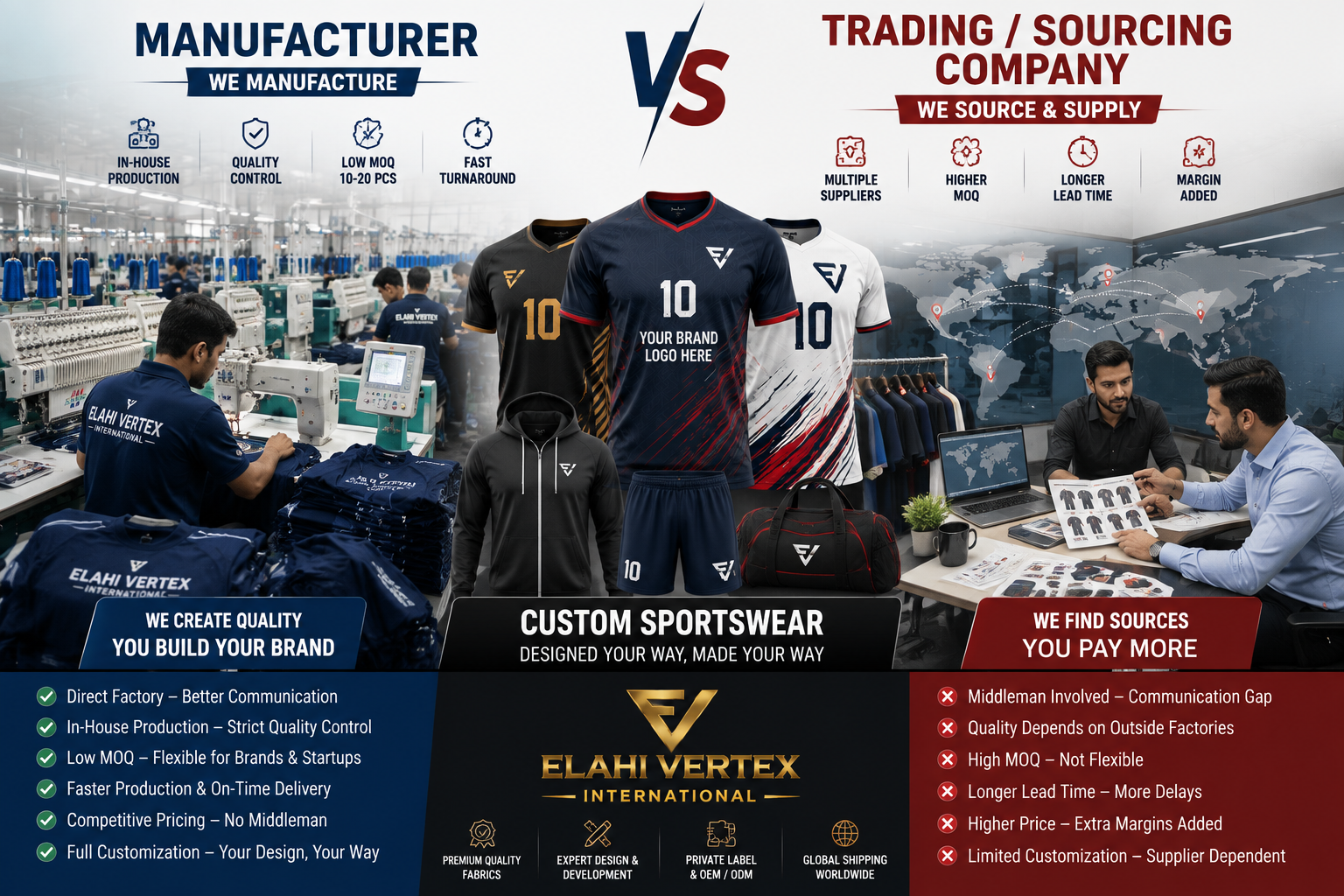
Sportswear manufacturer vs trading company is an important comparison for brands, wholesalers, distributors, retailers, gyms, sports clubs, and private-label businesses sourcing sportswear internationally.
Both may offer custom apparel, samples, quotations, export services, and private-label products. But the two business models can be very different behind the scenes.
The real question is not simply, “Which supplier is cheaper?”
It is:
Who controls production, understands your specifications, manages quality, and takes responsibility for the final product?
Understanding these differences can help B2B buyers reduce sourcing risks and choose a supplier that fits their requirements.
What Is a Professional Sportswear Manufacturer?
A professional sportswear manufacturer is directly involved in producing sportswear according to defined specifications.
Depending on its capabilities, a manufacturer may manage processes such as:
- Product development
- Pattern development
- Fabric coordination
- Cutting
- Sewing
- Printing
- Embroidery
- Labels
- Finishing
- Quality control
- Packaging
However, the word manufacturer alone does not prove production capability.
A serious buyer should ask:
Which parts of my order does your company actually control?
That question is more valuable than simply asking whether a supplier calls itself a factory.
What Is a Trading Company?
A trading company generally acts as an intermediary between the buyer and one or more manufacturers.
It may source products from external factories while managing:
- Quotations
- Supplier communication
- Samples
- Product sourcing
- Quality coordination
- Packaging
- Export documentation
- Logistics
A trading company is not automatically unreliable.
For some buyers, an experienced trading company can be useful because it can coordinate multiple products or factories.
The important issue is transparency.
You should know who actually manufactures your products and who is responsible for quality.
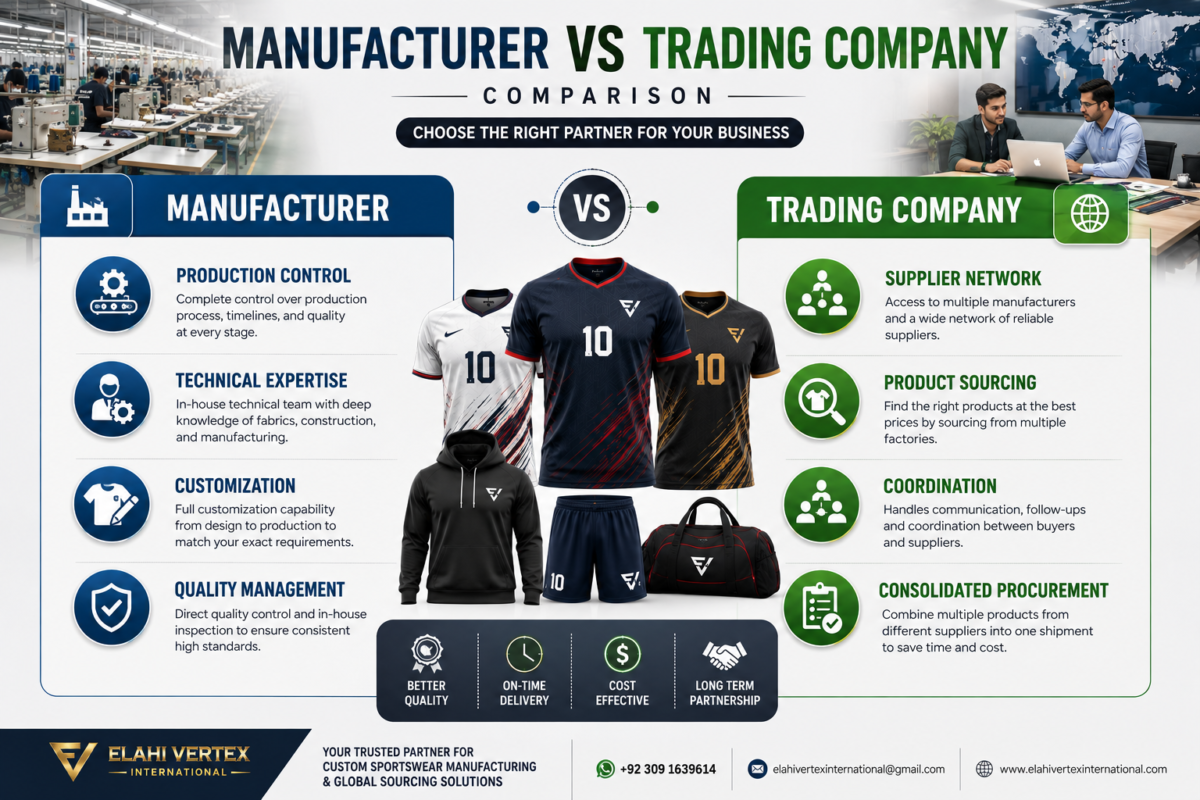
Sportswear Manufacturer vs Trading Company: 7 Key Differences
1. Sportswear Manufacturer vs Trading Company: Production Control
Production control is one of the biggest differences.
A professional sportswear manufacturer is directly involved in manufacturing its products. This can make technical communication more direct because production requirements can be discussed closer to the people responsible for making the product.
A buyer may need to specify:
- Fabric composition
- Fabric weight
- Measurements
- Stitching
- Construction
- Printing
- Embroidery
- Branding
- Packaging
- Finishing
When a trading company uses an external factory, your specifications may pass through another communication layer.
That does not automatically mean the result will be poor. But every additional communication step creates another opportunity for specifications to be misunderstood.
Questions to Ask
Before placing an order, ask:
- Where will my products actually be manufactured?
- Which processes are controlled directly?
- Which processes are outsourced?
- Who manages production?
- Who performs quality control?
- Who is responsible if the final product differs from the approved specification?
The goal is not simply to avoid intermediaries.
The goal is to understand who controls your order.
2. Sportswear Manufacturer vs Trading Company: Customization
Customization is particularly important in sportswear.
A B2B buyer may require:
- Custom designs
- Custom measurements
- Specific fabrics
- Custom colors
- Logo placement
- Printing
- Embroidery
- Woven labels
- Hangtags
- Custom packaging
- Private-label branding
A specialized manufacturer may be able to work directly with these requirements during product development and production.
A trading company can also arrange customized sportswear, but its capabilities depend on the manufacturing partners it uses.
Instead of asking only:
“Can you make custom sportswear?”
Ask:
“How will you take my specifications from design to sample and then into bulk production?”
The answer can tell you much more about the supplier’s actual manufacturing knowledge.
3. Sportswear Manufacturer vs Trading Company: Technical Communication
Technical communication is often overlooked during supplier selection.
Sportswear can involve detailed requirements related to:
- Fabric performance
- Fabric weight
- Stretch
- Fit
- Measurements
- Size grading
- Seam construction
- Stitching
- Printing
- Embroidery
- Branding placement
A capable supplier should be able to discuss these requirements clearly.
For example, compression wear has different construction considerations from a standard T-shirt. Team jerseys, tracksuits, boxing apparel, gymwear, leggings, and training apparel can also require different specifications.
A Simple Supplier Test
Send the same product brief to several suppliers.
Then compare the questions they ask.
A supplier that asks about measurements, fabric, construction, branding, sizing, and intended use may demonstrate stronger technical understanding than one that simply says:
“Yes, we can make it.”
4. Sportswear Manufacturer vs Trading Company: Quality Control
Quality control should not begin only after production has finished.
Depending on the product, quality can be considered during:
- Material checking
- Cutting
- Sewing
- Printing
- Embroidery
- Measurement checking
- Finishing
- Packaging
- Final inspection
The exact process varies between suppliers and products.
The more important question is:
Who is accountable for quality?
If a bulk order has incorrect measurements, branding errors, stitching problems, or differences from the approved sample, there should be a clear process for identifying and resolving the problem.
A manufacturer with direct production involvement may have greater visibility into the source of a production issue.
A trading company may need to investigate the issue through its manufacturing partner.
Neither model automatically guarantees better quality.
The actual quality-control system matters more than the label used by the supplier.
5. Sportswear Manufacturer vs Trading Company: Sampling
Sampling is a critical stage in custom sportswear sourcing.
A sample gives the buyer an opportunity to evaluate:
- Fabric
- Fit
- Measurements
- Construction
- Stitching
- Printing
- Embroidery
- Logo placement
- Colors
- Finishing
Before approving bulk production, buyers should confirm whether any revisions are required.
A strong sampling process should establish:
- What happens when revisions are needed?
- Which sample becomes the production reference?
- How are approved changes documented?
- How are final specifications transferred to production?
The purpose of sampling is not simply to see whether a product looks attractive.
It is to identify problems before they become bulk-order problems.
6. Sportswear Manufacturer vs Trading Company: OEM, ODM and Private Label
The sportswear manufacturer vs trading company decision becomes particularly important when a business is developing its own brand.
OEM Sportswear
OEM generally means that the buyer provides specifications and the supplier manufactures according to those requirements.
ODM Sportswear
ODM generally involves supplier-developed or existing designs that the buyer can customize or adapt.
Private-Label Sportswear
Private-label manufacturing allows a business to sell products under its own brand identity.
This can involve:
- Custom labels
- Hangtags
- Packaging
- Brand logos
- Product presentation
The exact level of customization depends on the supplier.
For a growing sportswear brand, manufacturing consistency becomes part of the customer experience.
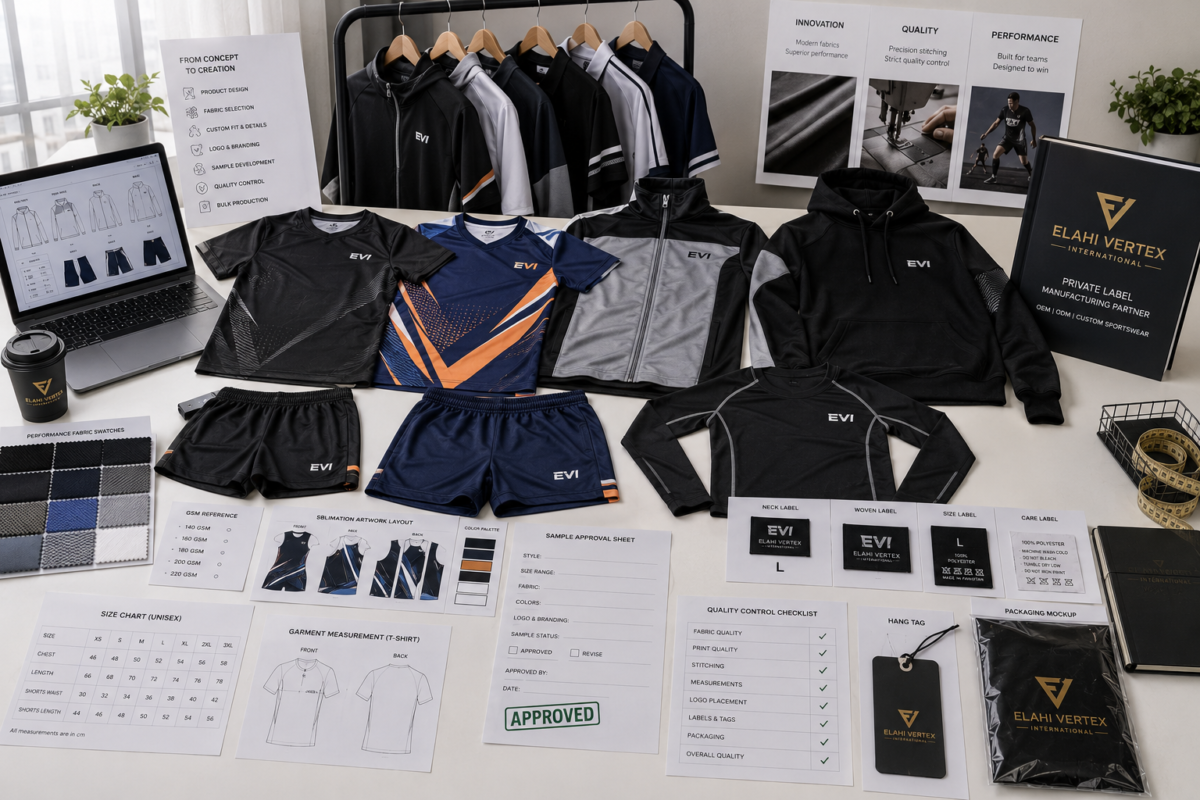
Elahi Vertex International works with B2B buyers seeking custom manufacturing, OEM/ODM production, and private-label sportswear solutions.
7. Sportswear Manufacturer vs Trading Company: Accountability
The final difference is one of the most important.
A supplier should not be evaluated only by the first order.
If your business grows, you may need to reorder the same products repeatedly.
That requires consistency in:
- Product specifications
- Materials
- Measurements
- Branding
- Construction
- Packaging
- Communication
- Quality
You also need clear accountability when something goes wrong.
Ask:
Who owns the problem when production does not match the approved specification?
That question can reveal more about a supplier than its marketing claims.
How to Verify a Sportswear Manufacturer
The sportswear manufacturer vs trading company distinction should not be based entirely on a website, marketplace profile, or sales representative’s statement.
Use several verification methods.
Ask Where Production Happens
Find out where your products will actually be manufactured.
Ask Which Processes Are Controlled
Determine which processes the supplier manages directly and which are outsourced.
Request Samples
A sample helps you evaluate whether the supplier can translate your requirements into a physical product.
Discuss Technical Requirements
Talk about fabric, measurements, construction, branding, sizing, and finishing.
Ask About Quality Control
Understand how quality is checked during production and before shipment.
Verify Business Information
Confirm business identity, payment details, production terms, and export arrangements before making a significant payment.
Evaluate Communication
A capable supplier should communicate specifications clearly and identify potential problems before production begins.
Is a Trading Company Always Worse?
No.
That would be an inaccurate conclusion.
A trading company may be useful when a buyer needs:
- Multiple unrelated products
- Several manufacturing sources
- Consolidated procurement
- Supplier coordination
- Export assistance
- One commercial contact
The better question is:
Which sourcing model gives my business the right combination of control, capability, convenience, quality, and risk?
For highly customized sportswear, direct manufacturing involvement can be particularly valuable.
For multi-product sourcing, an experienced trading company may provide greater convenience.
When Should You Choose a Professional Sportswear Manufacturer?
A professional sportswear manufacturer may be a stronger fit when you require:
- Custom sportswear
- Technical product development
- OEM production
- ODM support
- Private-label manufacturing
- Repeat production
- Detailed specifications
- Direct manufacturing communication
- Consistent product requirements
This is especially important when your products are central to your brand.
If customers judge your business by the fit, construction, materials, branding, and consistency of your sportswear, supplier selection deserves more attention than simply finding the lowest quotation.
When Should You Consider a Trading Company?
A trading company may make sense when:
- You need several unrelated product categories.
- You need multiple factories coordinated through one supplier.
- You want sourcing assistance.
- You prioritize supplier-network breadth.
- Your products are relatively standardized.
- You do not require extensive direct involvement in product development.
The right choice depends on your procurement requirements.
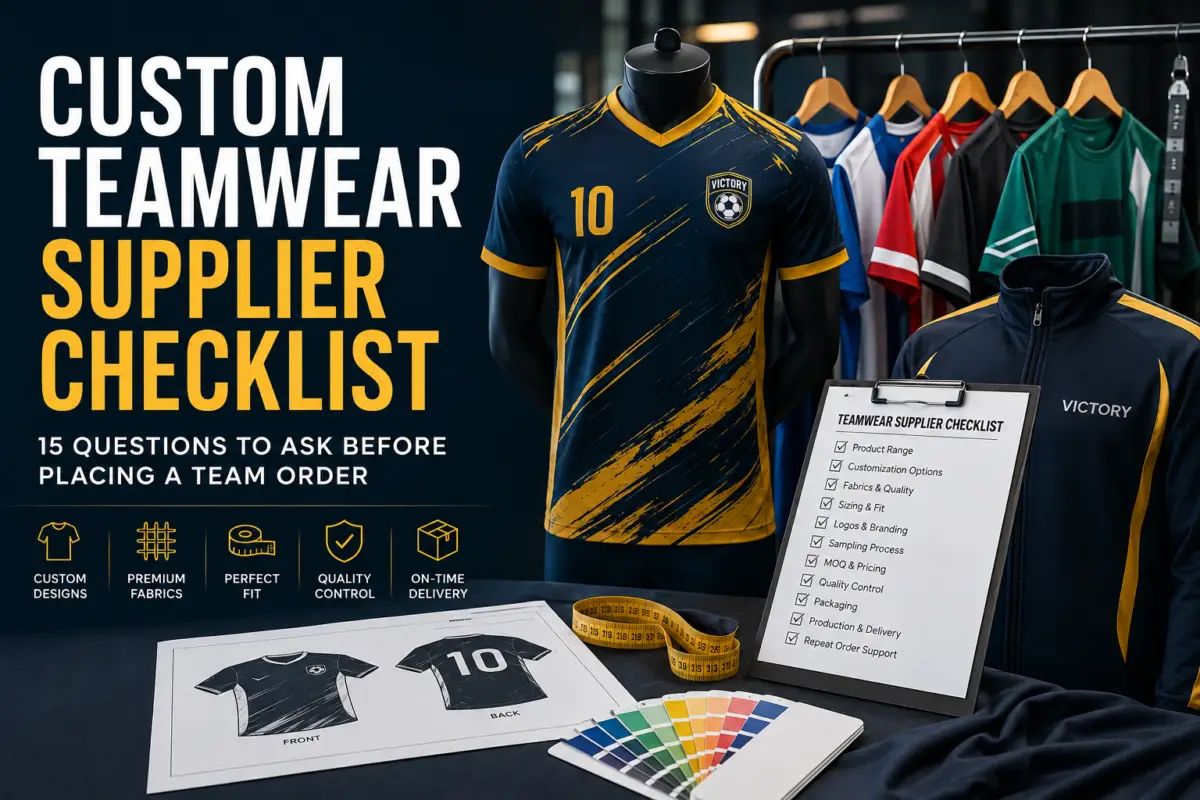
Sportswear Supplier Verification Checklist
QuestionWhy It MattersWhere will my products be manufactured?
Production transparencyWhich processes are directly controlled?
Manufacturing involvementCan you follow my specifications?
Customization capabilityCan you provide samples?
Pre-production evaluationHow are revisions handled?
Specification controlHow is quality checked?
Risk managementWho performs final inspection?
AccountabilityHow are branding requirements controlled?
Brand protectionWhat happens if production differs from the approved sample?
Problem resolutionCan you support repeat orders?
Long-term suitability
Related Industry Resources for B2B Sportswear Buyers
- Sialkot Sports Goods & Sportswear Directory: Buyers researching Pakistani suppliers can use Lookup.pk’s Sialkot sporting-goods directory to explore manufacturers and suppliers. Lookup.pk — Sporting Goods Manufacturers & Suppliers in Sialkot
- Sialkot Sportswear Manufacturers & Exporters: eSialkot provides a directory of sportswear manufacturers and exporters in Sialkot, making it relevant for international buyers researching the Pakistani sourcing market. eSialkot — Sports Wears Manufacturers & Exporters
- Sportswear Manufacturer Sourcing Guide: Buyers can also review practical sourcing considerations when evaluating a sportswear manufacturing partner in Pakistan. Sourcing a Sportswear Manufacturer in Pakistan
- OEKO-TEX STANDARD 100: Buyers concerned with textile safety can use the official OEKO-TEX resource to understand STANDARD 100 testing and certification. OEKO-TEX states that STANDARD 100 tests textiles and their components for harmful substances. (OEKO-TEX) OEKO-TEX STANDARD 100
These resources are useful for supplier research, sourcing education, and textile-industry verification. External links should support the reader rather than simply be added for SEO.
Frequently Asked Questions
What is the difference between a sportswear manufacturer and a trading company?
A sportswear manufacturer is directly involved in producing sportswear, while a trading company generally coordinates products from external manufacturers. Buyers should verify actual production control rather than relying only on company descriptions.
Is a sportswear manufacturer always cheaper than a trading company?
No. Pricing depends on materials, specifications, quantity, customization, quality requirements, production costs, and commercial terms.
Is a trading company automatically unreliable?
No. A capable trading company can provide useful sourcing and coordination services. Buyers should evaluate transparency, quality control, and accountability.
How can I verify a sportswear manufacturer?
Ask where production takes place, which processes are controlled, request samples, discuss technical specifications, review quality procedures, and verify business information.
Why is sampling important for custom sportswear?
Sampling allows buyers to evaluate fit, materials, measurements, construction, branding, and finishing before committing to bulk production.
Can a trading company provide OEM sportswear?
Yes. A trading company can coordinate OEM production through an external manufacturer. Buyers should understand who actually produces the products and who controls the specifications.
What should I look for in a professional sportswear manufacturer?
Look for relevant manufacturing capability, technical communication, customization, sampling, quality control, transparency, accountability, and the ability to maintain consistency across repeat orders.
Conclusion
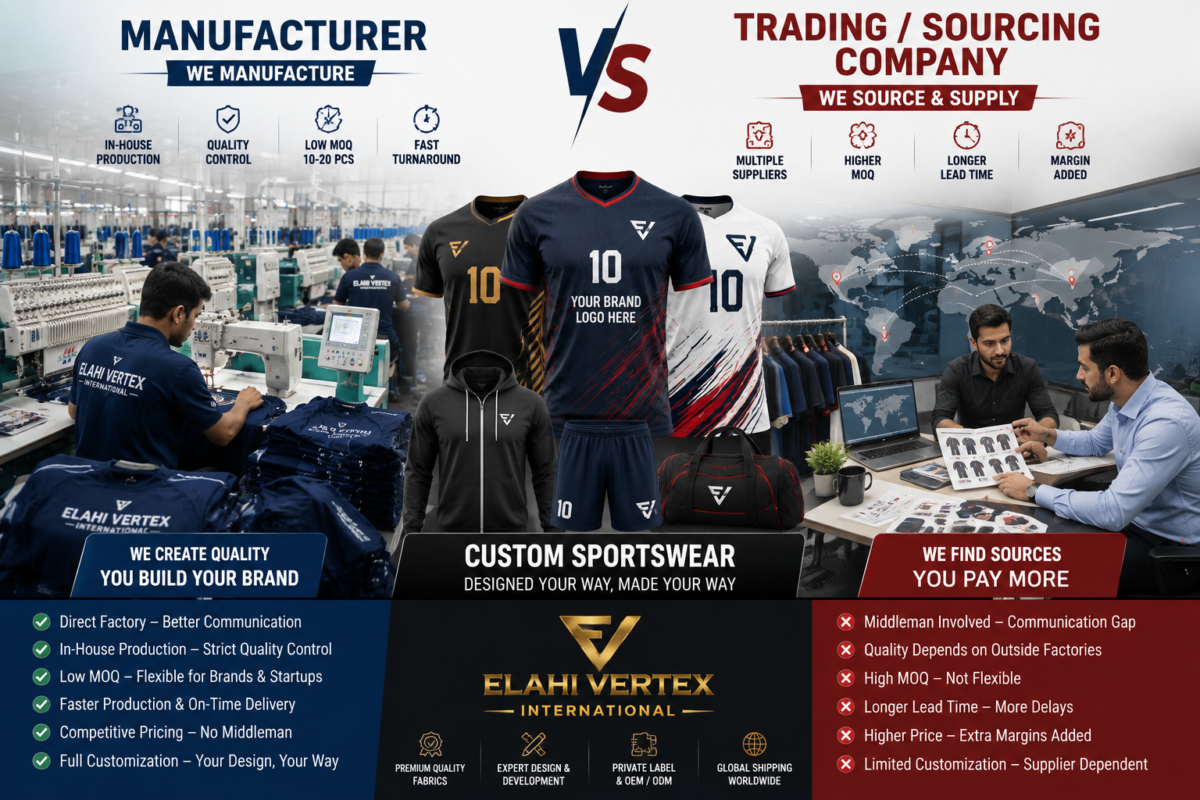
The sportswear manufacturer vs trading company decision should never be reduced to a question of who offers the lowest price.
The more important factors are production control, technical capability, customization, quality, transparency, and accountability.
A trading company can be valuable for buyers who need broad sourcing and supplier coordination. A professional sportswear manufacturer can be a strong fit for businesses requiring custom products, OEM/ODM production, private labeling, technical specifications, and repeat manufacturing.
Before choosing a supplier, ask:
Who actually manufactures my products?
Who controls my specifications?
Who manages quality?
Who is accountable when something goes wrong?
Can the supplier reproduce the approved product consistently?
Those answers provide a much stronger basis for supplier selection than the word “manufacturer” on a website.
Elahi Vertex International supports B2B buyers looking for custom sportswear manufacturing, OEM/ODM production, and private-label manufacturing solutions.
For B2B inquiries, buyers can contact Elahi Vertex International through the company’s website to discuss product specifications, customization, branding, sampling, and manufacturing requirements.