
How to Evaluate a Custom Teamwear Manufacturer
Finding a reliable custom teamwear manufacturer is not simply about finding the lowest quotation. For USA and UK buyers, the real challenge is identifying a supplier that can consistently turn your specifications, artwork, sizing, branding, quality expectations, packaging requirements, and delivery needs into the finished product you actually approved.
A supplier may have an attractive catalogue and competitive pricing but still create problems through inconsistent sizing, unclear specifications, poor artwork execution, weak communication, or inadequate quality control.
This guide explains 9 critical steps for finding and evaluating a custom teamwear manufacturer, from verifying manufacturing capabilities and reviewing samples to confirming technical specifications, quality control, labeling, communication, commercial terms, and first-order risk.
Whether you are sourcing uniforms for a sports club, academy, team, brand, distributor, retailer, or private-label business, the objective should be the same: choose a supplier based on capability, consistency, communication, transparency, and total procurement risk—not price alone.
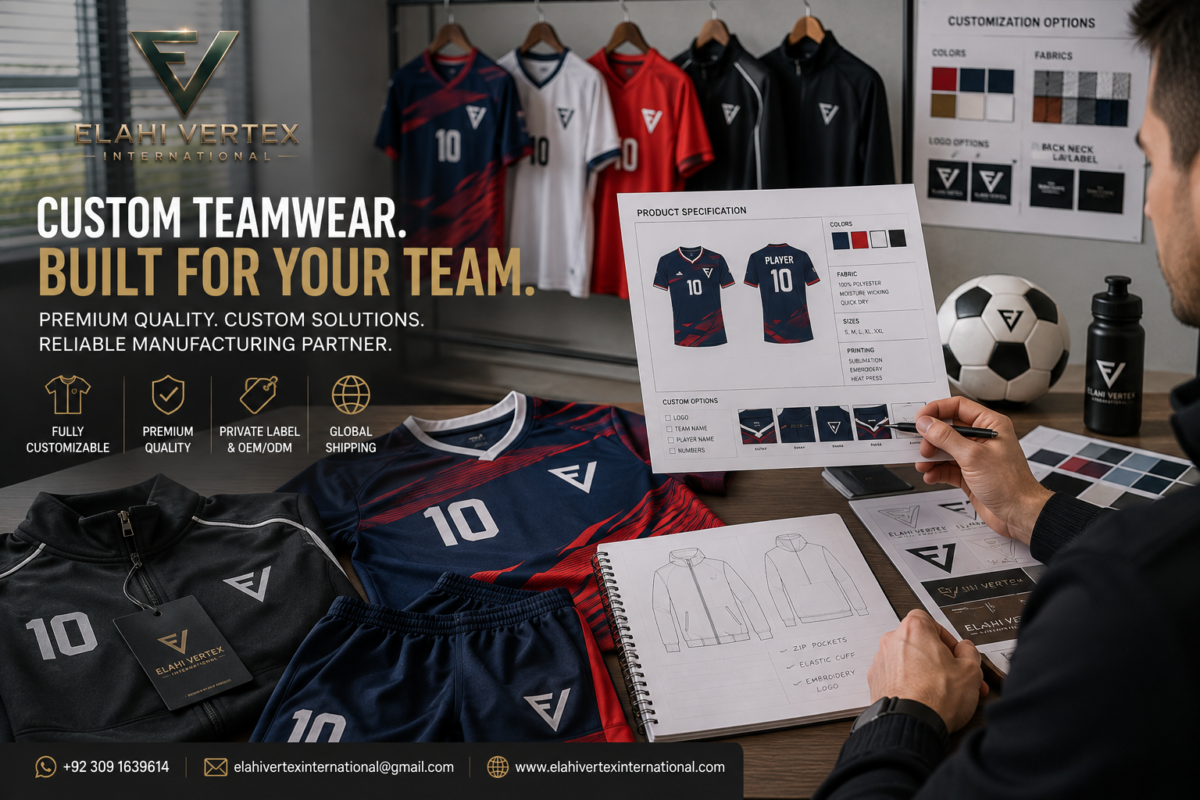
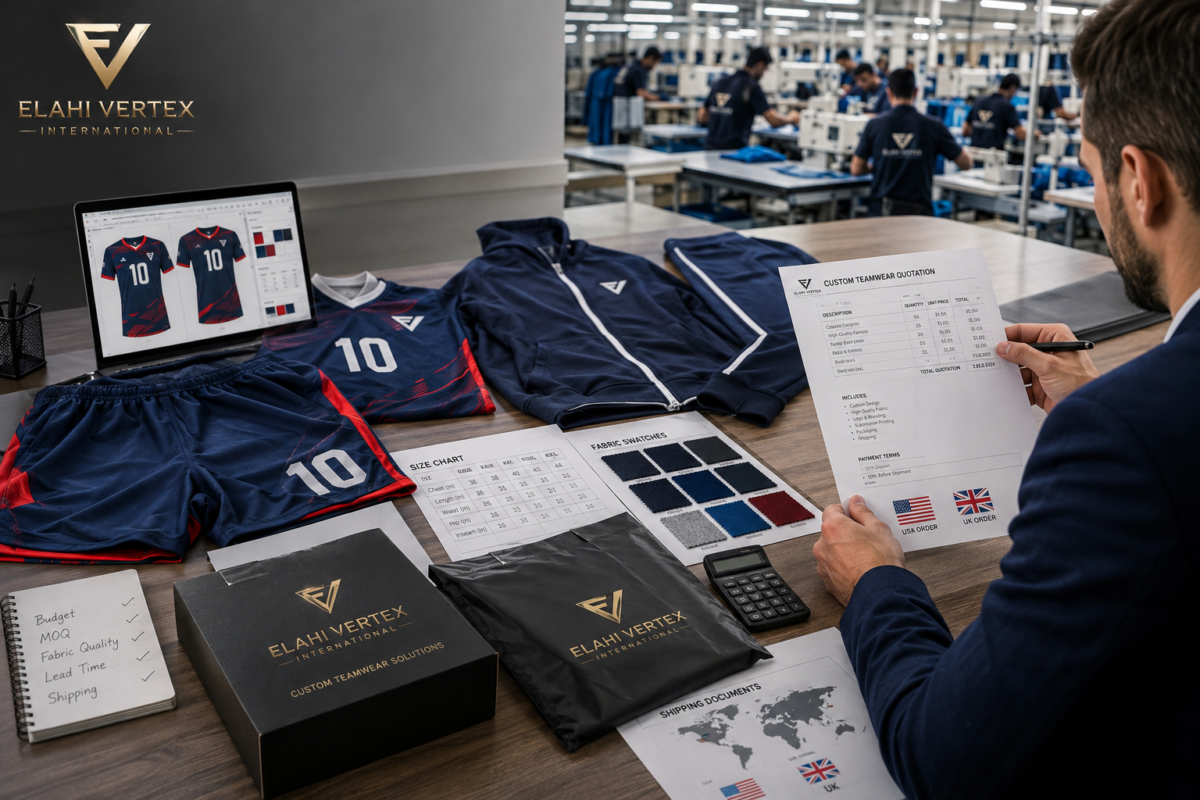
Evaluating a custom teamwear manufacturer for quality, customization, and B2B sourcing requirements.Table of Contents
- Quick Answer: What Makes a Reliable Custom Teamwear Manufacturer?
- Step 1: Verify the Manufacturer’s Actual Capabilities
- Step 2: Evaluate Product and Customization Expertise
- Step 3: Request Samples Before a Bulk Order
- Step 4: Confirm Technical Specifications in Writing
- Step 5: Evaluate Quality Control and Consistency
- Step 6: Check Branding, Labels and Market Requirements
- Step 7: Test Communication and Order Management
- Step 8: Compare the Complete Commercial Offer
- Step 9: Start With a Controlled Production Order
- Manufacturer vs Trading Company
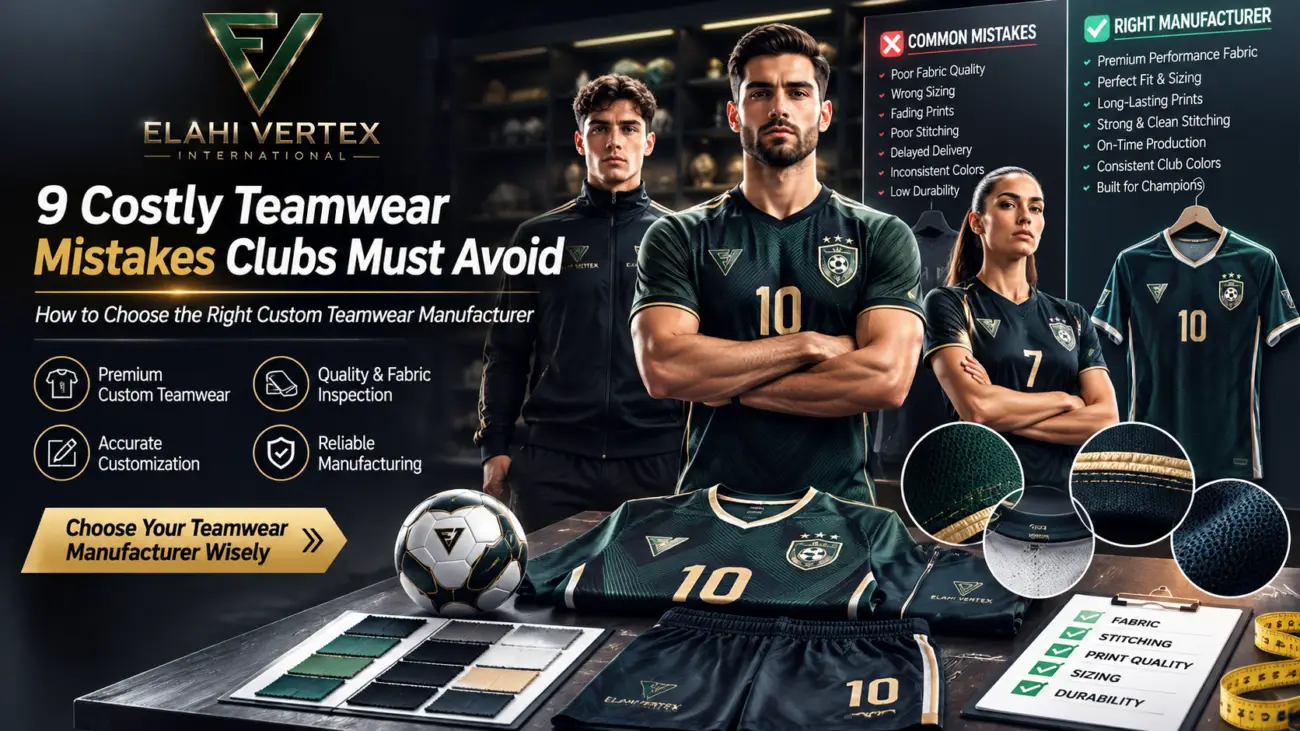
- Common Buyer Mistakes
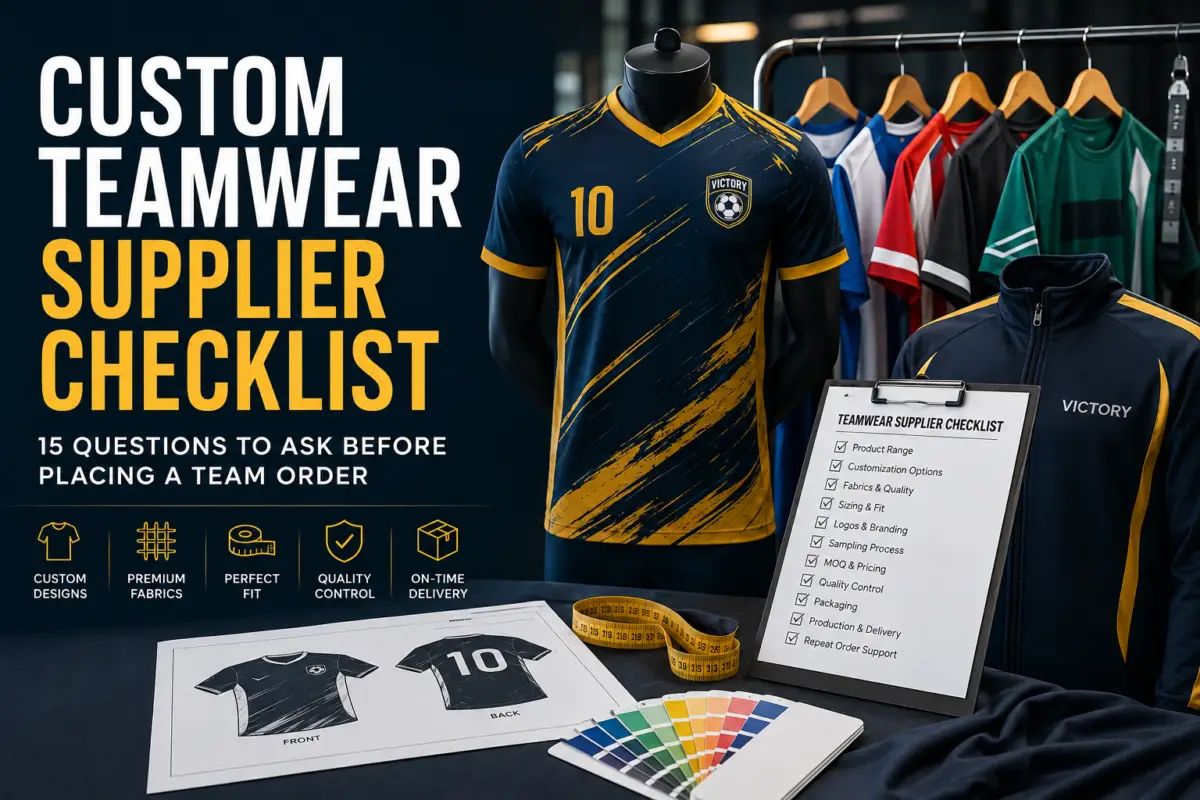
- Custom Teamwear Buyer Checklist
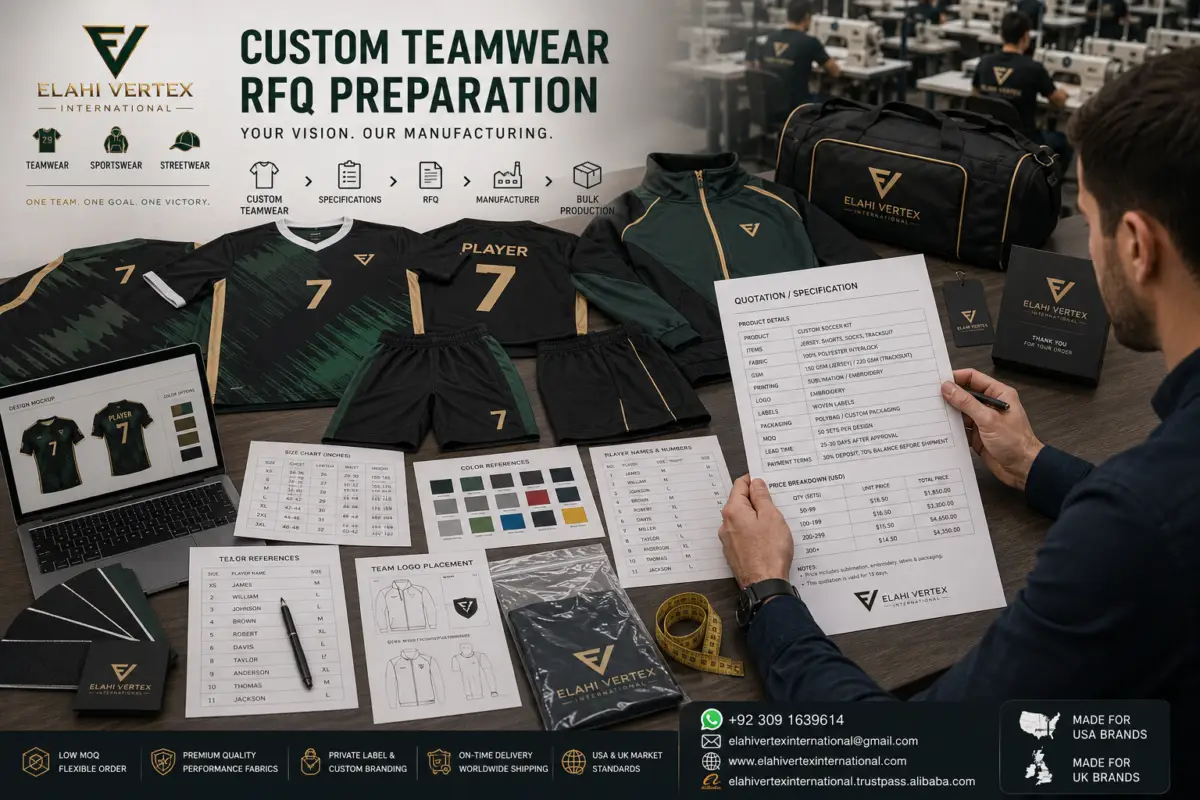
- What to Include in a Custom Teamwear RFQ
- Why Choose Elahi Vertex International
- Frequently Asked Questions
- Useful Industry Resources
- Conclusion
Quick Answer: What Makes a Reliable Custom Teamwear Manufacturer?
A reliable custom teamwear manufacturer should be able to demonstrate relevant manufacturing capability, understand your product specifications, explain customization options clearly, provide appropriate samples, confirm requirements in writing, maintain suitable quality controls, communicate reliably, and provide transparent commercial terms.
For USA and UK buyers, a practical supplier-evaluation process is:
- Verify the supplier and its actual manufacturing capability.
- Check whether its product expertise matches your teamwear requirements.
- Request and evaluate samples.
- Confirm a detailed technical specification.
- Establish how quality will be controlled.
- Confirm branding, labeling, and destination-market requirements.
- Test communication before committing to a large order.
- Compare the complete commercial offer rather than unit price alone.
- Start with a controlled production order and document the approved standard.
The key principle is simple:
Do not choose a teamwear supplier because it says it can manufacture your product. Choose one that can clearly demonstrate how your specific product will be developed, specified, produced, and checked.
For broader requirements, buyers can also explore custom sportswear manufacturing as part of their supplier-selection process.
Need to discuss a custom teamwear project? Contact Elahi Vertex International through WhatsApp or email elahivertexinternational@gmail.com with your product requirements.
Step 1: Verify the Manufacturer’s Actual Capabilities
The first mistake buyers make is treating a product catalogue as proof of manufacturing capability.
A catalogue can display hundreds of garments without explaining who actually manufactures them, which processes are performed directly, what may be subcontracted, or whether the supplier has experience with your particular product construction and customization requirements.
What Should You Verify?
Ask the supplier:
- What types of teamwear can you manufacture?
- Can you manufacture according to buyer-supplied specifications?
- Can you reproduce custom artwork accurately?
- What customization methods are available?
- Can you handle team-specific names and numbers?
- Can you provide custom labels or branding when required?
- Which production stages are handled directly?
- Which requirements need project-specific confirmation?
- What information is required before production begins?
- Can the approved specification be used for repeat orders?
You do not necessarily need a supplier to perform every production stage internally. What matters is whether the supplier has a controlled process and can clearly explain responsibility for each stage.
Manufacturer, Exporter or Sourcing Intermediary?
This distinction matters.
A manufacturer may control production directly. A trading or sourcing company may coordinate production through a supplier network. Neither model is automatically better for every buyer.
The important question is:
Who is responsible for the final product, and how is quality controlled from specification through delivery?
If the supplier cannot answer that clearly, your procurement risk increases.
What Evidence Should Buyers Request?
Depending on the project, useful evidence can include:
- Relevant product samples
- Product development information
- Technical specifications
- Branding examples
- Legitimate production information
- Packaging examples
- Company information
- References where legitimately available
- Clear answers to manufacturing questions
The goal is not to demand confidential information. The goal is to determine whether the supplier is credible and appropriate for your order.
Step 2: Evaluate Product and Customization Expertise
A reliable custom teamwear manufacturer needs more than general apparel capability.
Teamwear can combine multiple requirements, including:
- Performance-oriented fabrics
- Team colors
- Club branding
- Sponsor logos
- Player names
- Player numbers
- Size grading
- Multiple garment styles
- Matching sets
- Repeat orders
- Consistent appearance across production batches
A supplier may manufacture basic T-shirts successfully but still be unsuitable for technically demanding teamwear.
Ask Whether the Supplier Understands Your Product
For example, a custom teamwear project might involve:RequirementWhat the Buyer Should ClarifyJersey constructionFit, panels, neckline, sleeves, finishingFabricComposition, weight, performance expectations, hand feelArtworkFile format, dimensions, colors, placementTeam brandingCrest, logo, sponsor and personalizationPlayer detailsNames, numbers and personalization methodSizingSize chart, grading and measurement tolerancesMatching piecesJerseys, shorts, tracksuits or other componentsLabelsBrand, care and market-specific requirementsPackagingIndividual or consolidated packagingReordersAbility to reproduce the approved specification
The supplier should not simply answer “yes” to everything.
A professional manufacturing discussion should identify:
- What is possible
- What is recommended
- What requires confirmation
- What may affect cost or production
- What information the buyer must provide
Customization Is More Than Adding a Logo
There is an important difference between putting a logo on a ready-made garment and developing a genuinely custom teamwear product.
A custom project can involve:
- Garment construction
- Fabric selection
- Color development
- Pattern or fit requirements
- Branding
- Personalization
- Labels
- Packaging
- Artwork placement
The more variables your order contains, the more important specification control becomes.
Step 3: Request Samples Before a Bulk Order
A sample is one of the most useful tools for reducing manufacturing uncertainty.
It allows the buyer to evaluate the physical product instead of relying entirely on photographs, descriptions, or digital artwork.
What Should You Inspect?
Fit
- Is the sizing appropriate?
- Does the garment match the agreed size chart?
- Is the silhouette appropriate for the intended users?
Construction
- Are seams clean?
- Are panels aligned?
- Is stitching consistent?
- Are stress points appropriately finished?
Fabric
- Does the actual material match the agreed specification?
- Is the weight and hand feel appropriate?
- Does the fabric perform as expected for its intended use?
Branding
- Is the crest positioned correctly?
- Are logos sharp and correctly sized?
- Are names and numbers positioned consistently?
Color
- Does the physical product match the approved color reference?
- Are contrasting panels consistent?
Finishing
- Are threads properly trimmed?
- Are labels correctly positioned?
- Is the garment free from obvious production defects?
[IMAGE 2 — SAMPLE INSPECTION — INSERT AFTER THIS SECTION]
Image concept: Buyer inspecting a custom teamwear sample against a specification sheet and measurement chart.
Do Not Treat the Sample as Decoration
A sample should become a reference standard.
Record what was approved:
- Fabric
- Color
- Measurements
- Construction
- Branding
- Artwork placement
- Labels
- Finishing
- Packaging requirements where applicable
If the bulk order differs materially from the approved sample, the buyer needs a documented basis for discussing the discrepancy.
Sample Approval Should Be Explicit
Instead of saying:
“The sample looks good.”
use a more controlled approval statement:
“Approved for production subject to the attached specification and agreed corrections.”
This creates a clearer production reference.
Step 4: Confirm Technical Specifications in Writing
This is one of the most important steps in the entire sourcing process.
Many manufacturing disputes begin because the buyer and supplier had different interpretations of the same product.
A professional RFQ or purchase specification should contain enough information for another person to understand what is being ordered.
Your Specification Should Cover
Product
- Product type
- Intended use
- Style
- Construction
- Quantity
- Gender or unisex requirements where relevant
Fabric
- Fiber composition
- Fabric type
- Weight where relevant
- Performance requirements
- Finish
- Color
Measurements
- Size chart
- Key measurements
- Measurement method
- Acceptable tolerances
Artwork
- Logo files
- Club crest
- Sponsor graphics
- Colors
- Position
- Dimensions
- Personalization requirements
Branding
- Main label
- Size label
- Care label
- Hangtags
- Packaging branding
Packaging
- Individual packing
- Size identification
- Carton requirements
- Shipping marks where applicable
Commercial Requirements
- Quantity
- Sampling
- Pricing basis
- Payment terms
- Production timing
- Delivery terms
- Shipping responsibility
Not every project requires every field. The principle is:
The more important a specification is to the final product, the less you should leave it to assumption.
Use a Purchase Specification Sheet
A simple specification document can include:FieldRequirementProductCustom team jerseyFabricApproved specificationMain colorApproved referenceSecondary colorApproved referenceLogoSupplied artworkSponsorSupplied artworkNames/numbersRequiredSize rangeApproved size chartLabelsApproved artworkPackagingAgreed formatSampleApproved referenceQuantityProject-specificDeliveryProject-specific
This becomes particularly valuable when several people are involved in procurement, design, and approval.
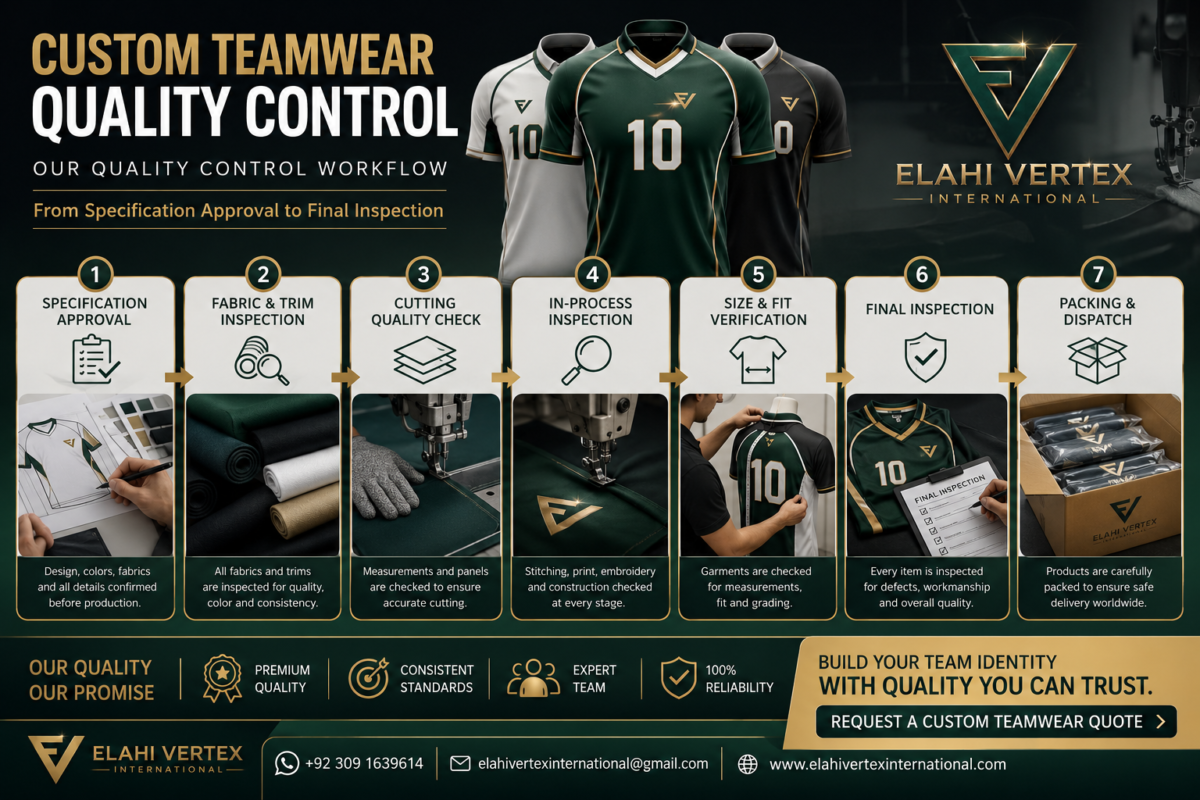
Step 5: Evaluate Quality Control and Consistency
Quality is not simply a final visual inspection.
For teamwear, consistency can matter just as much as the quality of an individual garment.
Imagine receiving 100 jerseys where individual pieces look acceptable but:
- Logo placement varies
- Colors differ
- Sizes are inconsistent
- Names are positioned differently
- Numbers are misaligned
- Stitching varies
- Packaging is mixed up
The order may still create serious operational problems.
Ask How Quality Is Controlled
A supplier should be able to discuss quality procedures appropriate to the project.
Potential control points include:
- Material verification
- Artwork and specification confirmation
- Sample approval
- Production checks
- Measurement checks
- Branding inspection
- Finishing inspection
- Quantity verification
- Packaging inspection
- Final review
The exact process should be confirmed for the specific order.
Ask About Acceptable Tolerances
No manufacturing process is completely free from variation.
The important question is whether acceptable tolerances are defined and understood.
For example:
- What measurement variation is acceptable?
- What color variation is acceptable?
- What happens if a logo is incorrectly positioned?
- How are defective units handled?
- How is personalization checked?
These questions are more useful than simply asking:
“Do you guarantee quality?”
A vague quality promise tells you very little.
A documented quality process tells you much more.
Step 6: Check Branding, Labels and Market Requirements
USA and UK buyers should not treat labeling and market requirements as an afterthought.
The exact obligations depend on the product, sales model, destination, and applicable regulations. Buyers should confirm the requirements for their specific project.
USA Considerations
The U.S. Federal Trade Commission states that most textile and wool products require labeling covering information such as fiber content, country of origin, and the identity of the manufacturer or another responsible business. FTC apparel labeling guidance
The FTC also provides care-labeling requirements for covered textile apparel. Care instructions need an appropriate factual basis, and requirements can depend on the product and circumstances. FTC care-labeling guidance
The practical lesson for buyers is:
Do not ask the manufacturer to guess your U.S. labeling requirements. Confirm the required label content and responsibility before production.
UK Considerations
UK government guidance states that textile labels must show fiber content, with additional requirements for products containing components with different fiber contents. UK Government textile labelling guidance
UK requirements can change and can depend on the product and destination within the UK, so buyers should check current official guidance before production.
What Should You Confirm With the Manufacturer?
Discuss:
- Fiber-content labeling
- Country-of-origin information
- Brand labels
- Size labels
- Care instructions
- Hangtags
- Packaging labels
- Barcode requirements where applicable
- Buyer-specific compliance requirements
If you sell through retail or e-commerce channels, product identification may also matter. GS1 explains the use of GTINs and barcodes for product identification across online and traditional retail environments. GS1 barcode and GTIN guidance
Important: A manufacturer can help implement approved specifications, but the buyer should ensure that the product and labeling meet the requirements applicable to its market and sales model.
Step 7: Test Communication and Order Management
Communication is part of manufacturing performance.
This becomes especially important for international B2B orders where buyers and suppliers may work across different time zones, languages, currencies, and business practices.
Test the Supplier Before Placing a Large Order
Ask a realistic set of technical questions.
Then evaluate:
- How quickly are questions answered?
- Are answers specific?
- Does the supplier understand technical details?
- Are contradictions corrected?
- Are requested changes documented?
- Does the supplier ask useful clarification questions?
- Are files and specifications handled carefully?
- Can the supplier distinguish confirmed information from assumptions?
A supplier that responds quickly but inaccurately is not necessarily better than one that responds slightly more slowly but precisely.
Watch for Warning Signs
Be cautious if a supplier:
- Avoids technical questions
- Changes answers repeatedly
- Gives unexplained pricing
- Refuses to document specifications
- Pressures you to order immediately
- Promises unrealistic production timelines
- Cannot explain sampling
- Cannot explain quality checks
- Avoids discussing defects or corrections
A professional supplier should be willing to explain what needs confirmation.
That is better than pretending every project detail is already known.
Planning a custom teamwear order? Share your product specifications, artwork, estimated quantity, and destination requirements with Elahi Vertex International through WhatsApp or email elahivertexinternational@gmail.com for a project-specific discussion.
Step 8: Compare the Complete Commercial Offer
Unit price is important, but it should not be the only comparison variable.
A manufacturer offering a lower unit price may become more expensive if the order creates:
- Poor sample results
- High defect rates
- Rework
- Incorrect personalization
- Packaging problems
- Communication delays
- Missed deadlines
- Unexpected charges
- Difficult reorders
Compare Suppliers Using a Structured Framework
Evaluation FactorSupplier ASupplier BSupplier CProduct capabilityCustomizationSample qualitySpecification clarityQuality-control processCommunicationBranding/label supportPackagingCommercial termsProduction timingShipping arrangementReorder potentialOverall procurement risk
You do not need numerical scoring if you do not have enough evidence.
Compare Total Procurement Risk
Ask:
Which supplier gives me the highest confidence that the approved product will be delivered consistently according to the agreed specification?
That is a better decision criterion than:
“Who quoted the lowest price?”
Price Must Be Compared Against the Same Specification
Two suppliers may quote different prices because their offers include different:
- Fabrics
- Construction
- Branding methods
- Packaging
- Quantities
- Personalization
- Sampling
- Shipping responsibilities
- Commercial terms
A lower price is meaningless if the underlying specification is different.
Step 9: Start With a Controlled Production Order
Even after supplier evaluation, do not assume that a successful sample completely eliminates production risk.
A controlled first order gives both buyer and manufacturer an opportunity to validate the production workflow.
Before Production
Confirm:
- Final artwork
- Approved sample
- Size chart
- Quantity
- Personalization list
- Branding
- Labels
- Packaging
- Delivery requirements
- Commercial terms
- Production timing
- Shipping responsibilities
During Production
Where appropriate, maintain documented communication around:
- Production progress
- Approved changes
- Quality issues
- Quantity
- Packaging
- Final inspection
After Delivery
Evaluate:
- Product consistency
- Sizing
- Branding
- Construction
- Packaging
- Personalization accuracy
- Defect rate
- Delivery performance
- Communication
- Reorder process
Then document lessons for the next order.
This is how a supplier relationship becomes more predictable over time.
Manufacturer vs Trading Company: What Should Buyers Check?
USA and UK buyers sometimes assume that a direct manufacturer is automatically superior to a trading company.
That is too simplistic.
A manufacturer can offer direct production control, while a trading or sourcing company may provide supplier coordination, product sourcing, or consolidated procurement.
The correct choice depends on the buyer’s requirements.FactorDirect ManufacturerTrading/Sourcing CompanyProduction controlPotentially directDepends on supplier networkProduct specializationDepends on factoryDepends on selected suppliersSupplier coordinationUsually narrowerMay coordinate multiple suppliersCustom developmentDepends on capabilitiesDepends on production partnersConsolidated sourcingMay be limitedCan potentially be an advantageQuality responsibilityNeeds confirmationNeeds confirmationCommunicationMay be directly with productionMay involve intermediaryKey evaluation questionWhat do you actually manufacture?Who actually manufactures my order?
The most important issue is transparency.
If an intermediary is involved, the buyer should understand who manufactures the product and who controls the quality process.
9-Step Custom Teamwear Manufacturer Evaluation Framework
StepKey Question1Can the supplier demonstrate relevant manufacturing capability?2Does the supplier understand your specific teamwear product?3Can you evaluate a suitable sample?4Are specifications documented clearly?5Is there a defined quality-control approach?6Are branding and market requirements understood?7Is communication accurate and reliable?8Are commercial offers genuinely comparable?9Can you start with a controlled order?
If several answers are “no,” the supplier deserves further scrutiny before you commit.
Common Buyer Mistakes
Choosing Only by Price
The cheapest quotation can become the most expensive order if quality problems create rework, replacements, or missed selling opportunities.
Skipping the Sample
Without a sample, you are approving a concept rather than a physical product.
Sending Poor Artwork
Low-quality or incomplete artwork can create avoidable production problems. Provide clear logos, dimensions, colors, and placement instructions.
Leaving Measurements Unspecified
“Standard sizing” is not a sufficient technical specification for many custom orders.
Changing the Design After Approval
Late changes can create confusion, additional costs, or production delays. Finalize the specification before bulk manufacturing whenever possible.
Failing to Separate Production Time From Shipping Time
Production and international delivery are different stages. Buyers should confirm both rather than treating one quoted timeline as the complete delivery period.
Assuming Every Market Has the Same Labeling Rules
USA and UK requirements are not necessarily identical. Verify the destination-market requirements applicable to the actual product.
Not Documenting Personalization
Team names, player names, numbers, and sizes should be provided in a controlled, easy-to-check format.
Comparing Different Specifications
A $10 quotation and a $12 quotation are not directly comparable if the fabric, construction, branding, and packaging differ.
Custom Teamwear Buyer Checklist
Before approving a supplier, confirm:
- Product type and construction
- Fabric specification
- Color requirements
- Size chart
- Measurement tolerances where needed
- Logo and artwork files
- Sponsor placement
- Player names and numbers
- Branding method
- Main labels
- Care labels
- Country-of-origin requirements
- Packaging requirements
- Sample approval
- Quality-control expectations
- Quantity
- MOQ, if applicable to the supplier/project
- Production timing
- Shipping timing
- Delivery responsibilities
- Payment terms
- Defect/rework procedure
- Reorder requirements
- Destination-market requirements
What Should You Include in a Custom Teamwear RFQ?
A strong request for quotation makes supplier comparison easier.
Your RFQ should ideally include:
Product Information
- Product category
- Garment type
- Intended use
- Reference images
- Construction requirements
Material Information
- Desired fabric
- Fiber composition if specified
- Weight where relevant
- Performance expectations
Customization
- Artwork
- Logos
- Colors
- Sponsor placement
- Names
- Numbers
- Labels
Quantity
Provide the expected quantity and size breakdown where known.
Packaging
Explain whether garments need individual packaging, size identification, or branded packaging.
Delivery
Specify the destination and required delivery window.
Commercial Information
Ask the supplier to clarify:
- Unit price
- Sampling costs where applicable
- Production timing
- Payment terms
- Shipping arrangement
- Additional charges
A detailed RFQ makes supplier comparison easier because suppliers are responding to approximately the same requirements.
Why Choose Elahi Vertex International
For buyers seeking a B2B manufacturing partner, Elahi Vertex International operates as a B2B manufacturer, exporter, OEM supplier, ODM supplier, custom manufacturing partner, and private-label manufacturing partner.
Its relevant manufacturing categories include custom teamwear and related apparel categories such as:
- Custom Sportswear
- Custom Teamwear
- Custom Activewear
- Custom Streetwear
- Custom Boxing Wear
- Custom Leather Wear
- Custom Hoodies & Sweatshirts
- Private Label Clothing
The appropriate manufacturing route depends on the buyer’s specifications, product requirements, quantity, branding, and project needs.
B2B Manufacturing Focus
Elahi Vertex International is positioned around B2B custom manufacturing rather than consumer retail sales.
The commercial discussion is therefore centered on product requirements, specifications, customization, branding, and buyer requirements.
OEM and ODM
OEM and ODM projects can require different levels of buyer involvement.
OEM generally involves manufacturing according to buyer-defined product specifications and branding.
ODM may involve adapting or developing products around existing manufacturer capabilities or development frameworks.
The exact scope should be confirmed for each project.
Private Label Manufacturing
For brands developing teamwear or broader apparel collections, private-label manufacturing can allow buyers to establish their own branding, labels, and product presentation.
Specific materials, labels, packaging, and production requirements should be confirmed before an order is placed.
Custom Manufacturing
Custom teamwear requires clear communication between the buyer and manufacturer.
Elahi Vertex International can discuss custom manufacturing requirements based on the actual project specification.
If you are evaluating suppliers now, send your teamwear requirements, artwork, estimated quantity, sizing information, branding details, and destination to Elahi Vertex International through WhatsApp or email at elahivertexinternational@gmail.com for a project-specific discussion.
Frequently Asked Questions
What Should I Look for in a Custom Teamwear Manufacturer?
Look for demonstrated product capability, clear customization processes, sample development, documented specifications, quality controls, reliable communication, and transparent commercial terms.
How Do I Know if a Teamwear Manufacturer Is Reliable?
Reliability cannot be established from a website or quotation alone. Evaluate samples, specifications, communication, manufacturing capability, quality procedures, and the supplier’s ability to manage your specific requirements.
Should I Request a Sample Before Ordering Custom Teamwear?
Yes. A sample is generally one of the most useful ways to evaluate fit, construction, fabric, branding, artwork placement, and finishing before committing to bulk production.
What Information Should I Send to a Teamwear Manufacturer?
Provide product details, reference images, artwork, fabric preferences, size requirements, quantity, personalization details, branding, packaging, and destination information.
What Is the Difference Between OEM and ODM Teamwear?
OEM generally means manufacturing according to buyer-defined specifications and branding. ODM usually involves a greater role for the manufacturer’s existing designs, development capabilities, or product framework. The exact scope should be confirmed for each project.
Can a Manufacturer Add Player Names and Numbers?
Many custom teamwear projects include names and numbers, but the available personalization method, artwork format, placement, and production process should be confirmed with the specific manufacturer.
How Important Is the Size Chart?
It is critical. A size chart gives the manufacturer a defined measurement reference and reduces ambiguity about fit and grading.
Should USA Buyers Check Clothing Labels Before Production?
Yes. U.S. textile and apparel labeling requirements can apply to fiber content, country of origin, responsible business identification, and care instructions depending on the product and circumstances. Buyers should verify applicable requirements before production.
What Labeling Information Should UK Buyers Consider?
Should I Compare Teamwear Suppliers Only by Price?
No. Compare the complete offer, including specification, fabric, customization, sample quality, quality controls, packaging, production timing, shipping responsibility, and commercial terms.
How Should I Compare Two Custom Teamwear Quotations?
Give both suppliers the same specification and compare what each quotation actually includes. Different fabrics, construction, personalization, packaging, or shipping arrangements can make apparently similar prices incomparable.
What Is the Biggest Mistake When Ordering Custom Teamwear?
One of the biggest mistakes is leaving important specifications to assumption. Document the product, measurements, materials, artwork, branding, personalization, packaging, and commercial requirements before production.
Can Elahi Vertex International Manufacture Custom Teamwear?
Elahi Vertex International operates as a B2B custom manufacturing and export partner and includes custom teamwear among its relevant product categories. Specific product capabilities, specifications, quantities, and requirements should be confirmed for each project.
Does Elahi Vertex International Have a Fixed MOQ for Every Teamwear Project?
MOQ should not be assumed to be identical for every product or project. Requirements should be confirmed for the specific project.
How Should I Start a Custom Teamwear Project With Elahi Vertex International?
Prepare your product requirements, artwork, quantity, size information, branding requirements, and destination, then contact Elahi Vertex International through WhatsApp or email for a project-specific discussion.
Useful Industry Resources
- U.S. Federal Trade Commission — Apparel and Labeling: Provides guidance on textile, wool, and apparel labeling, including fiber content, country of origin, and responsible-business identification. FTC Apparel and Labeling Guidance
- U.S. Federal Trade Commission — Care Labeling: Provides guidance on care-labeling requirements for covered textile apparel. FTC Care Labeling Guidance
- UK Government — Textile Labelling: Provides current UK guidance on textile fiber-content labeling requirements. UK Textile Labelling Guidance
- UK Government — Standards and Regulatory Import Requirements: Provides broader UK regulatory and import guidance relevant to international buyers. UK Import Requirements Guidance
- GS1 — Barcodes and GTINs: Provides guidance on product identification, GTINs, and barcodes for retail and e-commerce applications. GS1 Barcode and GTIN Guidance
Conclusion
Finding a reliable custom teamwear manufacturer is fundamentally a supplier-evaluation exercise.
The strongest buyers do not ask only:
“What is your price?”
They ask:
“Can you consistently manufacture this exact product according to this exact specification?”
The nine-step process is:
- Verify manufacturing capability.
- Evaluate product and customization expertise.
- Request and inspect samples.
- Document technical specifications.
- Establish quality-control expectations.
- Confirm branding and market requirements.
- Test communication.
- Compare the complete commercial offer.
- Start with a controlled production order.
For USA and UK buyers, this approach can reduce avoidable sourcing risk while creating a clearer basis for comparing suppliers.
The objective is not to find the supplier making the biggest promises.
The objective is to find the manufacturing partner whose capabilities, communication, specifications, quality process, and commercial terms actually fit your project.
If you are sourcing custom teamwear for a sports club, academy, team, brand, distributor, retailer, or private-label business, Elahi Vertex International can discuss your B2B manufacturing requirements.
WhatsApp: +92 309 1639614
Email: elahivertexinternational@gmail.com
Website: Elahi Vertex International