
Choosing the right custom teamwear manufacturer is one of the most important decisions a sports club can make before ordering uniforms in bulk.
The wrong custom teamwear manufacturer can create problems that go far beyond the original quotation. Poor sizing, incorrect colours, weak stitching, inaccurate logos, missed production deadlines, unclear shipping responsibilities and unexpected costs can turn a simple teamwear order into a major procurement problem.
For clubs in the USA and UK, the decision becomes even more important when uniforms are being manufactured internationally.
A professional custom teamwear manufacturer should be evaluated on product quality, specifications, sampling, customization, communication, production planning, quality control, packaging, shipping and commercial transparency—not simply the lowest price.
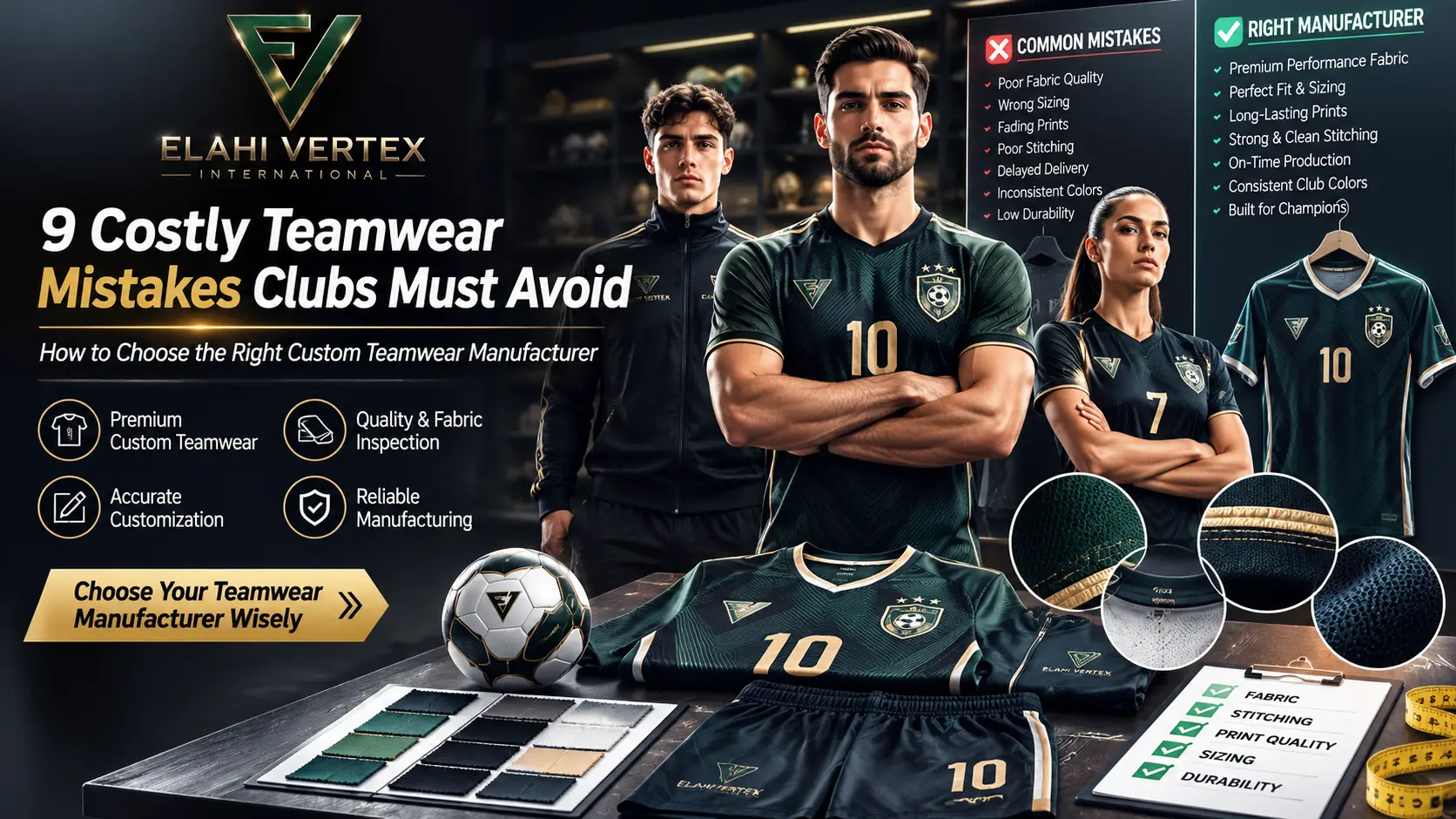
This guide explains the 9 most costly mistakes sports clubs make when choosing a custom teamwear manufacturer, along with a practical supplier-selection process you can use before approving a bulk order.


Why Choosing the Right Custom Teamwear Manufacturer Matters
A sports club may need football kits, basketball uniforms, rugby jerseys, baseball uniforms, training wear, jackets or complete club collections.
Regardless of the sport, the custom teamwear manufacturer must understand exactly what the buyer needs.
A professional teamwear project can involve:
- Custom colours
- Club logos
- Sponsor logos
- Player names
- Player numbers
- League badges
- Custom sizing
- Performance fabrics
- Sublimation printing
- Embroidery
- Heat transfer
- Custom labels
- Individual packaging
- Bulk production
- International shipping
The more customized the order, the more important supplier selection becomes.
1. Choosing a Custom Teamwear Manufacturer Only Because the Price Is Low
Price is important for every sports club.
However, choosing a custom teamwear manufacturer only because the quotation is cheaper can create problems later.
Two teamwear manufacturers may quote different prices for products that look similar in a digital mockup but have completely different specifications.
The difference may come from:
- Fabric quality
- GSM
- Fabric construction
- Printing method
- Stitching
- Logo application
- Numbering
- Packaging
- Labels
- Quality control
- Sampling
- Shipping terms
A cheap quotation may also exclude services that another custom teamwear manufacturer has already included.
What should clubs do?
Send the same specification to every shortlisted custom teamwear supplier.
Compare:RequirementSupplier ASupplier BSupplier CFabricConfirmConfirmConfirmGSMConfirmConfirmConfirmPrintingConfirmConfirmConfirmEmbroideryConfirmConfirmConfirmLogosConfirmConfirmConfirmNames & numbersConfirmConfirmConfirmSampleConfirmConfirmConfirmPackagingConfirmConfirmConfirmProduction timeConfirmConfirmConfirmShippingConfirmConfirmConfirmFinal costCompareCompareCompare
The best custom teamwear manufacturer is not automatically the cheapest manufacturer.
The better question is:
Which supplier gives the club the best combination of quality, specifications, communication, production reliability and total cost?
2. Skipping the Sample Before Bulk Production
Skipping the sample is another expensive mistake.
A digital mockup can show what the uniform is supposed to look like.
It cannot fully show:
- Actual fabric feel
- Actual fit
- Finished measurements
- Stitching quality
- Collar construction
- Sleeve construction
- Print appearance
- Logo placement
- Overall garment finishing
A reliable custom teamwear manufacturer should have a clear process for turning the approved concept into the final production garment.
Recommended process
Design → Specification → Sample → Review → Corrections → Approval → Bulk Production
A sports club should inspect the sample before approving production whenever the project requires physical sampling.
Sample inspection checklist
Check:
- Fabric
- GSM
- Measurements
- Size
- Fit
- Stitching
- Logo
- Sponsor placement
- Player name
- Player number
- Colours
- Printing
- Embroidery
- Collar
- Sleeves
- Overall construction
The approved sample can then become an important reference for the custom teamwear manufacturer during bulk production.


3. Giving the Custom Teamwear Manufacturer Poor Specifications
A custom teamwear manufacturer cannot accurately produce requirements that have never been clearly communicated.
One of the biggest mistakes clubs make is sending only a picture and saying:
“Make 100 jerseys like this.”
A professional RFQ should contain enough information for the custom teamwear manufacturer to understand the project without making unnecessary assumptions.
Include:
- Sport
- Product
- Quantity
- Fabric
- GSM
- Colours
- Club logo
- Sponsor logos
- Player names
- Player numbers
- Size breakdown
- Printing method
- Embroidery requirements
- Labels
- Packaging
- Destination
- Required delivery date
Example
Product: Custom football jersey
Quantity: 100 pieces
Fabric: Performance polyester
Colour: Club-approved colours
Logo: Front club crest
Sponsor: Front + sleeve
Player details: Names + numbers
Sizes: Final size chart attached
Decoration: Confirmed with manufacturer
Destination: United Kingdom
Required date: Confirm before production
The more detailed the specification, the easier it becomes for the custom teamwear manufacturer to provide an accurate quotation.
4. Failing to Confirm Customization Details
A club uniform is a representation of the club.
That means customization mistakes can become highly visible.
A custom teamwear manufacturer may need to apply:
- Club crest
- Main sponsor
- Sleeve sponsor
- Player names
- Player numbers
- League badges
- Flags
- Manufacturer branding
- Custom graphics
- Embroidery
- Sublimation
- Heat transfers
If the buyer does not approve the exact artwork, there can be confusion during production.
Use a final artwork approval
Before bulk production, confirm:
- Front artwork
- Back artwork
- Sleeve artwork
- Logo position
- Sponsor position
- Name position
- Number position
- Colours
- Size chart
- Final sample
This creates a clear reference between the club and the custom teamwear manufacturer.
5. Not Clarifying the Production Timeline
Another common mistake is asking a custom teamwear manufacturer:
“How fast can you deliver?”
“Fast” is not a production schedule.
A teamwear order may involve:
Artwork → Sampling → Approval → Production → Quality Control → Packing → Shipping
Each stage can affect the final delivery date.
Ask your teamwear manufacturer:
- When does production begin?
- Does production begin after payment?
- Does production begin after sample approval?
- How long does sampling take?
- How long does bulk production take?
- What happens if artwork changes?
- What happens if the size list changes?
- Is final inspection performed before dispatch?
- Who handles shipping?
- What is the estimated transit time?
A good custom teamwear manufacturer should be able to explain the production process clearly.
Never build a club’s entire season around an undocumented promise such as:
“Don’t worry, we’ll deliver quickly.”
6. Ignoring Quality Control
Quality control should be discussed with the custom teamwear manufacturer before production begins.
The club should know what will be checked and when.
Before Production
Confirm:
- Final artwork
- Fabric
- Measurements
- Colours
- Logo files
- Sponsor files
- Sample
- Size chart
During Production
Where appropriate, check:
- Fabric consistency
- Stitching
- Construction
- Print quality
- Logo positioning
- Measurements
- Colour consistency
Before Dispatch
Verify:
- Quantity
- Sizes
- Player names
- Player numbers
- Packaging
- Visible defects
- Final order accuracy
A strong quality-control process helps reduce the gap between the approved sample and the final bulk order.
7. Ignoring Hidden Costs When Comparing Teamwear Suppliers
The quoted price from a custom teamwear manufacturer is not necessarily the complete project cost.
Possible costs can include:
- Sample development
- Artwork
- Labels
- Individual polybags
- Custom packaging
- Special trims
- Extra embroidery
- Rush production
- Freight
- Courier charges
- Duties
- Taxes
- Import charges
- Payment fees
Not every order will contain all of these costs.
The important thing is to ask the custom teamwear manufacturer what is included and excluded.
Instead of asking:
“How much is one jersey?”
Ask:
“Please provide the complete quotation based on our specification and identify any additional costs that could apply.”
This makes supplier comparison much more accurate.
8. Not Confirming Packaging and Shipping Responsibilities
A club can have excellent uniforms manufactured and still experience problems because packaging and shipping were never properly discussed.
Before placing the order, ask your custom teamwear manufacturer:
- Are garments individually packed?
- Are player sizes separated?
- Are cartons labeled?
- Are player names and numbers organized?
- Who arranges shipping?
- Which shipping method is used?
- Who handles import clearance?
- Are duties and taxes included?
- What documents are provided?
For USA buyers, federal rules cover labeling for many textile and apparel products, including information such as fiber content, country of origin and manufacturer/marketer identification. Care-labeling requirements can also apply. (Federal Trade Commission)
For UK buyers, textile products have fibre-content labeling requirements, and manufacturers and retailers have responsibilities for compliance. (GOV.UK)
The exact requirements should always be checked for the specific product and transaction.
9. Choosing a Custom Teamwear Manufacturer Without Checking Communication
A manufacturer can have excellent product photographs and attractive prices but still be difficult to work with.
Communication matters because custom teamwear involves many individual decisions.
Evaluate whether the custom teamwear manufacturer:
- Responds clearly
- Understands specifications
- Documents changes
- Provides realistic information
- Explains production stages
- Confirms costs
- Confirms shipping
- Provides appropriate company information
- Has a clear project contact
Use a supplier scorecard
Evaluation FactorSuggested WeightProduct quality25%Specification accuracy15%Sample process15%Production planning10%Communication10%Quality control10%Commercial transparency10%Shipping/documentation5%
This prevents the club from making a decision based entirely on price.
How to Compare Custom Teamwear Manufacturers
If you are comparing several custom teamwear manufacturers, use a structured process.
Step 1: Prepare your specification
Define exactly what you need.
Step 2: Send the same RFQ
Give each custom teamwear manufacturer the same information.
Step 3: Compare the specifications
Don’t compare only the price.
Step 4: Request a sample
Where appropriate, inspect the physical product.
Step 5: Approve the final artwork
Make sure every customization detail is documented.
Step 6: Confirm production
Get the production schedule in writing.
Step 7: Confirm quality control
Agree on the key checks.
Step 8: Confirm packaging and shipping
Know what happens after production.
Step 9: Approve the bulk order
Only proceed when the important details are clear.
What Should Sports Clubs Ask a Custom Teamwear Manufacturer?
Before choosing a custom teamwear manufacturer, ask:
- What fabric will you use?
- What GSM is the fabric?
- Which printing method will be used?
- Can you produce a sample?
- How will the sample be used as a production reference?
- How do you check measurements?
- How are names and numbers verified?
- What quality-control checks are performed?
- What is included in the quotation?
- What costs are excluded?
- When does bulk production begin?
- How is packaging handled?
- Who is responsible for shipping?
- What information do you need from the club?
- What happens if specifications change after approval?
A manufacturer that can answer these questions clearly gives the buyer a stronger basis for supplier evaluation.
Custom Teamwear Manufacturer Buyer Checklist
Before approving a bulk order, check:
- Manufacturer verified
- Company information checked
- Product specification completed
- Fabric confirmed
- GSM confirmed
- Quantity confirmed
- Size breakdown confirmed
- Colours confirmed
- Club logo approved
- Sponsor logos approved
- Names confirmed
- Numbers confirmed
- Printing method confirmed
- Embroidery confirmed
- Sample reviewed
- Corrections completed
- Final artwork approved
- Production schedule confirmed
- Quality-control process confirmed
- Packaging confirmed
- Shipping confirmed
- Additional costs identified
- Payment terms confirmed
Why Choose Elahi Vertex International?
Elahi Vertex International is positioned as a B2B custom manufacturing and export company offering OEM, ODM, private label and custom manufacturing services. Its stated topical clusters include Custom Teamwear, Custom Sportswear and Custom Activewear.
For clubs, academies and procurement buyers, the correct approach is to discuss the actual project specifications, quantity, customization, sampling requirements and destination before production.
Discuss Your Custom Teamwear Project
WhatsApp: +92 309 1639614
Email: elahivertexinternational@gmail.com
Website: Elahi Vertex International
Alibaba: Elahi Vertex International Alibaba Store
Frequently Asked Questions
What is a custom teamwear manufacturer?
A custom teamwear manufacturer produces sports uniforms according to the club’s requirements, including colours, logos, names, numbers, sizing, fabrics and customization.
How do I choose the best custom teamwear manufacturer?
Compare several suppliers using the same specification and evaluate quality, samples, customization, communication, production, quality control, packaging, shipping and total cost.
Should a sports club order a sample?
Where appropriate, a sample allows the club to evaluate the physical garment before committing to bulk production.
What should I send to a custom teamwear manufacturer?
Send your design, quantity, fabric requirements, size breakdown, logo files, sponsor artwork, customization requirements, packaging requirements, destination and required timeline.
What is the biggest mistake clubs make when choosing a teamwear supplier?
Choosing purely on price without comparing specifications, sample quality, production capability, quality control and total project costs.
How can I compare custom teamwear manufacturers?
Use the same RFQ for every supplier and score each manufacturer against quality, price, sampling, communication, production, QC and shipping.
How long does custom teamwear production take?
Production time varies by manufacturer, product, quantity, customization and approval process. Always request a project-specific timeline.
What printing methods can custom teamwear manufacturers offer?
Depending on the product and supplier, options can include sublimation, heat transfer, screen printing and embroidery.
What should be checked before bulk production?
The club should confirm the final artwork, sample, measurements, fabric, colours, logos, names, numbers, quantity and production specifications.
Do USA teamwear orders have labeling requirements?
Many covered textile and apparel products sold in the USA have federal labeling requirements relating to fiber content, country of origin and manufacturer/marketer identification. Care instructions can also be required. (Federal Trade Commission)
Do UK teamwear products require textile labels?
UK textile products are subject to fibre-content labeling requirements, with responsibilities applying to relevant manufacturers and retailers. (GOV.UK)
Can a custom teamwear manufacturer handle international shipping?
Many international manufacturers offer shipping support, but the exact shipping arrangement, responsibilities, duties and import requirements should be confirmed for each order.
Conclusion
Choosing the right custom teamwear manufacturer is not simply about finding the lowest price.
For sports clubs in the USA and UK, a better supplier-selection process is:
Define the requirements → Compare custom teamwear manufacturers → Review specifications → Approve a sample → Confirm customization → Establish quality control → Confirm production → Clarify packaging and shipping → Approve bulk production.
The right custom teamwear manufacturer should give your club clarity before production begins.
If you are looking for a custom teamwear manufacturer for football, basketball, rugby, baseball, training wear or other custom sports uniforms, prepare your design, quantity, sizes, customization requirements and destination before requesting your quotation.
Contact Elahi Vertex International:
WhatsApp: +92 309 1639614
Email: elahivertexinternational@gmail.com
Website: elahivertexinternational.com
Alibaba: Elahi Vertex International Alibaba
External Resources for Sports Clubs Buying Custom Teamwear
These resources are directly relevant to clubs, procurement buyers and international buyers researching custom teamwear manufacturers.
1. U.S. FTC — Apparel & Textile Labeling
Sports clubs importing or selling covered textile apparel in the United States should review official FTC guidance on fiber content, country of origin, responsible business identification and other apparel-labeling requirements. (Federal Trade Commission)
FTC Apparel and Labeling Guide
2. U.S. FTC — Care Labeling
Care instructions are another consideration for covered textile apparel. Manufacturers and importers should understand the applicable care-labeling requirements for their products. (Federal Trade Commission)
3. GOV.UK — Textile Labelling
UK sports clubs and buyers should review the official UK guidance covering textile fibre-content labeling and the responsibilities of manufacturers and retailers. (GOV.UK)
GOV.UK Textile Labelling Guidance
4. GOV.UK — UK Standards & Regulatory Import Requirements
International buyers importing textile products into the UK can use this official resource to understand applicable product and import requirements, including textile labeling. (GOV.UK)
UK Standards and Regulatory Import Requirements
5. Custom Teamwear Manufacturer Market Reference
For additional market research, buyers can review how established sportswear manufacturers present custom team uniforms, sampling, customization and production services. For example, MTH Sports publicly describes factory-direct custom sports uniforms, sublimation, embroidery, quality-control inspection and bulk team apparel programs. (MTH Sports)
MTH Sports — Custom Sports Uniforms Manufacturer
Looking for a reliable custom teamwear manufacturer?
Send your design, quantity, size breakdown, customization requirements and destination to Elahi Vertex International to discuss your custom teamwear project.WhatsApp: +92 309 1639614Website: Elahi Vertex International